
From the Blog
-

Serve to Lead
Leadership in the Kingdom of God is a call to service. In the book of Luke, Jesus taught his disciples that the true path to greatness in the kingdom of heaven was to follow His example of servant leadership. Jesus calls each of us to be servant leaders as He was.
-
Bow Down to be Lifted Up
Are you “up” or “down” today? If you are feeling down today, guess what? God wants to teach you how to give that to Him today. He wants to show you how that actually puts you in a better position to hear from Him and get some things in order with Him. If you’re feeling…
-
Talk Less to Say More
In a modern culture of self-promotion on social media and the constant chatter on our smart phones, texting and tweeting about every opinion that pops in our heads, the Bible says, “Be quick to hear and slow to speak.” That’s biblical wisdom, godly wisdom. Stop talking so much and start listening more. Even when we keep quiet, in our heads we’re already thinking of what we’re going to say. No wonder we’re having so much trouble in our society. Divisions within and without. Arguments everywhere. But no one is listening. And no one is really being heard.
What can be done? The book of James offers the paradoxical wisdom that we can actually talk less in order to say more. For real communication, real understanding to take place, we need less talk and more listening, and more appropriate action. The book of James is one of the most practical books of wisdom in the Bible. It is sometimes referred to as the New Testament’s book of proverbs. Written by James, the brother of Jesus, and the pastor of the first church of Jerusalem, it is also a very pastoral book, and a very practical one too.
In the first chapter of James, he told believers that the first place to apply this paradoxical principle of talking less to say more should be in rightly responding to God’s Word. We can learn to rightly respond to God’s Word. -
Lose to Find
How do you answer the question, “Who am I?” For many of you, you’ve tied your identity to your name, “I’m John or I’m Susie.” Others might say, “I’m a father or mother, or I’m a husband or a wife, I’m a son or daughter, I’m a teacher, I’m a nurse, I’m a coach, I’m a dog-lover or cat-lover. How do you answer the question? In Tim Keller’s book, Making Sense of God, he describes two ways that people have found their identity. One, he calls the “traditional path,” where the individual finds identity from the community in which they are born and grow up. The second path, Keller calls the “modern” or “secular” approach. This is the new emphasis on looking “inward” to find the true self, where one’s desires and dreams are to dictate one’s identity.
In the gospel of Matthew, Jesus told His followers that they must lose their former sense of self in order to find their true identity in Christ. The only way that we can discover our true, God-given identity is by losing our former one and finding our true identity in Christ. How can we find our true identity in Christ? The text gives three steps to finding your true identity in Christ. -
Spiritual Life
There’s a lot of interest in spiritual things these days. The 20th century’s emphasis on science and technology and the related philosophy of materialism– that accepts only the natural and denies the supernatural– resulted in a generation that is starving for the spiritual. People today, especially young people, are looking for something more. They are looking for a spiritual life. And the numbers are growing…
However, this new search for meaning in spirituality and religion doesn’t necessarily mean that people will discover true spiritual life. Nor will they find the benefits for which they are longing. They only way to find this true spiritual life for which our souls desire, is to place our faith in the resurrected Christ! In the book of Romans, the apostle Paul encouraged believers to understand the benefits of their new spiritual life in Christ. We can be encouraged by the benefits of our new spiritual life in Christ. -
Reconciled Life
There are so many places that we need reconciliation today. War, terrorism, hatred, the brokenness of communities, countries and even churches, these are just some of the outward symptoms of people living without reconciliation. Then, there are the more personal effects of living without reconciliation: Divorce, depression, unresolved anger, unforgiveness, and even suicidal thinking.
The truth is, a lack of reconciliation is at the root of all of these factors. If we could be reconciled to God, reconciled to others, and even reconciled to ourselves, what joy and peace might that bring into our lives? What if Christ’s death and resurrection, could mean a reconciled life for us? In the book of Romans, the apostle Paul wrote to the believers in Rome to show them how they might rejoice in the reconciled life they have through Jesus Christ. We too can rejoice in the reconciled life through Christ. -
New Life
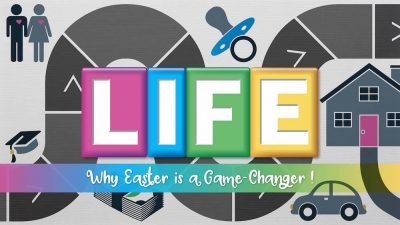
Have you been playing your version of the game of life and realized you were either following the wrong rules or aiming for the wrong goal? You thought more money would make you happy, but it made you hungry for more money. You thought new stuff, a new car, new house, new boat would make you happy, but you still feel empty. You thought a new relationship, a new boyfriend, a new girlfriend, a new love would make you feel like a winner. But you still feel like a loser.
So, how do we get a new view of life? Is there a way of starting over, starting fresh, with a new life? In the book of Romans, the apostle Paul wrote that those who identify with Christ’s death and resurrection might live in newness of life. We can experience this new life by identifying with the death and resurrection of Jesus. -
The Word of Triumph
Do you ever feel defeated? Have you ever felt as if you were a failure at everything? School, work, marriage, parenting, etc? Do you ever feel defeated by sin? Like certain sins continue to beset you? Jesus took what looked like complete failure and turned it into total triumph!
In the Gospel of John, Jesus let out a triumphant cry from the cross that He had finished the work of salvation. This salvation is a finished work, yet we still have to respond to it. -
The Word of Distress
Are you thirsty today? Would you admit your thirst? What are you thirsty for? What desire goes unsatisfied, so that you thirst for it always? As Americans, we rarely go thirsty for basic needs. Food, water, clothing, housing… most of us have these needs met. Yet, our thirst remains. Have you tried to quench your thirst with material things? You spend money you do not have to purchase things that will not satisfy. Yet, the thirst remains, so you keep spending. You thirst for love and relationship, so you give your body away, and settle for sexual lust rather than waiting for covenantal love. So your thirst remains. We thirst for significance, for meaning, for happiness, yet the more we have, the more we drink from every worldly fountain, the more we thirst!
Jesus cried out with the constant cry of all humanity, “I thirst.” Jesus took on our thirst that we might be satisfied. He poured out his life that we might be filled. -
The Word of Salvation
Last words – we will all someday speak them. The seven last words of Jesus on the cross were recorded in the four gospels. In the gospel of Luke, Jesus responded with a promise of salvation to the criminal hanging on the cross next to Him, who had called on Jesus to remember him. In…