Be Fearless
Read transcript
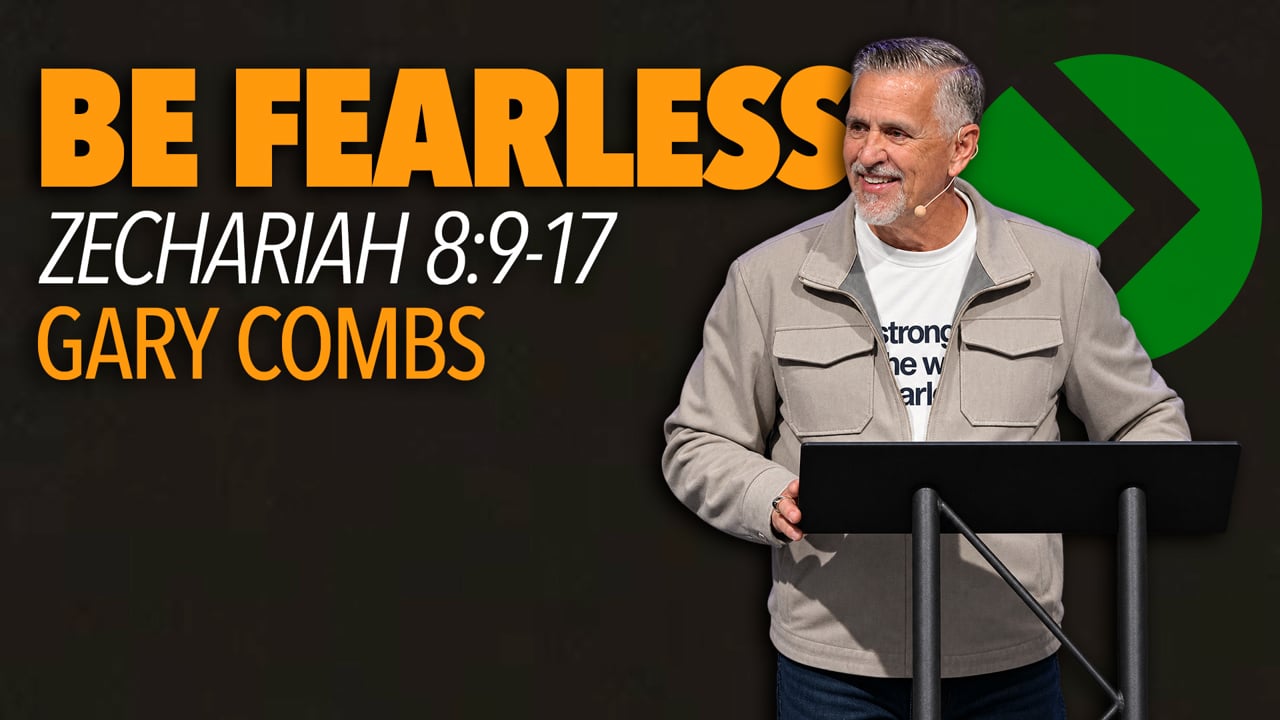
Zechariah 8: Be Fearless
Let’s dig into the sermon today. We’re in chapter 8 of the book of Zechariah, and here’s the thing that can stop us. Here’s the thing that can stop us with all this enthusiasm, all this excitement, all of us around here wearing our t-shirts saying, be strong, do the work, be fearless. Here’s what can stop us is fear. We can be afraid, we can doubt.
And so today’s message is entitled Be Fearless because whenever God challenges us to take a step of faith, He always asks us to step outside of our comfort zone. And whenever we’re called to step outside of our comfort zone, our first reaction is always fear. And fear is the thing that can stop us from saying yes to God. What if I make a commitment and I can’t come through? What if I don’t have enough money already now and then God wants me to be generous?
I can’t be generous. I don’t have enough to be generous. What if I say I’ll serve? You know, I put it on a card. Yes, I’m available to serve.
But what if I don’t feel qualified? What if, you know, I’m an introvert? I don’t really want to be on the— what if they put me on guest services? I don’t know, you know. I mean, like, and so fear, fear, fear.
You know, I don’t have enough ability. I don’t have enough money. I don’t have enough time. I don’t have an— and so we live in a world, we often do, of lack and of fear, and it causes us to be afraid to step out. Some of us have fears about the future.
We wonder if we’ll have enough. But here’s the good news. God has called us to be fearless, not because we know what tomorrow holds. He’s called us to be fearless because we know the one who holds tomorrow. He’s not called us to be fearless because we can see what’s coming, ’cause we can’t, but we know the one who can.
And so today, as I said, Title in this message, Be Fearless. We’re gonna be in Zechariah chapter 8. Zechariah was a contemporary of Haggai. Haggai was the study that we did back when we started this series. It’s where we got the 3 phrases, be strong, do the work, be fearless.
We’re gonna see in today’s message that Zechariah is kind of ringing the same bell, this idea of being strong and being fearless. And so we’ll see it today. And we’re at a time period where both Zechariah and Haggai are both saying to the people, you laid the foundation of the church, you got started, but then you got discouraged, you went through hardship and you’ve lost heart and now you’re afraid, but I want you to be fearless and get started again. And so as we look at the text today, I believe that we can be fearless. We can continue the work that God’s called us to do and we can overcome our fear and step outside of our comfort zone and follow the Lord.
So let’s look at the text today. We’ll see 3 reasons that we can be fearless. Chapter 8, verse 9.
Zechariah 8:9-17 (ESV) 9 Thus says the Lord of hosts: “Let your hands be strong, you who in these days have been hearing these words from the mouth of the prophets who were present on the day that the foundation of the house of the Lord of hosts was laid, that the temple might be built. 10 For before those days there was no wage for man or any wage for beast, neither was there any safety from the foe for him who went out or came in, for I set every man against his neighbor. 11 But now I will not deal with the remnant of this people as in the former days, declares the Lord of hosts. 12 For there shall be a sowing of peace. The vine shall give its fruit, and the ground shall give its produce, and the heavens shall give their dew. And I will cause the remnant of this people to possess all these things. 13 And as you have been a byword of cursing among the nations, O house of Judah and house of Israel, so will I save you, and you shall be a blessing. Fear not, but let your hands be strong.” 14 For thus says the Lord of hosts: “As I purposed to bring disaster to you when your fathers provoked me to wrath, and I did not relent, says the Lord of hosts, 15 so again have I purposed in these days to bring good to Jerusalem and to the house of Judah; fear not. 16 These are the things that you shall do: Speak the truth to one another; render in your gates judgments that are true and make for peace; 17 do not devise evil in your hearts against one another, and love no false oath, for all these things I hate, declares the Lord.”
This is God’s Word. Amen. We’re looking for 3 reasons we can be fearless.
1. God Is Faithful to Keep His Promises
Here’s the first, because God is faithful to keep His promises.
Because God is faithful to keep His promises. Notice who’s speaking here. Zechariah is speaking on behalf of the Lord of hosts. That title is repeated 5 times in our reading today. It’s a significant title.
When I’m reading this, I’m going, Lord, why did You choose this title? Because He’s known by many titles, but here He’s following the title Lord of hosts. First of all, all caps, L-O-R-D. Do you take note of that? And what’s that mean? If you see L-O-R-D in all caps, it means the covenantal name of God, Yahweh, is underneath that in the Hebrew.
It’s a translation of Yahweh. That was a name that was revealed to Moses at the burning bush in Exodus chapter 3. He said, we’ve been calling You God of Abraham, Isaac, and Jacob, but what’s Your name? He says, I AM THAT I AM, Yahweh. The eternal present one, the self-existent one, not I was, not I will be, I am, outside of time, Creator of all.
That’s Lord. Then he says, Lord of hosts. That’s another way of saying the Lord of heaven’s armies, the Lord of all the angelic hosts, all the armies. Why is he using this title? It’s because this is a discouraged, fearful, small, They’re a remnant.
They used to be all that and a bag of chips, but they’re nothing now. That’s how they view themselves. But the Lord of hosts is on their side. This is why He’s talking to them from this title, I believe, the Lord of hosts. He says, “Let your hands be strong.”
The word strong here, and you’ll see it, it kind of is like bookends in the first part of our reading, verse 9, and then again in verse 13. We see he begins with it and then he has it again in verse 13, and he connects it in verse 13 with, do not be afraid, fear not. Now, the word strong here is not so much about physical strength as it is more like courage or willingness to persevere or hang on. And so, let your hands be strong, he says it twice, I think has more the idea of not in order to punch, but to hang on. And so the idea of being strong here in the Hebrew could easily be translated, be firm, be resolute, persevere, keep on keeping on, don’t be afraid.
He sets it in verse 13 as if fear and this type of strength are opposites. Do you see it? “Fear not, but let your hands be strong.” What I’ve noticed is fear, causes us to be weak, and not weak in a good way, weak so that we are powerless to move forward, and it causes us not to cling to the one who calls us. He says, let your hands be strong.
And then he gives us some context as to where the people are in this story. You who, who are you? You’re the ones who’ve been hearing these words from the mouth of the prophets, Who are they, Haggai and Zechariah? They’re contemporaries. They’ve been preaching for the past 16 years ’cause they set the foundation.
And so we’ll pop up this chart for you to remind you. We’ve been putting this up from time to time. So they returned from Babylonian exile. Jerusalem had been overthrown. Nebuchadnezzar, king of Babylon, had conquered them, carried off the people to exile in Babylon.
And then along about 6, or excuse me, 536 BC, they were released from exile and the first group of exiles returned under the leadership of Ezra and Zerubbabel and Joshua. And so they’ve come back and they laid a foundation as soon as they got back, but then they lost heart, they got discouraged, they had some political difficulties, and so they quit. And so it laid here, you can just picture a foundation sitting there and no work had been done on it for 16 years. And he goes, now you’ve been hearing these prophets, and he’s referring to himself to— well, this is the Lord speaking, but he’s referring to Zechariah and Haggai. And so now it’s 520 BC, 520 years before Christ comes.
So 16 years has gone by, they’ve been preaching. And he goes, since the foundation of the house of the Lord was laid, from the temple being built. He says, now before those days, verse 10, “there was no wage for man.” And so there was economic trouble, there was economic problems. Does that sound familiar?
You ever had any economic problems? You ever had any money problems? Remember, they was having— he said that y’all were having money problems, and that was probably part of why you were afraid. And he says in verse 10, he goes, you couldn’t even get a wage for your beast. I mean, you couldn’t even rent your donkey out, right?
And so there was— There was no wage. And then he said, that’s not all though. He goes, there was no safety, “neither was there any safety from the foe for him who went out or came in.” And so you couldn’t get out of your house without running into a crime problem. Are there any crime problems in our world today?
Any problems with crime in Wilson County and Nash County and so forth? Any problems with crime? And he goes, there were some problems with crime, And then he says, and I’ve set every man against his neighbor. So there was social unrest. There were people living in the same neighborhood who had political disagreements and racial disagreements.
And so it sounds very familiar, doesn’t it? And that creates fear. And that causes them not to be thinking about doing God’s work. They’re just trying to survive.
They’ve got kind of a spiritual PTSD here.
But then verse 11 comes. It’s one of those great buts in the Bible. I love, but God. Here’s God speaking. He says, but now,
Zechariah 8:11 (ESV) 11 But now I will not deal with the remnant of this people as in the former days, declares the Lord of hosts.
the God of Yahweh of heaven’s armies.
For there shall be sowing of peace. I’m going to sow peace. I’m going to sow peace and it’s going to come up in your nation. There’s going to be peace where there used to be social unrest. There’s going to be peace, He says.
He says,
Zechariah 8:12 (ESV) For there shall be a sowing of peace. The vine shall give its fruit, and the ground shall give its produce, and the heavens shall give their dew.
There’s going to be prosperity. I’m going to make the land prosperous for you. I’m going to rain on this place.
You know, you can plant seeds and you can till the ground, but only God can make it rain. He’s going, I’m going to make it rain.
That’s what— but now, that’s what I’m going to do now. He’s making promises, isn’t He? He’s making promises.
Zechariah 8:12 (ESV) And I will cause the remnant of this people to possess all these things.
And then verse 13, He says, and you’ve been a byword.
In other words, you’ve been a curse word.
People, when they say your name, they say it with a curse. And you’ve been a curse to the people around you ’cause, oh man, oh, woe is me, we’re just, oh, you know. You’ve just been, that’s where you’ve been. But I’m gonna turn you into a blessing. Do you see it?
“so will I save you, and you shall be a blessing.” You used to be a curse word, now you’re gonna be, when people see you coming, they’re gonna be like, that person, I just feel better just seeing them, just knowing them. Because they’re a giver, they’re generous, they’re no longer— they’re now living as God would have ’em live. They’re a blessing to other people. And then He concludes as He began in verse 9, “Fear not, but let your hands be strong.”
Instead of being fearful, take hold of Me and persevere and do what I’ve called you to do ’cause I’m going to bless you. And this is what he calls them to. And this is the context of the story. He’s preaching to them so that they’ll get busy doing what God called them to do to rebuild His temple. Now we can fearlessly hold fast because He who promised is faithful.
It says in Hebrews chapter 10, “Let us hold fast.” In other words, that’s that same idea of taking hold of something and not letting go. And who’s the something here? Well, the something here is the confession of our hope And what’s our hope? That Jesus is coming again.
The one who defeated sin, death, and the grave’s coming again. And because He was raised from the dead, we too will be raised from the dead. So hang on to that. When everything around you might look like economic problems, crime problems, social unrest every time you turn the news on, instead of taking hold of that which causes fear, take hold of your “of our hope without wavering, for he who promised is faithful.”
Now, I’ve been talking about this the past few weeks. This November marks 35 years since we started with 7 people in my living room.
The Lord put it on my heart. I look back on it now and I can’t believe that I thought that I could do this. This is what happens when you’re young and you’re, you know, 31 years old, 32 years old, and you think you can do things. And I felt like the Lord was calling me. I had been preaching at some little country churches while I was in seminary, and I started like, man, I just really feel like God’s calling me to plant a church that would reach lost people.
I didn’t really feel like He was calling me to be a chaplain, like in a church, but to be an evangelist. And that’s always been my heart, to reach people far from God, to have a church that raised up people like that. And so, So I said yes to Jesus about that. And, and so we got excited and we invited people to our house. And the first meeting we had, 15 people came.
We invited 40 people that I knew. I’d been working in the corporate world for 12 years, and so I knew a few people. I wasn’t from this area, but I knew a few people. We invited 40, 15 showed up the first time. And then we talked about being a church, that we’re planting a church, would you help us?
And the following week We grew that church from 15 to 7.
Woohoo! And that’s when reality started hitting, you know. And so it took us 3 months to get to 26 people coming to small groups in my house. And then we launched on January 26th, 1992. And so in January, we’ll actually celebrate our church’s 35-year anniversary.
Right now I’m thinking about That small group is 35 years, but our church launched in January of ’92 and 66 people came. I can’t remember how many people came here last week, but I can remember how many came. It’s kind of like when you have your firstborn child, you take so many pictures and you remember every detail. And then by the time you get to the third, you’re exhausted.
You remember, I remember you. I remember if you was here last week, I think. But boy, those early days, and it was always, it was exciting, it was an adventure, but it was really hard at times. 19 years we were portable. What does that mean, Gary?
We rented buildings. I used to meet pastors in town, I’d say, how many weddings have you done at your church? Well, what do you mean? I mean at your building, how many weddings have you done? Well, I’ve done 3.
I’d go, well, I’ve done 5 at your building. ‘Cause we didn’t have a building. So we rented things around town and we were— some churches in town called us the roadie church ’cause, you know, just point and we could set up sound equipment and have a church. 19 years. Didn’t do it on purpose.
We kept reaching people far from God that had a lot of things they had to get in order and finances were among them. And I got to where I was apologetic about talking about finances. I got to where I didn’t want to talk about it because I didn’t want to hurt anybody. Plus, we were so small, I didn’t want anybody to get mad at me and leave over money, because money is the idolatry of Americans. We don’t like to talk about it because we’re afraid somebody will ask us to be generous.
And so I was afraid to ask for a long time. Some Sundays I’d have the deacons come up to me after church and say, Pastor, you did it again. What’d I do? You forgot to take up the offering.
And that meant I didn’t get paid that week. That’s how I was sometimes. Sometimes I wanted to quit, and sometimes some of y’all wanted to quit because we— you were on the setup and teardown team and it got old. We kept going because God kept calling us, and we got a little bit of what I’d call spiritual PTSD where we felt like our dream ability, our ability to believe God for great things, had gotten really small.
And reaching our city for Jesus, we were just trying to— could we just like show up and have church again next Sunday? Reaching our Judea, Eastern North Carolina, sending missionaries around the world to to make disciples of all nations like Jesus commanded? Wow, that’s so far out. And so we lost heart. We kept showing up, and if you asked me, I could quote the right verses, but in my heart, I was just hanging on by my fingernails, and so were some of you.
That’s how those, that remnant of Judea felt when God started speaking to them. “Fear not, but let your hands be strong.” keep on. And then I’m glad I lived long enough, the Lord allowed me to be faithful long enough, and it’s been the Lord that allowed it for verse 11 to start appearing in my life and in your life in this church. But now, But now I remember this room, this very room. It was still a movie theater, the Regal Cinema, 2004, this very room.
I was contacted along with several pastors all over the nation to go to Chicago and preview a movie. And I got the invitation that you’d get a chance to hear from Mel Gibson, And he’d made this movie called The Passion of the Christ. And so here we were, broke as we could be, and me and my wife, we bought tickets to Chicago and flew up there in February, a little bit before that, I think it was January of 2004, and we previewed the movie The Passion of the Christ, and Mel Gibson was there on the stage and he described it. He goes, now we hadn’t put music to it yet before you watch it. Now there’s no background music, And we haven’t put captions on it.
We’re trying to decide if we’re going to put captions on it because, by the way, I made the whole movie in Aramaic and Latin and Hebrew. And I’m like, whoa. And so we, we got to hear him talk about— then we watched the movie and I cried until I had snot running down my face.
And so I got home from that movie and I wrote articles to the newspaper talking about this movie that’s coming out. And I contacted Regal Cinema and we bought every seat in this room to preview it. And we used to have— before we bought it, there used to be chairs that came all the way to here. We tore them out to make room for the stage. So there were 300 and some seats in here.
And I still remember that because I paid for every ticket for a Wednesday night. We bought this very room out to watch so our church members could watch The Passion of the Christ. And then when it released publicly on Friday night, They could invite their family and friends to come and see the movie, but they could say, we saw it. Pastor Gary got us tickets to preview it before it ever came out. So that was my big strategy.
Little did I know that, but now I’d be preaching from the room that I rented because that’s all we ever did for 19 years was rent, rent, rent.
But now, but God. I’m so glad. I’m so glad. Were you there? Anybody there?
Yeah, some of y’all were there. And so you’ve been coming to this room since 2004. We made it our home in 2010. Little did I know 6 years later we’d buy this property. We’d move in and make it our church.
God’s good. God’s good. But we have to stretch. Don’t let yesterday’s fears keep you from trusting God with tomorrow. Don’t let yesterday’s PTSD keep you from saying yes and getting outside your comfort zone and doing what God’s promised he wants to do in your life.
That leads us to the second reason. The first is because of he keeps his promises.
2. God Will Accomplish His Purposes
The second is because God will accomplish his purposes. God will accomplish His purposes. We’re at verses 14 and 15 now.
“For thus says the Lord of hosts: “As I purposed,” you see it there, circle that in your notes. And then again in verse 15, “so again have I purposed.” God’s got a purpose for your life. I want you to hear that right now. You’re not an accident.
God’s got a purpose for you. He has a purpose for every one of you, and He’s got a purpose for this church. This is His church. It’s not my church. It’s not your church.
It’s His church, and we are the church. And so He’s got a purpose for us, and He’s got a purpose for you in the church. He says,
Zechariah 8:14 (ESV) For thus says the Lord of hosts: “As I purposed to bring disaster to you when your fathers provoked me to wrath, and I did not relent, says the Lord of hosts,
What’s He referring to? He’s referring to 86 years previous to this.
How do I get the number 86? 70 years of exile plus the 16 years they’ve been in the land without finishing the temple. That’s 70 plus 16, that’s 86. So 86 years ago, He brought Nebuchadnezzar to judge and overthrow Jerusalem and to burn down the temple and destroy Jerusalem because of their idolatry.
And He said, I didn’t relent. I purposed to discipline you. And I did it, but now I’m purposing to bless you. I disciplined you, I broke you of your sinful works. You provoked Me to wrath, which is you provoked Me to judgment.
Now again, I have purposed in these days,
Zechariah 8:15 (ESV) 15 so again have I purposed in these days to bring good to Jerusalem and to the house of Judah; fear not.
It’s the same God. We read in the book of Hebrews that, that a father disciplines his son, and our God is a good God, and he will discipline you if you’re a follower of Jesus. He will discipline you.
How many of you know that? You know that? You know that? You ever been— I’ve been disciplined. I don’t like it.
Do you like it when you get disciplined? I don’t like it. But I look back on it and I go, thank you, Lord, I needed that. Because what’s He doing? He’s making us— what’s His purpose?
Like, I have young people all the time, like teenagers, people that just started college, they’ll come to me like, I just want God’s will for my life. Pastor, how do I learn God’s will for my life? What they’re usually thinking is, what should I major in and who am I going to marry? That’s what they usually mean. And I understand.
You do want God’s will for your life, for those things like, what am I going to do with my life and who am I going to spend it with? Those are important questions. That’s usually what they want. But I always tell people, if you come to me and say, how do I discover God’s will for my life? I’m going to tell you, it’s not a problem.
You don’t even have to look. I’ll tell you what God’s will for your life is because I know what God’s will for every one of your lives is. I know. He wants to make you like Jesus, who’s the firstborn from among the dead. The firstborn is the idea of the prototokos, the prototype.
He’s the model of what He— He’s the one that He’s conforming us to His image so that it says in Romans chapter 8, and “And we know that God causes everything to work together for the good,” what don’t always feel good, but He causes “for the good of those who love God and are called according to his purpose for them.” His purpose for them, “For God knew his people in advance, and he chose them to become like his Son, so that his Son would be the firstborn.” There it is, the prototokos, the prototype “among many brothers and sisters.” What’s God up— what’s God’s will for your life? He’s making you like Jesus, and He’s got a lot of stuff to cut away, a lot of stuff to remove, a lot of changes to be made, and sometimes discipline hurts, but don’t let that cause you to be fearful. Let it lead you to being faithful.
Do you remember the story of Joseph in the book of Genesis? He was a young man. He had a dream that he felt like was from God. And as it turns out, it was. And his dream, in this dream, he had a dream that his brothers, his 11 brothers and his mother and father would bow down to him someday.
And he told them about the dream. He probably should have kept it to himself, but he told them and it made his brothers hate him. So they sold him into slavery, and instead of having them bow down to him, he was bound down to everybody. He became a servant, and then he got falsely accused of, of a sexual advance to his master’s wife and got thrown into prison. Instead of going up, up, up, he went down, down, down.
Doesn’t sound like the dream that God gave him in his heart was coming true, did it? But then we remember that Pharaoh called him out of prison because they found out that he was an interpreter of dreams and he got elevated to second in command. Then the day came because of a famine that his brothers and his family came and they bowed down to him as the second in command in Egypt and he rescued his family. God’s dream came true in his life, but there was a season of discipline. There was a season of wilderness.
And the thing about wilderness seasons, the thing about those kinds of seasons is they have one thing in common. They all have the same thing in common. They have a beginning, a middle, and an end. So I don’t know where you’re at today. I don’t know if you’re in a wilderness season or not.
One of the worst kind of wilderness seasons that I’ve experienced in my life is not so much a time of discipline, as a time of limbo where I feel like, what am I supposed to be doing right now?
Is this it? I mean, like, you told me— I felt like you told me to plant this church and like, what? Those seasons were the hardest on me. I mean, financial hardship, that’s hard. Setting up and tearing down week after week after week, that was hard.
But I don’t mind work. I’ve always been the kind of person, I kind of lose myself in the work, so that’s okay. I can work hard, I can do that. But if I’m working for nothing, apparently, that’s really hard. That limbo season, boy, those are hard.
But every season has a beginning, a middle, and an end. So let your hands be strong. Fear not. Keep on keeping on. For the one who called you, for the dreams.
He always calls us outside of our comfort zone, and we don’t know what the future holds, but we know the one who holds the future. I’ve got in your bulletin again a generosity ladder to help you find yourself on your generosity level. And I make no apologies now as a younger pastor, a pastor that was running a portable church, a pastor that was reaching people far from God that were struggling in their marriage and in their finances and in their parenting and every kind of arena. I was apologetic and I did a disservice to the church by not teaching generosity. But I’ll make no apologies now.
If you’ve never been a giver, be an initial giver. Find yourself on the ladder. Make an initial gift. Did you know for the past few weeks we’ve had more initial givers just because I’ve been talking about it? Some of you are going to get mad at me because I’m talking about generosity.
That should let you know right there that you’ve got a little bit of idolatry in your heart. And it’s to break— my desire is that you’d grow to be more like Jesus because that’s his purpose for you. And so look there. Now, if you’re an initial giver, why not be thinking about being a consistent giver so that you’ve thought about your generosity, you’ve thought about what you’re giving to God at the church, how you’re living according to your family and according to others, that you become one who’s generous in every area. Not just at the church, but in every area.
And then become— and then ultimately, as you get older like myself, you begin to think, okay, how can I be a legacy giver? How can I make sure I leave something behind that goes towards the gospel? But I’m just challenging you to grow. I think as we grow like Jesus, we’re gonna grow in generosity.
Not equal gifts, but equal sacrifice. And so we grow. Don’t let fear of the unknown keep you from obeying God. And
3. God Will Lead Us to Walk His Path
that leads us to the third reason that we can be fearless. It’s because God will lead us to walk in His path.
He gives promises that He keeps. He reveals His purpose to us that He will accomplish in us. And then He calls us to be obedient and follow Him on His path. We’re in verses 16 and 17. He moves from promises and purposes to our responsibility.
Our responsibility to obey. He gives us a few things. He goes in verse 16, “These are the things that you shall do: Speak the truth to one another.” Okay.
“render in your gates judgments that are true and make for peace.” He’s talking about justice. Be just. They would meet in the city gates with the elders if they were going to buy or sell property or had some, you know, you know, legal decision to make, the elders would do that in the city gates.
“do not devise evil in your hearts.” Don’t be conceiving of things you’re going to do to get revenge on somebody or to hurt somebody. And love no— don’t love lying, don’t love a false oath. And then He tells you how He feels about these things. “for all these things I hate, declares the Lord.”
It’s not like he’s got a comprehensive list here. I think he was probably addressing something that he saw that was in the people there. I noticed he doesn’t address idolatry. He broke them from idolatry pretty good when he carried them off to Babylon, but they still got some stuff. They got a problem with lying.
They got a problem with their neighbor, with hating their neighbor and devising evil schemes. They got some problems. He addresses them, prescriptively here, I think, for the time period they were in. I would summarize all these by just saying He gave them a path to walk on, and the way to do it is to be obedient. He called them to obedience and to be fearless about being obedient.
You see, God is at work in us. It says in Ephesians chapter 2,
Ephesians 2:10 (ESV) For we are his workmanship, created in Christ Jesus for good works, which God prepared beforehand, that we should walk in them.
That we should walk in them. And so we’re saved by grace. We don’t earn that.
But having been saved by grace, we’re to walk by grace in obedience. He strengthens us to do it. Do you remember the story in Matthew chapter 14 where Jesus walked on the water? The disciples, the 12 disciples were in the boat and they were alone and a storm had come up and they’d been trying to get to shore and they couldn’t get to shore. And Jesus came down off of a mountain after praying And he thought he would just walk by them, I think, and meet them over there on the other side.
And then they saw him in the mist and they went, oh my goodness, it’s a ghost. They were fearful, they were afraid. And then he called out to them and said, do not fear, it’s I. And then Peter, boy, I love Peter. Don’t you love Peter?
Peter goes, if it’s really you, Lord, tell me to come out there. And he goes, Come. And old Peter, he gets off the boat. Can you imagine that first step? Boy, that took some faith, don’t you guess?
And the scripture says that he walked on the water towards Jesus, but then he took his eyes off Jesus and he looked at the waves and the storm, and he was afraid, and he began to sink. And then the Lord— he goes, save me, Lord! And Jesus reaches out and He pulls him up, puts him back in the boat, and He says, oh, you of little faith, why did you doubt? It’s because doubt and fear live in the same family. Doubt and fear hold hands with one another.
If you’re fearful, that’s the opposite of faith. You’ll be doubtful. He took his eyes off of Jesus and he put them on his circumstances. And when he did, he began to sink beneath his circumstances.
When we walk the path, we cannot walk the path of obedience without keeping our eyes on Jesus, because He’s the one who enables us and strengthens us and makes it possible. The safest place you can be is not where you feel the most comfortable. The safest place you can be is out there walking on the water with Jesus. Say, Lord Jesus, where are You at today? Wherever you are, that’s where I wanna be.
And He might be calling you way out of your comfort zone because He always does. He always pulls off the interstate and goes off-road because that’s where you grow the most to be like Jesus. Remember what the Lord of hosts spoke to the returning exiles in Zechariah’s day? He said, “Fear not, but let your hands be strong.” He says that to us today, church.
He says, remember my promises. I keep my promises. I will accomplish my purpose for you. I have a purpose for you. You’re not an accident.
And he calls us to fearlessly obey and follow him as he leads us on his path.
And I would just remind you again that we’re going to be turning in our commitment cards at the end of the service. Bring them up and put them in the buckets. In a moment, we’re going to give you an opportunity to do that. For those of you that have already been on the journey, it’s your opportunity to affirm it.
You’re just affirming what you’ve already said. And those of you that are new, it’s your opportunity to join us on the journey for the last 18 months of the journey. This is how we are not raising more money, but reaching more people and raising up disciples of Jesus who are generous people. And so that’s the commitment that many of our members and our new attenders are starting to make today. But there’s one commitment that’s more important to me than that, and it’s the reason God called us as a church, and it’s to make disciples of Jesus.
And this is the commitment. If you’re visiting right now, you’ve only been coming a few Sundays, it might be your first Sunday, don’t worry about the commitment card today. This is for our covenant members and our new attenders that have been on the journey with us. For the past few weeks. But if you’re here today and you’ve never committed your life to Jesus, the one who died for your sins, was raised on the third day and lives today and is coming again, if you’ve never surrendered your life to Jesus, that’s the only commitment I would urge you to make today.
Would you give your life to Jesus? And that’s the commitment for you today. Be fearless, fear not, Jesus is calling. Let’s pray. Lord, thank you for your word.
Thank you for this prophet Zechariah, and thank you that he calls us to fear not, be strong. I pray for that one that’s here today, you’ve never given your life to Jesus. Would you pray with me right now, right in your seat? You can do that right now. Pray like this.
Dear Lord Jesus, I’m a sinner. I repent of my sin and I believe in You. I believe You died on the cross for me and that You were raised from the grave and that You live today. Come and live in me by Your Spirit. Forgive me of my sins.
Adopt me into Your family as a child of God. I want to follow You. I surrender my life to You as Lord and Savior. If you prayed that prayer of faith, believing, confessing Jesus as Lord, Believing in your heart that God raised Him from the dead, the Bible says He will save you. Others are here today and you’re a follower of Jesus and He’s calling you out of your comfort zone today.
He’s calling you to faith commitment with your time, your talent, and treasure. Would you hear Him? Lord, what do You want to do in me and through me? In Jesus’ name, amen.
Whenever God calls us to take a step of faith, fear often gets in the way. What if I make a commitment and my financial circumstances change? What if I don't have enough? What if I invite someone and they say no? What if I want to step up to serve, but I don't feel qualified?
We all have fears about the future. We wonder whether we'll have enough time, enough resources, enough ability, or enough strength to do what God is calling us to do. And sometimes, those fears can keep us from taking the very steps of faith that God is calling us to take.
But here's the good news: God doesn't call us to be fearless because we know what tomorrow holds. He calls us to be fearless because we know the One who holds tomorrow!
In Zechariah 8, the LORD called His people to be fearless as they continued rebuilding the temple. We can be fearless in finishing the work God has called us to do.