
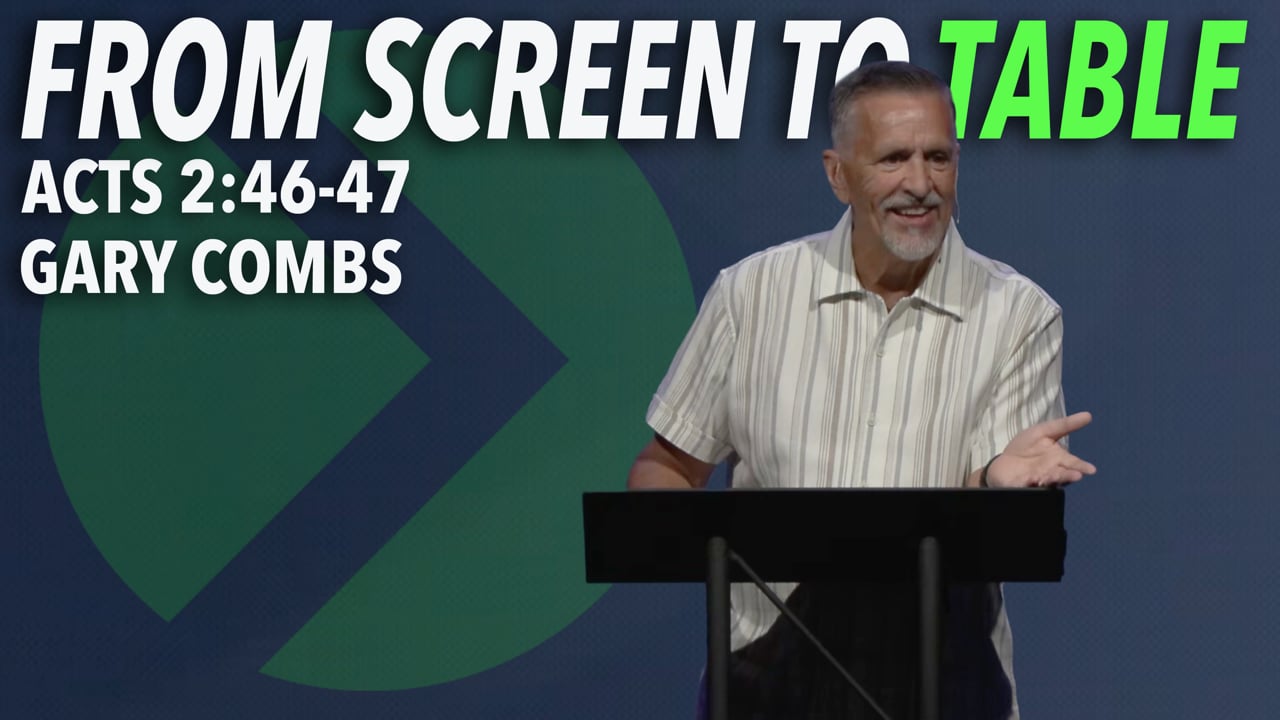
From Screen to Table
Read transcript
Good morning, church. We’re in part 3 of our series, “Connected: Finding Real Community in a Digital World.” And we’ve been talking about the fact that although technology has made it easier to be connected, we are actually feeling more lonely and isolated than ever. But the question isn’t that we need to give up our screens.
It’s not that we need to give up our smartphones and our iPads, but whether we should recognize that there’s no substitute for face-to-face fellowship. And as we think about that, we’re not saying one is evil, we’re just saying it’s not preferred, that there’s something better than digital connection. The apostle John observed the same thing, that face-to-face fellowship is to be the first thing that you would choose. And so here’s what he says in his second letter. 2 John 12 (ESV) “Though I have much to write to you, I would rather not use paper and ink. Instead I hope to come to you and talk face to face, so that our joy may be complete.”
And so he wasn’t saying paper and ink are evil. He wasn’t saying that you need to stop writing letters. He was saying, no, it’s the best I can do right now, but I can’t wait to be face to face with you because then our joy will be complete. He just recognized the superiority of face-to-face connection. So it’s about priorities.
It’s about what you’re going to be devoted to. And not seeing digital communication as being a substitute because it’s not a good substitute. It’s not to be preferred. And so speaking of the word, “devoted,” that reminds us of our theme verse that we’ve been reminding ourselves of every week, Acts 2:42 (ESV) “And they devoted themselves to the apostles’ teaching and the fellowship, to the breaking of bread and the prayers.” This is the first century church; they were devoted to four devotions.
They were devoted to the apostles’ teaching, to studying God’s word. They were devoted to the fellowship of being together. They were devoted to the breaking of bread, eating meals together, and to prayer. And so those four devotions. We’ve already talked about the first two in the previous two sermons, talking about those two devotions, and today we’re going to be looking at “the breaking of bread;” the idea of eating meals together. And we’ve entitled this, “From Screens to Table,” because the idea is that we’re to be devoted to the table.
In other words, face-to-face having and sharing meals together, because we long for the connection that a shared table provides. But, we’ve traded the screen for the table. Now picture, if you will for a moment, the modern American family at dinner. Everybody’s there, everybody’s got a plate, the food’s been passed around, everybody has their head bowed.
No one is praying. Dad is checking the scores.
Mom is in a group chat that she’s trying to keep up with. The teenager keeps laughing; for the last eleven minutes, he’s been staring at his phone, apparently watching some group of reels that no one knows what he’s laughing about. And then there’s the little girl and she’s sitting there with an iPad leaned up against a bottle of ketchup playing with her food. You don’t have to picture that very closely, do you?
All you have to do is remember your meal last night, because the truth is, that’s every American family right now. We’re all at the table together perhaps, but we’re not really together. We’re present, but our souls are absent from the fellowship that we’re called to. And you might say, well, you know, that’s not good manners, is it? But it’s more than a matter of manners, it’s a matter of formation because this way of living is forming our new society.
And even more importantly, parents and grandparents, it’s forming the way our children interact with each other and with grown-ups. Just last month in an article published by researchers in JAMA Pediatrics, this is a journal to physicians, it reports what Americans are saying about their family meals. It says that 78% of parents report using phones and screens at the table at their house, and 70% of children. Now what troubles me about that is I’ve been telling you that there’s an increase of young people using screens, and that’s true.
But what troubles me about this statistic is that it’s actually the parents who are worse at the dinner table. The article goes on, the lead author in the study said that parents assume that simply being at the table means they’re giving their children attention, but the research suggests that a parent’s physical presence can quietly become absent when they’re absorbed in a screen. Present in body, absent in soul. But it’s not just families, it’s everywhere.
It’s the whole neighborhood. In Robert Putnam’s book, “Bowling Alone,” he says that back in the ’70s, the average American household had friends over for a meal about fifteen times a year. So that’s a little greater than once a month, that people would have somebody come over and eat at their house; about fifteen times a year. So most Americans got together at least once a month back then. But now face-to-face time, according to Derek Thompson’s research in his article, The Antisocial Century, he says it’s dropped 70% in the last 20 years.
So just in the last 20 years, he says that young people hosting a meal or going to a party at someone else’s house is down 70% in the last 20 years. We have bigger kitchens than our grandparents ever did. We have farmhouse sinks, double ovens, marble countertops, fancy dining rooms with place settings on them. But we just walk through the dining room on the way to the recliner so we can kick back and look at our screen while we eat our meal. It’s not just the table, it’s the way we’re not gathering around it anymore.
We’ve come to a place where we don’t have undivided attention with each other because we’re settling for a substitute. I wonder, have we lost one of God’s ordinary means of grace for growing our fellowship, our families, and our church? Just the ordinary means of grace of breaking bread together so that we get our bodies fed, but our souls and our relationships as well. Well, in the book of Acts chapter 2, Luke described how the first century practiced a rhythm of gathering in the temple regularly to worship and how they gathered house to house to share meals together and fellowship together and how God caused that church to just grow and explode in the first century. And I believe today we can experience that same kind of growth.
We can experience that same kind of Christian fellowship around the table. And as we look at the text today, we’ll be looking for three practices that help us experience that kind of fellowship, that kind of Christian community around the table. We’re going to look at two verses today from chapter 2 in the book of Acts, verses 46 and 47.
Acts 2:46-47 (ESV) 46 “And day by day, attending the temple together and breaking bread in their homes, they received their food with glad and generous hearts, 47 praising God and having favor with all the people. And the Lord added to their number day by day those who were being saved.” This is God’s word. Let me pray and then we’ll dig in. Lord, I pray right now that you’d give us hearing ears, that you’d give us receptive hearts.
And Lord, I pray for myself, Lord, that you would allow me to get out of the way and let you speak for yourself through your word and through your Spirit. Lord, we pray this now in Jesus’ name. Amen. So we’re talking about three practices that we see in this text today that will help us experience Christian community around the table. Here’s the first practice:
1. Gather regularly face to face.
Gather regularly face to face. We see in these verses that there’s repetition here, in verses 46 and 47 with the phrase “day by day.” So there was this practice, this regularity of gathering day by day. You see it in verse 46 and again in verse 47. They had a rhythm of life that they were practicing.
Verse 46 says that the church gathered. Verse 47 says that the Lord added. So day by day they gathered, day by day the Lord added. They did their part, which was to gather. And God did what only he can do, and he added day by day those who were being saved.
Notice this rhythm of gathering regularly; you might picture right now that we’re gathering on the first day of the week in a public place. They gathered publicly in the temple, and then they gathered personally in houses. And we have a ministry in our church that we call community groups. These are small groups that meet in homes; they gather and they follow the same rhythm. Do you know what we decided when we planted Eastgate Church? We decided to not try to reinvent the wheel. Let’s just do what the church did from the beginning.
Let’s gather regularly, face-to-face. Let’s hear God’s word, worship and learn together in public places, in the temple courts. And then during the week, let’s meet in homes, share a meal together, study God’s Word together and pray for each other. And let’s see God add to our church. Because remember what Jesus told Peter? He said to him in Matthew 16:18, “You are Peter, and on this rock I will build my church…” He never called us to build the church.
He called us to be the church. In order to be the church and let Jesus build the church, we must gather. We just make it a priority to gather regularly and day by day; to attend to what he’s called us to. Notice there are two parallel participles here, attending and breaking,
The word attending could have also been translated as devoted – they were devoted. It’s the same word that’s used up in verse 42 in the original Greek. And so they were devoted to worshiping together regularly, and they were devoted to breaking bread together. Now when they say breaking bread, they’re not just talking about just breaking bread. No, that’s a euphemism for having a meal together.
It would begin with the breaking of bread and an opening prayer. So usually the host of the house would break the bread and pray over the meal. It meant to have a meal together. And they met not only in public places but in homes. You see, if our church only happens in rows, we’ll miss out what our church can grow together in circles. We need both.
We need rows and circles. We need that rhythm of gathering in rows in order to experience the unity of worship together and having big gatherings where our vision is expanded for how the church is growing. We hear God’s Word proclaimed and we’re able to sit under God’s Word and be discipled. And then we also need to gather in circles. And so we see this rhythm.
Luke repeats this as a pattern that’s a settled practice in the early church. It’s not just the early days of the church, but as we get into chapter 5, they’re still following this practice It says in Acts 5:42 (ESV) “And every day, in the temple and from house to house, they did not cease teaching and preaching that the Christ is Jesus.” In other words, they’re still preaching that Jesus is the Messiah, He’s the Christ. How are they doing it? From temple courts and house to house. That was their rhythm.
That was their rhythm. They followed that regularly. When Paul planted the church in Ephesus, he followed the same rhythm. We see in Acts chapter 20 that he talks about how that was his practice. He says in Acts 20:20 (NIV), “You know that I have not hesitated to preach anything that would be helpful to you but have taught you publicly and from house to house.”.
He didn’t try to reinvent the wheel. Paul planted churches and he did it the same way the first century church started, publicly and house to house. If you read the book of Acts, you find that he actually rented the Hall of Tyrannus. He rented a place because the church grew so fast in Ephesus, he had to rent a facility for his public space. And so they were meeting in the Hall of Tyrannus, you can read about that, for three years.
Now someday when we get to heaven, I’d like to sit down with Paull. Paul’s got a lot that he would like to tell me about, and I’d love to hear it, but I’ve got him on one thing. It’s a small thing, but it’s one thing. One thing I can say to Paul is, ‘Hey, you were renting a facility for three years, and that’s pretty hard, I know what that’s like, but we rented ours for nineteen years. For nineteen years. See, the truth about Eastgate Church isEastgate Church did not start in a building like this. It didn’t start in a church building.
It started in my living room. It started in the same house I live in today. It started in a little house, in a little living room. I invited about forty people when God called me to preach and to start a church. I invited about forty people because I wasn’t from here, so I didn’t know a lot of people to invite.
Most of the people I knew, I knew from having been in the workplace or neighbors I knew. And out of the forty people I invited, about ten or fifteen showed up at the first gathering in my living room. And then the church, boy, we grew it big the following week. It grew from like fifteen to seven the next week. And that was counting me and Robin,
me and my wife. So we had five people show up, praise God. But in the next three months, we actually had three community groups meeting in three different homes. In ninety days, God added to it. And what was our secret sauce? We were devoted to the apostles’ teaching, to the fellowship, to the breaking of bread and prayer in homes.
People would just sit around my dining room table; then it got too big for my house. I was the oldest guy in the church; I was thirty-two. And so we were attracting kids from Barton College and young married couples who didn’t have kids yet. And they loved being in houses and just sitting around. And so I led three different nights in three different homes for almost a year because I didn’t have any leaders yet. And so I was just out every night
leading these different groups and God provided the increase. So then we started renting facilities because within ninety days, we probably should start meeting all of us together and nobody had a house big enough for all three of these groups. So we were small groups before we had public worship. And so we rented Forest Hills Middle School. If you grew up in Wilson and used to drive by Forest Hills Middle School back in the ’90s and all the way into 2005,
for fifteen years we rented Forest Hills Middle School. We used to drive by and my daughter, when she was like 5 or 6 years old, we’d drive by during the week and she’d look over there and she’d say, “Daddy, there’s people in our church today.” I’d say, “Well honey, we let the school use it during the week.”
But we were over there for fifteen years and we were looking for space, but the whole time our church was growing and we didn’t want to limit what God was doing. And we know the church is not the steeple, the church is the people. It’s not the building. And so then we grew and then we rented Community Christian School on Packhouse Road for four years when this property became available. And so we bought this property and the church is still growing. But what we’ve been doing has not changed.
We are devoted to God’s Word, devoted to the fellowship, devoted to sharing meals together. That seems weird, doesn’t it? But that’s part of it. And not just the meal, but the table, the Lord’s Supper, which is represented also by the meal, and then to praying together. We gather regularly face-to-face. But we can’t cause the church to grow; only Jesus can do that.
And he promised if we would be the church, he would build the church. And so we said, let’s just be the church. And look what God has done. Two campuses, one in Rocky Mount, one in Wilson. Look what he’s done.
Look at the giving report we were able to give this morning from our It’s Time generosity initiative. I’m not celebrating me, I’m not celebrating you, I’m celebrating what Jesus is doing, his faithfulness through us, because our job has always just been to gather regularly and worship him and let him add to their number daily those who are being saved.
Praise God. Thank you, Lord. If we will be the church, he’ll build the church. And that’s what he calls us to do. It’ll be thirty-five years in November; November 1991 with seven people in my living room.
And I’m so glad that God called me to it so I could see you and we could be together here worshiping today on this day. So let’s make gathering face to face a priority rather than something we do when there’s nothing else on our schedule. Let’s celebrate on the first day of the week, worshiping in the temple courts as it were, and then during the week house to house in a community group. Some of us feel like our houses are too small for this.
Or we’re afraid to go to someone else’s house. Let me get you to think about something. Now we’re row to row right now, but just think, is there somebody in the room that you’ve never said hello to? And maybe even take a bigger step. This is going to scare you.
I know it’s going to scare you. What if you invited them over for a meal at your house? And I know what you’re thinking. You’re thinking, man, I have to clean for a week to get my house ready for company, you know? And plus my kids— oh, my house is so chaotic.
I don’t know. I don’t know if I want them to see the way my kids behave. I’m not a very good cook. So you’re afraid to invite somebody over. But what if we started opening up our homes that way? It doesn’t require a special meal.
It doesn’t require special plates; all it really requires is an available heart, an open door, and an invitation. The Lord grows real community when we gather regularly face-to-face. So think about it. Think about what God wants to do when we gather. Here’s the second practice.
2. Share meals gladly heart to heart.
The first practice is to gather regularly. The second is: We’re still in verse 46. Luke continues. He says, “they received their food with glad and generous hearts,”
They received their food. How do you receive food? You eat it. Some translations say they partook; they partook of their food. Yeah, well, I partake of food too.
Do you partake of food? And so when I receive food, I put it in here. And so that’s really all it is. And that’s really what they’re saying. But what the focus here for Luke was that they were having ordinary meals.
They were just doing what people do, just eating food. But it was their heart that he wanted to clue us in on. When they received their meals, when they ate their food, they did it with glad and generous hearts. So he gives us these two attitudes they had when they shared meals together and this habit, this practice they had that they did it with glad hearts. That word glad could have been translated with joy, and exultant hearts, with joy-filled hearts. Now look, just getting a good meal can fill me full of joy.
You know, when you get older, just a good meal and a nap afterwards, that’s pretty good, right? But they were gathering together with one another, and there’s something about sitting across the table from someone that maybe you don’t know well, but you start talking about the food. You start talking about your favorite whatever, and it just kind of lowers the barrier and enables the relationship to go deeper when you share a meal together. So they were glad. And as I said before, these meals, this breaking of bread here, he says they received their food. This was a meal.
It may have been a meal that included The Lord’s Supper. It may have included that, that they had communion together. I think often they had practices that some have referred to as “agape feasts” or “love feasts,” where they would get together as a church family and they would have a meal that might be preceded with or followed at the end with taking the Lord’s Supper and remembering what Jesus did. And so I think it’s both. They were doing this gladly, and they did it with generous hearts.
Now, that “generous” word is of interest. It originally or literally had the idea of “the smoothness of soil without stones.” And so that’s why it was often translated as simplicity or sincerity of heart. Just picture soil without stones, the smoothness of it. I remember my wife’s father, my father-in-law, he had two acres and we would go to visit and he used to till up about an acre of it for a garden. And he and his wife loved to garden, but he had stony soil.
And he used to say, “Gary, my land grows rocks. No matter how many times I till.” He had stones stacked up all along the edge of his garden. He would say to me, “You think you got ’em all, but I’ve been here for forty years. I’ve been gardening here, fifty years and I’m still growing stones.” He was looking for smoothness of soil. And that’s what we’re looking for, for simplicity.
My son, Jonathan, who pastors our Rocky Mount campus, and I were studying this week. I’m going to quote him. This might be the first time in so many years that we’ve worked together, I’m going to quote him instead of him quoting me. Here’s what he said when we were studying this word. He says, “Dad, I got a quote for you here.”
He says, “The gospel smooths out the rough places in our hearts so that we can truly fellowship.” He did all right on that one, don’t you agree? I decided I’d put that in my notes. Now you all tell him, so I get credit. So you put those two together, glad in simplicity, full of joy and empty of pretense.
That’s what makes a real table of fellowship. Not the menu, not the home decor, not the pretty soaps and candles in the bathroom, although that’s nice. But the gladness and the generosity. It’s a description of Christian hospitality, and Christian hospitality begins with remembering that it was Christ who first welcomed us, because hospitality is welcoming. Here’s what Romans says in Romans 15:7 (ESV) “Therefore welcome one another as Christ has welcomed you, for the glory of God.”
So welcome one another. Welcome. Do you know the people on your row? Welcome them. Say hello to them.
You know, sometimes people say, well, your church is getting big, pastor Gary. The church is getting big. And it’s only as big as you let it get because we’re big on Sundays, but we’re small in homes every week. We have to grow big and small at the same rate. And the other thing is, if there’s people on the row that you don’t know, well, do you know how you could know them? Say hello.
Welcome them to the church and say, ‘have we ever met before?’ And then they say to you, ‘well, I’ve been coming here for three years.’ Well, you know, it’s about time that you met, okay? And so say hello to someone next to you. Be welcoming and welcome them for the glory of God.
Peter goes on in his first letter to talk about hospitality. He says we should be glad and not grudging with it. Show hospitality to one another without grumbling. So when you welcome someone today, don’t tell them, ‘well, I’m just doing it because the pastor told me to.’ Do it and be glad about it.
I preached this sermon at the first service and I had people come out to me afterwards and one lady came up to me and she said, “We’re going out to lunch together.” I said, “Who are you going out to lunch with?” She says, “I think they’re all the way down there to guest services” and she named who they were. “I told them, let’s go out to lunch like the pastor said, we’re going to go out and eat together.”
I said, “Well, hold up. I’m going to go down there and see if it’s true.” And so I went down and talked to those two ladies, and I said, “Such-and-such up here says that she invited you to go to lunch. Is that true?” They said, “yeah.”
And I said, “Good, I’ll give her credit now. Go back and tell her.” And she says, “you did not do that.” I said, “yes, I did. I went down there to find out.
If you want credit, I’m going to go verify, okay?”
And so invite somebody to go out to eat with you. Now, do you know the difference between entertaining and hospitality? A lot of people want to entertain at their house, and that’s why they won’t ever have anybody over. Entertaining says this – come and see what I have prepared for you. Hospitality says –come and share what God has given me,
or come and share what God has given us. Entertaining worries about whether the house is spotless, the food is impressive, and everything goes according to plan. That’s entertaining. Hospitality makes room for another person even when the house is lived in, the children are noisy, and supper is only soup and sandwiches. That’s hospitality.
So here’s the challenge, and I want to make it small on purpose. If it’s small, maybe you can do it. Why not sign up on your connection card to be in one of our small groups? We call them community groups. Or better yet, let’s try this.
Let’s see if this works. If you’re already in a community group, lift your hand and hold it up for a second. Okay, hold it up. Don’t put it down. Now, if you’re not in a community group, look around on your row or nearby and see if you like anybody you’re looking at.
And if you do, Go to them afterwards and say, ‘is there room at the table at your community group for me?
I’d like to try it out this week.’ And if you had your hand up and you looked around, maybe saw some people who didn’t have their hand up, you can do likewise and say, ‘I noticed you didn’t have your hand up. I’d love for you to come and try our community group out this week where we’re devoted to four things – to the apostles’ teaching, to the fellowship, to the breaking of bread and prayer.’ And so invite people.
That’s your challenge. Paper plates are fine. Chick-fil-A on the way is fine.
And put the phones away.
Not as a rule, not as a law, but as a gift to the others at the table. And the gift is you fully present, listening, and fellowshipping. That leads us to the 3rd practice. Here’s the 3rd practice. We’ve said gather regularly, share meals gladly, and then finally:
3. Witness God’s work in life after life.
Witness God’s work in life after life. We’re in verse 47. Now watch what happens when the church gathers regularly and shares meals together. Watch what happens. Three things spill out of that room: praise, favor, and life change. Because they did it?
No. The secret sauce wasn’t that they gathered regularly and shared meals. It was that the Lord gave an increase. Their part was to gather and His part is to add. I can’t help but wonder if revival hasn’t come to our nation, to this city, because of our low priority about gathering, because it seems a small thing that he would call us to gather regularly and share meals. Do I have to eat
with other people, get together and praise God and share God’s Word and study? That’s my part, and then the Lord will grow the church? The Lord will bring revival? That’s what I’m seeing in the first century. That’s what I’m not seeing on display in the American church today.
A few years back, in 2018, I was on a study break. I take a week at the end of every year; I go away, I read, I study, I pray and I ask God to give us a fresh vision for the upcoming year. And this particular year, the Lord impressed upon me to gather pastors in Wilson to pray for revival in our city. And I was like, Lord, surely there’s another pastor in town that has more influence than me. Why are you asking me?
Is that really you, Lord, or is that just me in my head? And so I thought, well, I’ll start with one person when I get back. So, the first week of January 2019, I called my good buddy Pastor Rusty over at Peace Church, and I said, hey, I really feel the Lord impressing me to call pastors together to maybe have a I don’t know, a monthly breakfast and pray together for revival in our city. And I’m kind of thinking non-denominational, as long as they believe in Jesus and the gospel and can work together to see the gospel saturate our city.
He goes, man, Gary, the Lord’s been putting that on my heart too. I said, well, why didn’t you do it? The Lord had to turn to me and get it going. So we got eight pastors to show up at Denny’s in January 2019. And we’ve been meeting monthly ever since.
And I have like twenty-five pastors on my list right now that get a monthly email from me. I’m still trying to wave the banner, hey, let’s gather and pray and see if God will add to our number. That’s what we’re doing, and we’re still doing it, and across the city. We’re praying for revival in our city, and we’re asking God to do it. We want to see God’s work. I’m getting older and I’m still praying, God, what would it look like to see a spiritual movement in our city?
What would it look like? I want to see it. And so we’re praying for that because only God can do it. What’s it look like here in Acts? What was the outcome? They praised God.
These gatherings caused praise to come up in them. It caused them to have favor with the people. It says all the people. I think what I’m seeing here is that it wasn’t just the people in the church, it was the people outside the church started noticing these people, and they had favor with those people. God gave them favor with outsiders.
This past Monday evening, I got invited to go to dinner with one of the community groups. I told Robin to let them know that we would go. And she said, “Well, Gary, they’re going to meet in Goldsboro at this restaurant and it’s 7 o’clock. You like to go to bed early.” And I said, “I do. I go to bed early because I get up early, but you know what? I’m preaching on this this coming Sunday, and if I say no…” So, this is what God does to me.
If I’m going to preach on this, I better not be a hypocrite. They’re inviting me to go and break bread together in Goldsboro.I didn’t get home until 10:30.
My goodness, if you were waiting for my one-year Bible devotion the next morning, it’s their fault because I could not get up early enough the next morning to put that out as I normally do. But we had a great time. There were about twenty of us there. This is a big small group. We stood up and the leader of that group prayed for us. He brought the owner of the restaurant over and introduced him and prayed for him, and we felt God’s favor in that restaurant. Do you know why? It was because we just got together and ate with glad and generous hearts and God gave us favor. That’s what happens.
Jesus talked about a people like this. He said in John 13:35 (ESV) “By this all people will know that you are my disciples, if you have love for one another.” I think it shows the world when we share these meals together, whether it’s in public or in private. And so let us make room at our tables. Let us make room in our hearts for gathering regularly with one another.
The farmer can get the rocks out of his soil, he can prepare it, but he can’t make the seed and he can’t make the seed grow. But we can decide together and we can decide to break bread together and then we allow God to do the work. The first-century believers regularly met and gathered between the temple and the table. They worshiped together in the large gathering And they shared their lives in the intimacy of their homes. They gathered face to face and Christ made them one.
They shared meals heart to heart and Christ filled their hearts with gladness and generosity. They witnessed God’s work in life after life because the Lord was continually changing lives. But Christian community does not ultimately begin with our invitation to invite someone to our table. It really begins with Christ’s invitation to come to his table. That’s really where it begins.
And throughout his ministry, Jesus sat at tables in homes, and he said yes to people that respectable society would reject. He ate with tax collectors and sinners. He welcomed the guilty, the ashamed, the lonely, the spiritually hungry. And then on the night before his crucifixion, he invited his disciples to the table, and he broke bread, and he said, “This is my body. Whenever you eat it, you do it in remembrance of me.
You see, unless you’ve been invited to that table, nothing I’ve talked about today will really make sense, nor will it have the outcome that I’ve described, because it’s not just the fellowship. It’s not just the “one anothers,” those are healthy for humans. We need that. But it’s the part that God does that only God can do.
And when we say yes to the table that Jesus invites us to— “Come unto me, you that are weary and heavy laden, and I will give you rest”— he invites you to the table. Come, my body is broken for you. At the cross, his body was crucified, his blood was shed for our sins. But three days later, he was raised from the grave and lives today. And after his resurrection, we hear this story in the book of John that poor Peter, he had denied Jesus three times, even though he didn’t want to, even though he said he never would, he did.
And on this particular day, he had led the disciples, and they all looked to him as a leader. He led the disciples to go fishing. I mean, he felt like he’d lost his calling, I’m sure, and he said, ‘Well, let’s just go fishing. At least I’m good at that.’ And they fished all night and didn’t catch anything.
Turns out he couldn’t go back to his former life. He wasn’t good at that anymore. And then someone started beckoning them from the shore. Someone on the shore had a little campfire going with some fish cooking on it. Someone had made breakfast.
And John hears him calling out, and this one on the shore says, “Why don’t you throw the net on the other side?” And they did, and they pulled up a catch so big it filled the boat. And John said, ‘It’s the Lord.’ And Peter says, ‘What?’ And Peter dives in and swims ashore; he didn’t even help the guys get the fish in.
And they bring the boat in and Peter runs up to Jesus. Can you see him dripping wet? He runs up to Jesus and Jesus says, ‘Why don’t you bring some of the fish you caught over here too?’ And as they sat around that meal, that breakfast that Jesus prepared, he said, “Peter, do you love me?” “Yes, Lord, you know all things.
You know that I love you.” “Feed my sheep,” Jesus said. Three times Jesus asked, and three times Peter answered. And Peter was restored to his calling. And to his love of Jesus, because Jesus invited him again to the table.
I don’t know where you’re at today. Maybe you need to come to the table for the first time. You’ve never come to Jesus as your Lord and Savior. Or maybe you’ve been drifting, you’ve been isolating. That’s what the flesh, that’s what the world, that’s what the evil one calls us to do, is to isolate.
To pull away. Maybe that’s been you. You’re a believer, but you’ve been hurt by the church, or you’ve been hurt in some relationship with a Christian.
Why don’t you come back to the table? “Do you love me?” Jesus says, Do you love me? Come back.
Come back to the table. Let’s pray.
Lord, I first of all want to pray for that person that’s never come to you as Lord and Savior. They’ve never come to that first meal that you offer —”This is my body which is broken for you. This is my blood which is shed for you.” They’ve never come to you and said, ‘I’m a sinner, I need a Savior.’ If that’s you right now, my friend, right in your seat, right in this moment, this holy moment, why not pray with me? Why not pray like this,
right where you’re at: ‘Dear Lord Jesus, I’m a sinner. I repent of my sin. I turn from it and I turn to you. I believe that you died on the cross for my sins, that you were raised from the grave.
I believe that you live today. Come and live in me. I invite you by your Spirit to come and live in me and save me and make me a child of God. I want to follow you. Forgive me of my sins.
I want to follow you as my Lord and Savior all the days of my life.’ And if that’s you today, you’ve come to the table. And the scripture says that if you confess Jesus as Lord and believe that God raised him from the dead, you will be saved. Others are here today and you’ve drifted. You’re lonely.
You’re looking for fellowship. I don’t know where you are. The Lord does. He’s been speaking to you this morning, right? Why not right now just say, ‘Lord, forgive me for pulling away from you and from your people.
Help me to plug in all the way to this rhythm of life— house to house and temple courts— this rhythm of life of gathering regularly with God’s people. I want to do that. Help me, Lord. In Jesus’ name, amen.’
Read transcript
All right. Good morning, church. It’s good to see all of you this morning. Very thankful to be preaching this morning. Continuing our series called Connected.
I hope, if anything else, that after this morning, you’re going to feel more connected than ever. But we’re going to talk this morning about our 3rd piece of a 4-piece series. Where we’re talking about this idea of finding real community in a very digital world. What we’ve noticed I bet you’ve noticed probably many times is although you have access to a lot of people, you don’t necessarily feel like you’re getting to know people better in this really hyper-digital world. I love what the Apostle John once wrote in his older years.
In 2 John 12, he says, though I have much to write to you, I would rather not use paper and ink. Instead, I hope to come to you and talk face to face. So that our joy may be complete. So even in his day, he’s like, you know, a letter’s cool and all, but I’d rather see you face to face. Like, none of us are writing letters anymore, but we’re writing letters basically like this.
And then sometimes we need to just say, rather than me text this, let me just come see you. And so that’s the idea of this series, is that we would figure out ways to have real face-to-face connection and community like never before. How do we move then from this idea of this digital world to like face-to-face fellowship? Our theme verse for the series has been a verse we’ve talked about quite a bit as a church. But we’re looking at it from a different angle.
And we’re in the 3rd devotion this morning. In Acts 2:42 it says, they devoted themselves to the apostles’ teaching, to the fellowship, to the breaking of bread, and to the prayers. So this morning We’re going to talk about breaking bread. And so if you’ve shown up and you haven’t eaten breakfast yet, this one’s going to be trying. Because we’re going to talk about what it’s like to eat meals together.
And how important that is. And you’re like, okay, this is going to be an interesting church service. We’re going to talk about food. Well, sort of. Sort of.
And we’re going to have a good time together as we dig into this. Because over the last couple weeks we’ve been talking about, alright, what does it look like to have fellowship with God around His Word? And then fellowship with each other in a real and intimate kind of way. And what does this idea of breaking bread have to do with all of that? So today our sermon is titled, From Screen to Table.
Now I want you to picture something, and you don’t have to really work hard to picture this. In fact, if you go out to eat today for lunch, just look around the room. I guarantee you will observe this at more than one, if not maybe all of the tables. Picture this. Everybody’s there.
Mom, dad, couple of kids. Everybody’s at the table and everybody’s got their heads bowed and they’re not praying. Everybody’s got their heads bowed and dad’s checking the scores. Mom’s checking a group chat. The teenager has been not looking and making eye contact with anybody for the last 12 minutes, but they continue to chuckle about something no one else knows about.
And the little one with her little sippy cup has got her iPad pressed up against the ketchup. And that’s a lot of us. That’s a lot of our families. That’s family dinner. And the funny thing about that is that that’s all of us.
And it’s not unique to just a few people. In fact, in a recent study, they found out— this is JAMA Pediatrics looking at family, American family meals. They discovered 78% of parents use their phone at every meal and 70% of kids. And so parents, we’re the main problem. We’re the main culprit.
And perhaps you’re thinking, well, I’ve heard before it’s important to eat meals together. And so you’re making that happen, but you’re actually absent because you’re not present in mind. You’re merely there in body. And it’s not just the families. In a book called Bowling Alone by Dr. Putnam, he says, back in the ’70s, the average American household had friends over for a meal about 15 times a year.
Most Americans got together in somebody’s home over once a month. Now, what’s interesting, we have bigger kitchens. We have double ovens and islands and farmhouse sinks and things are looking cool. But no one ever sits at the dining table. We’ve got a dining table that can seat 12, and we forget to sit there even with our family of 4.
It’s interesting. It’s interesting. Our grandparents would have dreamed of stuff like this, and yet they did one thing a whole lot better. They sat around in what they had to sit around in and had a meal face to face, eye to eye.
What are we to do with this? What are we to do with this idea and why does it matter? It’s so important that we dig into this today because it’s merely— it’s not merely just sitting around the table. It’s the way in which we gather around it. In a world where we spend most of our time around screens, have we lost this really ordinary function that God has given us?
This is just a basic thing. Isn’t it interesting? I don’t know if you’ve ever considered this, but God does these little things in his creation to make us slow down and think about him and about one another. There’s just odd things he does. Like, I’m going to make a creation that has to eat a couple times a day or it will die.
Weird. I don’t know if I’d have thought— I’m going to make a creation that if it doesn’t sleep for a third of its life, it’s not going to make it. That’s wild. It’s like God said, I’m going to install pause buttons that you have to honor. And this meal one, I’m going to install it in such a way that it’s going to be in some ways a central theme throughout all of scripture.
Did you know? You may never have thought about this, but sin enters the world through a piece of food. That throughout all of the Old Testament, you’ve got the Passover meal. So God puts one of the most important things in Israel’s whole history around a meal. And then Jesus, what does he do?
He puts one of the most important things he ever did, if not the most important thing that the world has ever known, he puts it around a meal. It’s not accidental. It’s also not accidental that one day when the Lord comes again and takes us home, we will meet around a meal. And I’m pumped about that, y’all. I’m so happy that there’s eating in heaven.
Hallelujah. It’s one of my favorite things to do. I love a feast. But it’s important that we make it what Christ and what God has intended. We’re going to be in the book of Acts today.
In the later part of chapter 2. And I really do pray that you will find the— not only the reasoning. But the encouragement to fellowship around the dinner table. Both in your families and in your communities. In your community groups.
We can experience authentic Christian community around the table. So here comes 3 practices as we dig in. Very short text. Acts 2:46-47. Listen to this, church.
It says, day by day attending the temple together and breaking bread in their homes, they received their food with glad and generous hearts. Praising God and having favor with all the people. And the Lord added to their number day by day those who were being saved. God bless the reading of His Word. Amen.
Boy, this is encouraging that when the people of God get together and they praise him in the temple, the modern-day church, when they praise him in worship and then they go into their homes and they eat together, guess what God does? He adds to their number day by day, those who are being saved. God does the harvesting, but we’re to do the praising and the fellowshipping, which I’m pretty down with. This is exciting. I’m looking forward to digging in with this with you.
How do we experience Christian community? Around the table. Here’s the first. Here’s the first thing. And these are really based around these -ing words.
The first one is this. That we would gather regularly face to face. I want you to see there’s a rhythm of life in the first century church. A rhythm of life that we have to some degree. But we could probably turn it up a little bit.
The volume’s a little low. We could crank it a little more. We have a rhythm of Sunday worship and perhaps midweek community group. And we have a rhythm perhaps. But what if you had a rhythm of, I’m meeting with a friend over lunch once a week.
I’m meeting with— that you turn up that volume a little bit so that there’s a day-to-day kind of gathering regularly. Who am I pouring out into? Who is pouring into me? What if I make that A rhythm. There’s a rhythm to this text.
It says, day by day they were praising and they were receiving their food with glad hearts. And day by day, verse 47, the Lord was adding to their number. There’s a rhythm not only to what we do, but to what God is doing through us. This is incredible. Verse 46, it says they were attending.
They were devoted to it. They were together. They were of one mind. The word here together is the idea of being in unison. In fact, it’s a compound word that means to rush along in unison.
So the people are locking arms basically, and, and, and they’re running towards Christ together. This— they’re attending, they’re worshiping, they’re praising, they’ve made friends, they’re eating together. And it’s not merely just bread. I think we know this, right? This isn’t like surprising.
The text here says they were breaking bread. So did the first century church, all they ate was bread? I mean, I think we know this terminology is the idea of having a meal. It’s not merely just a meal. I think it could include both.
They’re eating dinner. They’re eating lunch perhaps. But it doesn’t exclude the possibility that they’re sharing in the Lord’s Supper together too. And so I think there’s a commonality to how often they’re doing the Lord’s Supper as well here. And so in this moment though, it’s got to be slightly more than just that because they’re doing it daily, they’re doing it in their homes, and they’re, they’re glad and they’re gathering.
It’s more than just becoming sociable. Like, the message here to the church is not, hey, you guys need to be more social. It’s make the most of your opportunities. You may not know this. I say this enough in my sermons that hopefully you’ll remember.
I’m not an extrovert. I’m actually an introvert. When I go home after church, I’m really quite tired because I’ve tried to— tried my best to be joyful and happy and talk to you. And I’m really putting that forward and saying, hey Lord, it’s not my natural tendency to be in groups and mingling, but help me to crank it up. And then we’ll take a nap after lunch and recover.
But that’s, that’s me. And this, this idea though is not just that I would be sociable. That would be a good start for me, this introvert. But it’s more than that. It’s, am I really trying to meet you, get to know you, find out more about you?
This is what a dinner table can do. This is what the early church figured out. That really the first families figured out. And that’s something incredible can happen around a meal. I’ve noticed this especially with men.
I’m a man. So I can’t really speak from the woman’s perspective. It seems like you guys break through the ice a little quicker than men do. I could be wrong. Y’all can tell me after service.
But it seems like y’all get to more important topics a little quicker and you don’t need help all the time. Men, we need a lot of help. We really just don’t want to talk about anything very deep very quickly. Generally it’s sports and fishing and whatever hobbies we like and maybe politics, but that’s a stretch. It takes us a while to get deep, but here’s what I’ve noticed.
There’s a couple of things that will break the ice for men and I bet it’s true for all people. Is you sit down around a meal. You’ve got a designated amount of time. You’re opening your face. And so you look a little bit, you look a little bit silly no matter how you slice it.
Like nobody can look stoic when they’ve got to eat ribs, right? Like the most stoic person, that’s the one you take to go get baby back ribs. So that way we both got to get messy together. And you’re getting sticky and all of that. And now finally, someone would open up, perhaps.
I’ve noticed this with my kids. Those of you in the room with teenagers, if, if you know this question, hey, how was your day? You know how every teenager responds. How do they respond? Fine.
Good. It was school. I don’t have any words. I have no words. I don’t even have any expressions.
I’m just kind of like, I’m not even gonna open my eyes to respond to this question. Asked. That’s what you get. But just sit down with your teen and wait and eat. Silence kills a teenager, at least some of them.
Maybe not all of them, but like sit, eat, just look at each other, make eye contact. Makes them real nervous, right? All of a sudden they’ll start opening up about stuff. Sometimes you got to increase the quality of your question. How’s your day is not a very good question.
Hey, what happened today in math class? How did soccer practice go? Improve the quality of your question. I’m not saying it’s going to immediately get anything better than fine.
But something can happen over a meal. I’ve noticed at least my 2 teens, especially my oldest, my oldest son, he gets in moods where sometimes he’s very talkative. You just got to be ready in those moments. You got to just— when that happens, let him ride. You know?
It happens sometimes over dinner. It happens sometimes when me and Nicole are just in our bedroom watching a show and he just comes and lays on the bed. That’s when I know he’s both bored and maybe has a lot to say, which is rare. So sitting around a meal can really open people up. Luke repeats this pattern as a settled practice of the church.
This is a common practice. Later in Acts chapter 5, it says, every day in the temple and from house to house, they did not cease teaching and preaching that Christ is Jesus. Paul recounts his ministry in Ephesus with this same pattern. He says, you know that I’ve not hesitated to preach anything that would be helpful to you, but have taught you publicly and from house to house. Church, this is an ancient model that we must not walk away from.
That we would get together regularly face to face. Something incredible happens when you go to someone’s house. I think people are sometimes shocked when they come to my house for community group and I’m not still wearing a polo or a button-up. I’m going to put a t-shirt on after church, y’all. Straight up.
And you’re going to come and I might be barefoot. And if that grosses you out, then let me know and I’ll put shoes on. Because I love you. But typically, I’m walking around my house with my bare feet and some athletic shorts and a t-shirt. And that’s how people come to my house.
It’s kind of nice to see people with their hair down. Casual. I think this is what’s happening in the first century. It’s what’s happening in the 21st century. That people get to see the real you.
There’s something incredible here. During the wintertime, I have a tendency to do this thing where There’s a channel on my TV that will show like a fire. Like a house. Not a house on fire. But like a fireplace with a fire in it.
And it’ll even make the little crackly sounds. And this digital fireplace kind of sets the mood in the room. I might put that on when I’m having people on. So everybody goes, ooh, it’s cozy in here. You know?
They kind of feel that. But you can see it. It’s crackling. But you know what you can’t get? You can’t get warm off of it.
Now, I don’t know. Maybe they’ll invent something one day. That’s going to be weird. If they ever invent— I’ve thought about this, y’all. Please, if those of you in the room who create things, do not create this.
All right? But one day they might make a TV that can make a smell. All right? So that like when something happens, you get the aroma of it. That will be Nuts.
All right. But you can’t get warm off of this digital fireplace and you can’t smell that nice burning hickory smell that you would get out of a real fireplace.
This is what’s happening, I think, in Christian fellowship on so many levels. Sure, you can watch it. You can watch great preaching. You can watch preachers that are a lot better than me. You can.
You can watch worship that’s a lot better than what we can put on.
But you can’t feel the warmth.
You can’t smell the smells. I don’t know if I want to go there. But hopefully there’s a nice coffee aroma floating around. But you can’t feel the warmth and the fellowship. You can text one another and say, hey man, I love you.
You know, I care for you. I’m praying for you. But you can’t feel the warmth on a text. It’s not the same as putting arms around a neck. There’s something powerful here.
Jesus. He made it a part of his mission. In fact, it’s interesting. 3 years he spends with his disciples. And most of what you’re reading about.
Just go back and read the Gospels. What is he doing? They’re eating together. They’re walking around. They’re talking.
They’re eating. They’re eating a lot. There’s so many passages of scripture about Christ sitting down with tax collectors. With his disciples. With broken people.
People that the Pharisees would go, oh my goodness. I can’t believe you would eat with them. And he’s eating with them. Because it says something about who he is that he’s open to this. Like, you’re not going to share a meal with people you shouldn’t share a meal with.
But that’s not Jesus.
He makes it important. So here’s the question, church. Are we worshiping together here? Which is more— honestly, it’s more spectator. Are we moving that into fellowship?
Where we’ve got people in our life. Maybe it’s community group. Maybe it’s individual. Where there’s people that we’re hearing from and being mentored by. We’re eating together, people we’re pouring out with.
Are we making serious this idea of day-to-day gathering? And not just any kind of gathering. In fact, for many of us, I think we need to— I saw these on Amazon recently. They make little bitty jails for cell phones. You seen this?
I think this is hilarious. The people who really struggle with this, the whole family has to put all their cell phones in jail before they eat a meal. I think it’s great. Some of you should use this. All right, mealtime.
It ain’t but 30 minutes. You will survive 30 minutes without your digital pocket watch. You know, you’ll be fine. Put it in jail.
We should all install this. Maybe every single meal we’re just going to actually look at each other with no phones. Here’s the second. That was the first. Gather regularly, day by day, face to face.
Next, share meals gladly, heart to heart. Gladly. It says in verse 46, they received their food. This is the idea of nourishment. Notice he uses this word here, not breaking of bread.
That means it’s more than just the Lord’s Supper. It doesn’t exclude it, but it’s more than that. There’s ordinary meals they’re having together commonly, and they’re sharing it with gladness. It’s pretty sad if you have a meal and you can’t smile together. It’s like, I know not everybody can cook real well.
I get that. But like, at least try to have a grin on your face with this food time. And they go on to say, verse 46, and generous hearts. That sounds kind of weird. They’re eating with happiness.
Okay. And generosity. This word here is— there’s a lot of different ways that the translations translate this word. If you have other versions of the Bible, you’ll see some say sincerity. Some say singleness or simplicity.
The idea here is that your heart is completely open to one another. This word quite literally means the smoothness of a soil that doesn’t have any stones on it. So it’s, it’s the kind of heart where you won’t accidentally stump— stub your toe. So would you have the kind of heart with people that like everything isn’t a stumbling block with you?
There’s a reason that the translators go a lot of different routes with that. It’s because this idea here is that we would have such an open heart with one another that we wouldn’t be so offended all the time, that we wouldn’t be so in our feels about everything, that part of getting together is, all right, I’m going to listen. I’m going to respond. If you have harder things to say, almost in the line of rebuke, I’m going to try to have an openness to that and not be a rocky soil. So that’s the idea here.
Glad and simple. The gospel, in fact, what the gospel should be doing in your life is smoothing out those rough places so that authentic fellowship can really happen. Look, it’s really hard to get along. Just in a church of this room’s size right here. It’s hard to get along.
There’s a whole nother service coming after y’all. There’s— I don’t know. You might be at first service because of some of the people in second service. You’re like, I’m not going when they go. I just want you to hear the gospel should be smoothing that out.
That you can’t look at other people and go, oh, I’m just going to hang on to hostility. Hostility in my heart for them. No. A generous heart. A sincere heart is smoothing out the stony places.
Now, I’m not saying they’re going to be your best friend. But at some point you start going, I’m just not going to be so offendable about everything. I’m not going to hold things against people like that. Instead, I’m going to be glad and have a generous heart. You put these 2 things together.
And you’ve got something powerful. Then the real table, the meal of fellowship, is about joy and openness. It’s not about how good the room looks or how good the food is. Notice that’s not even in this text. Now, yeah, try to make good food because why not?
Like, some of you need to learn how to use seasoning. Just do it. Like, it’s going to be okay. It’s going to be good. And if you know, if you’ve overseasoned, you’ll know.
You know, sometimes I really like pepper, y’all. So sometimes I go a little bit much and I like it and the kids are like, oh my gosh. Oh well, I cooked. You didn’t. Too bad.
You should learn to cook.
But that’s not what’s important here. It’s not the home decor. It’s not the pretty soaps. It’s not the candles. It’s not Now, some of y’all have a gift of hospitality.
You need to roll with that. Roll with it. Because you know it’s part of what gives you joy. Then have joy. When people come into your house, they go, oh, wow.
Do that. Because that’s what God has put in you. I’m just looking for my house to be fairly tidy and clean. You know, it’s not going to be— we’ve lived there since 2018. We barely got anything hanging on the walls.
I don’t know what’s That’s just me and Nicole just don’t have that decorator gift. But we can keep it clean and keep it tidy so that you can come in. We’ll try to have enough chairs ready. That’s what we’re aiming at. Christian hospitality begins with remembering that first Christ has welcomed us like this.
Romans chapter 15, it says, therefore welcome one another as Christ has welcomed you for the glory of God. And our hospitality should be glad. With a sense of gratitude and not complaining. The Bible actually says this, 1 Peter chapter 4, show hospitality to one another without grumbling.
Because the Bible knows and the writers who wrote it know, okay, I’ll have them over, but I’m not going to be happy about it. No, do it with joy and sincerity of heart. This topic of of eating meals with gladness. There’s a couple of times a year, at least in my life, where I have like top-notch kind of mealtime. I bet you do too.
You might have more than I do. One that’s top-notch at the Combs house is Thanksgiving. Right? It’s a top-notch one for a lot of you, I bet. Right?
Now here’s the thing. What makes it top-notch is a lot of things. First of all, my mom makes the sweet potato casserole, which I love. All right. That thing is killer.
And the deviled eggs are just right. Some of you, you’re going to hear me say these things and you’re going to try to make me deviled eggs. Be careful. Okay? Because I’m going to tell you they’re good.
And I’m going to have to confess that to the Lord later. Because they’re not Mama Combs’. All right? So just be careful if you’re making me deviled eggs. Because the bar is really high.
And so yeah, the food’s great. And there’s things that she only makes at that time of year. And now lately all the wives, they come together and they make certain things. Sometimes my sister makes the sweet potato casserole. It’s close.
It’s close. It’s close. And if she hears this, which she probably won’t, but if she does, you’re getting there.
But what makes it amazing? Isn’t all those particular little foods. Think about this. Because you probably had some amazing meals that you’ve forgotten all the details about. You might have had a really good meal at some restaurant a week or two ago.
But you’re not thinking about that. You don’t remember much about that. But you probably remember the last like great mealtime you had with your family or extended family. Why? Because there’s a difference between the quality of your nourishment and hospitality.
Hospitality is what the Bible speaks of. That when we get together at my community group, y’all, we be eating some weird stuff. I’m just saying. Every week, like, somebody creates a strange menu. It’s like we’re trying to be weird.
I don’t know what’s going on. One week we ate noodles peas, and mustard, which sounds gross, and it isn’t. It’s all right. It’s weird. This one young man from California that’s moved away since then, but he said, this was something I grew up eating.
And so we tried it one night, and it works. If you’re in a pinch, it kind of strangely works. But we’ve had some weird meals. But you know what makes that time so great? We all try to bunch into my dining room, which does not fit as many people as we’ve got, but we try.
We bring in metal chairs. It’s chaotic in there. And we’re just talking about stuff. Sometimes spiritual stuff. Sometimes family stuff.
Sometimes movies. We’re all over the place. And there’s gladness. And generally there’s an openness. You better be open if you come to the Combs community group.
Because we’re all over the place. And that’s a lot of our small groups. I hope that that can be not only what we express as a church. But what we express in individual families. What makes Thanksgiving powerful is hospitality.
What makes a good community group powerful is hospitality.
Here’s the third. And this is the beautiful thing that God’s doing. Witness God’s work in life after life after life. This is what God can do.
Now, some of you are new to our church. Maybe it’s your first Sunday or you’ve only been a few Sundays, maybe a couple of weeks, couple of months. My guess is what attracts you to a church, what attracts you to a people is fellowship. Are these people kind? Are they good to me?
Do they seem sincere? Um, do they really honor this God that they claim to serve? You know, do they? I think most people, like, if you could— if I could just in the room go, okay, what, what kept you coming? Well, it was actually so-and-so.
It was actually— it was Derek, or it was, it was, it was Bernie, or it was, it was, it was somebody that kept me coming. Some of you might even say me. Probably not. You would never tell me that to my face. You wouldn’t want me to have that kind of encouragement.
Right? But you’ll say, hey, it’s somebody. It’s probably the most— it’s probably the number one answer. You know, I come for Thomas, man. He invited me.
And he seems really sincere about this. And now being in this fellowship, I’m starting to notice something. It’s all about that. It’s all about that hospitality. And that’s what’s happening here.
I just feel like what incredible things happen when the church of God, when they get together and they authentically fellowship and they love and they give and they’re generous and they’re hospitable. When they do these things well, the outside world looks in and goes, man, I can’t find that anywhere. Where do I find that? I mean, there’s lots of clubs. You can play sports, adult sports.
You can go to pool nights where you play pool. You can You can find different genres of hobbies where everybody gets together and rides motorcycles or fixes things. You can do all of these things, right? And those things are good. A lot of them are really good and you have a good time.
But where do you find a group of people that love each other so much that they would give the shirt off their back? That they would humble themselves before you? That they would invite you into their homes for mealtime? That they would open up their hearts to you? You’re just rarely ever going to find that.
Sometimes it’s even rare at church.
I feel like church is— part of our mission is to constantly combat this internal focus. That we would continue to look outward and say, all right, how do we present ourselves to the world? Here’s how they presented themselves to the world in the first century. They were praising God. They were hanging out.
They were receiving their food with glad and generous hearts. They were open to one another. Earlier in this text it says, as anyone had need, they were supplying those needs. That we would look at each other and say, hey man, I really— I don’t have the money to help you do that, but I’ll show up. Like I put a late plug out to my community group this week and said, hey, there’s a family moving.
Does anybody want to hang out and help me do that? And one of our brothers here helped me do that. It was wild, y’all. I found every time I go to help somebody move, they’re rarely ready to help— let you help them. So this is a shameless plug.
If any of y’all move anytime soon, can you have the boxes packed before the movers get there? We don’t want to do that part. All right. That has nothing— that was just a freebie. Witness God’s work in life after life.
Verse 47 said they had favor with all people. And then what happened? The Lord added to their number. The Lord added to their number day by day those who were being saved. So the gospel then is calling us to something very unique.
It’s calling us to constantly prepare the soil That God might come and water the plant. So here’s this wild thing we do called being the church. This wild thing we do is we get together and we try to do all these things we’ve been commanded to do in obedience to Jesus. We try to do these things together. And none of it’s going to work to reach your neighbor, to reach your family member, to reach your coworker.
None of it’s going to work unless the Lord adds.
Now, that’s not discouraging to me. Here’s why. I’m glad to know I don’t have the power to make something happen. Because what if, what if I’m having a bad week? What if I’m not doing well and all of it rests on my shoulders or your shoulders?
It’s not the case, friend. The only thing that rests on me is that I would be open and obedient and do as Christ has called me, and he will supply. This isn’t just one place. There are many places in scripture I could take you to where it talks about, hey, man plants the seed, but God provides the water. Man here, the church, they get together, they praise, they worship, they fellowship, and God adds.
What do we have to do? We praise and we fellowship. And we ask the Lord, say, Lord, send more. We’re ready. Hey, we have empty seats in the room.
Send more, Lord. We’d be happy to love on them and be kind to them. But I guess I can almost guarantee you this. The Lord’s not going to send a harvest more if we’re not obedient to fellowship, to praise, to worship, to love. So we’ve got empty seats, sure.
But how well are we loving one another? Such that a new person would come in here and go, boy, these people, they’re uncommonly kind.
I’ve had some other introverts tell me along the way, like, you guys are a little bit over the top. Right? Like, you’re trying to walk me through the building. You’re trying to show me to my seat. You’re doing all these things.
It’s a lot. I get that. But friend, notice this. If we didn’t do all these things, and something we don’t always get it right, but if we failed to do all of those things, Those people who were expecting it, they would be terribly saddened. They’d probably not come back.
And I’ve noticed the introverts that get that over-the-top experience, they might still come back. Right? They’re not mad that we did all that. They’re just like, that was a lot. We all just had to go home and take a nap afterwards.
All right? But at least you would never— my prayer is that no one would ever walk out of this building and say, hey, nobody talked to me. Nobody shook my hand. Nobody said anything kind to me. I pray that never happens.
That’s happened at our church before.
Some of you are back, but your previous experience with our church was, these people are kind of cliquey. They’re not really talking to people. Boy, we got to— that’s not the first century church, and that’s not the witness we want to show to the world. The powerful thing that happens when we prepare the soil like a farmer, when we come and we say, here’s the seeds we’re going to plant.
Plant the seeds of generosity, of kindness, of joy, of love. I pray that every word that we say to each other in this building would be uplifting to the Savior. Even if it’s rebuke. There’s rebuke at times, but I pray that even that would glorify God. And that we would take serious this idea of loving one another.
So that the outside world would come and look in and say, those people, they genuinely care for each other. That’s attractive. Then the Lord can do his part. He can water. He can add.
A joyful and loving church becomes a visible witness to the world. This is what Jesus said to his very disciples. He said, John 13, he said this, by this all people will know that you’re my disciples. If you have love for one another.
You love each other.
Let us make room at our tables not only for our close Christian friends, but also for people who don’t know Christ.
There’s something amazing that can happen. Some people that would never step foot in this church, they’ll come to your house. Invite them over for a meal, they’ll show up for that. I’ve had people literally say, I don’t know, if I come into church, I think I’ll get struck by lightning. I’ve had people say that.
I don’t know how the science would work. There. I guess it would go in through a window and get you somehow. I don’t know how that would work, but there’s nowhere in the Bible that says that. So I don’t know where people get that idea.
And as if, if you were so sinful that you walked into church that God would punish you for that is a wild theology. But that’s how some people feel, honestly. Maybe some of you feel that way or felt that way. I just don’t know if I can go in there because I’m so I’m such a mess. It’s like so many people have this kind of thought about God.
I can’t come before God unclean. I’ve got to be clean first. And that’s impossible. None of us can come to the Father clean. It’s his job to clean.
So you’re going to run into coworkers and family members and all kinds of people in your life that they’re going to resist coming to church because they’re afraid or they don’t feel welcome. They have some past stigma that they can’t get over. Guess where they might show up? Your house for a meal. Say, hey, come over, man.
We’re here. We’re watching a ballgame. And then invite a bunch of church people. And we’ll see what happens to them. We’ll have a meal together.
Maybe they can watch the way your family interacts. You’re like, ooh, I don’t know if they should watch that. Well, maybe that’s something for you to work on. Because they should be able to come in there and say, hey, that’s authentic fellowship. You know, the kids are a little spastic, but it’s real.
People are not looking for fake. They’re looking for real. Let me end this way. Let me conclude this way. They gathered face to face.
They shared their meals heart to heart, and then they witnessed God’s work in life. Life after life after life. This is what Christian community looks like. And ultimately, Friend, ultimately it does not begin at my table or your table. Here’s where it ultimately begins.
It begins by Christ inviting us to his table. I want you to hear this today. What makes us a genuine community is not that we worship in the same way or that we might have the same kind of hobbies. What makes us authentic community is we worship the same Savior. And it’s what uniquely bonds us.
That each of us can look face to face and go, I’m a sinner saved by grace. And so are you. So let’s authentically love one another. Let’s walk with Jesus in this way. Let’s pray now, church.
Heavenly Father, thank you so much for the gospel. For your goodness to us. Lord, your mercy and your grace was poured out for us first. You first invited us to your table. I’m so thankful for that, Lord.
That you did what was necessary to make me free and set me apart that I could walk with you, Lord. That that’s what drove me to yourself was authentic love. Christ, I’m thankful that you died on the cross for my sin and rose from the grave to conquer death on my behalf. And you did that for humanity. Thank you, Lord.
Lord, I I ask now, would you guide me, guide our church to have the kind of fellowship that people would say is attractive? That there’s genuine love. There’s genuine grace for one another. It’s not that we get everything right, Lord. We’re going to bicker sometimes.
We’re going to have— we’re going to find faults. We’re going to not always get along. But Lord, I pray that you would help us to be a church of true reconciliation. That we would be this generous heart like a soil that’s been smoothed out from all the rocks and the rocky heart. God, would you do that in each one of our people?
I pray maybe even today someone might reconcile to another. That we would be a place of authentic mercy and grace and love. God, would you do the part only you can do? We beg you. We plead with you.
Our city is filled with people that don’t know you. Our county is filled with people that don’t know your loving mercy, and they’re going to go eternity without knowing it. God, we have empty seats. Would you send them? And we’re asking, Lord, help us to be the church that shows joy and grace and sincerity and authentic fellowship.
We will honor you in this.
To that person who’s come in today. This sounds really nice. I want to be a part of a fellowship like that. Friend, I want you to hear this. God, Christ Jesus, he’s invited you to sit at his table first.
And here’s what that looks like. It looks like laying your life down and saying, not my will, but yours be done, Lord Jesus. I believe today. If that’s you. You’re ready to receive mercy from Christ Jesus.
His payment on the cross. Would you pray a simple prayer with me today? Pray this. Lord Jesus, I believe today that you died on the cross for me. That you rose from the grave.
And in this you conquered both sin. My sin. And death. Thank you for that. Lord, I’m asking now.
Would you help me to understand how to have first fellowship with you. Teach me how to pray. Speak to me when I come to you in prayer. Show me and reveal to me your mercy and grace when I begin to read your word. I’ve never had a habit of these things, Lord.
Show up in a powerful way and guide me in these. And help me to know how to have fellowship with your church. Dear friend, if you prayed that, welcome to the family of God. I do pray you would join a church, whether our church or another gospel-believing church, that you would make serious fellowship. God, help us as your people, your sons and daughters, that we would take very seriously this brotherhood, this fellowship, that we would love each other genuinely, that we would look to help and show hospitality, that grace would be on the forefront of our minds and on the front of our tongues.
Lord, we love you. Help us to represent you well. We pray in Jesus’ name. Amen.
Over the last 2 weeks we have discussed the first two devotions that foster real connection. They are a devotion to God’s Word and to Christian fellowship. Now we come to the third, which is the breaking of bread. That’s why we’ve titled this message, From Screen to Table. Because we long for the connection a shared table provides, but we have traded the table for a screen.
We have bigger kitchens than our grandparents ever dreamed of. Islands. Double ovens. Farmhouse sinks. Marble countertops. And nobody comes over. We have a dining room, but nobody uses it. It's the room you walk through on the way to the recliner.
But it’s not merely the table, but the way we gather around it. Have we come around the meal with undivided attention and a heart focused on fellowship? In a world where we spend more time gathered around screens than around tables, have we lost one of God's ordinary means of growing us closer together and of growing His church?
In the book of Acts, Luke described how the early church grew not only through worship in the temple but also through fellowship around the dinner table. We can grow in Christian community by sharing life around the dinner table.
Keep Watching
 Life In Christ – An Exposition of Ephesians
Our Peace in Christ
WilsonGary CombsRocky MountJonathan Combs
Life In Christ – An Exposition of Ephesians
Our Transformation in Christ
WilsonGary CombsRocky MountJonathan Combs
Life In Christ – An Exposition of Ephesians
Our Enlightenment in Christ
WilsonGary CombsRocky MountJonathan Combs
Life In Christ – An Exposition of Ephesians
Our Peace in Christ
WilsonGary CombsRocky MountJonathan Combs
Life In Christ – An Exposition of Ephesians
Our Transformation in Christ
WilsonGary CombsRocky MountJonathan Combs
Life In Christ – An Exposition of Ephesians
Our Enlightenment in Christ
WilsonGary CombsRocky MountJonathan Combs