
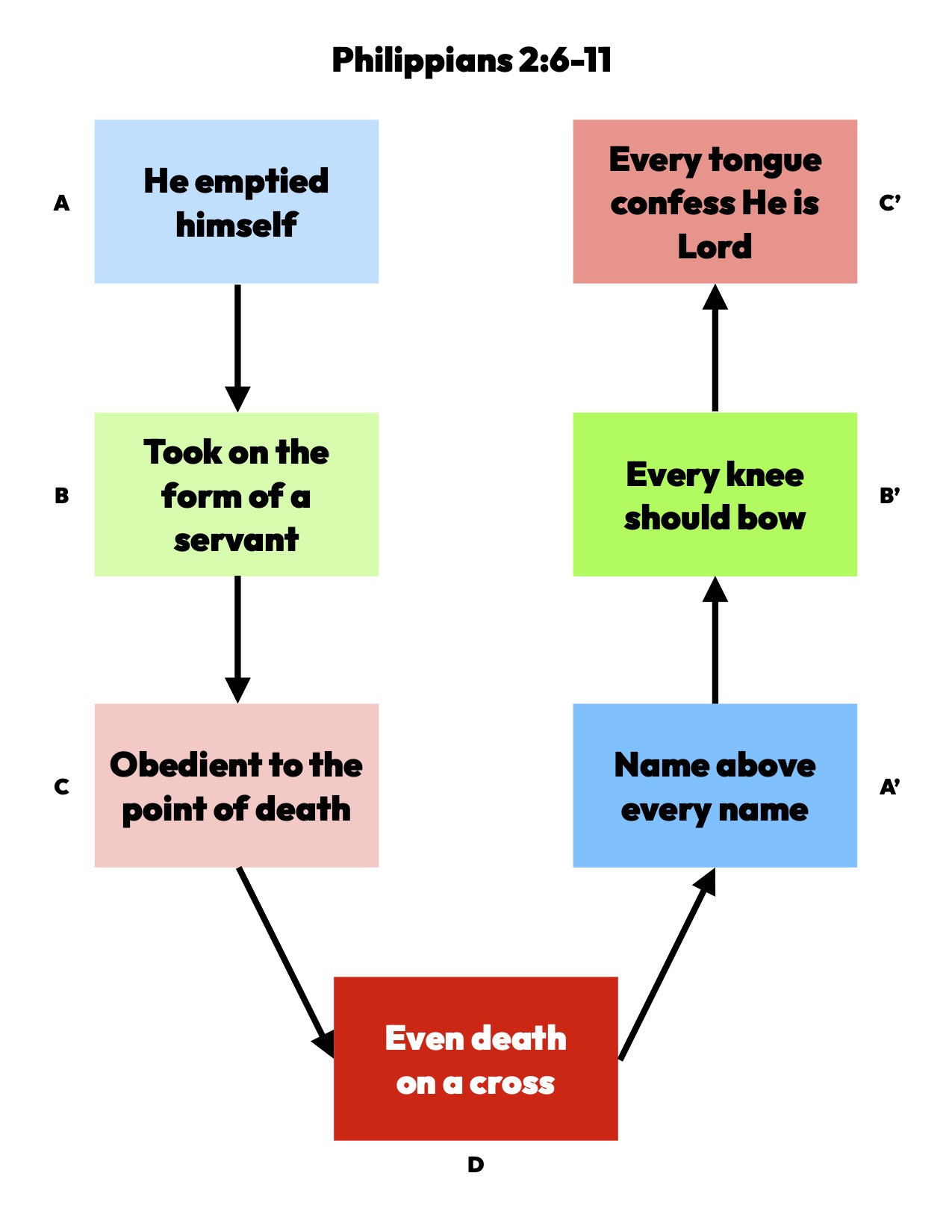
Download the “Philippians 2:6-11 Structure” graphic from this sermon.
Good morning everyone. My name is Jonathan. I’m one of the pastors here and what’s up? And honored and happy to be here today to bring the word to you all. We are in the middle of this series, but we started it last week.
It’s called Built different and we’re talking about how the life of the believer should be built on Christ and it should fundamentally look different than the world, than the culture around us. Then the patterns of this world, then the priorities of this world. We’re to be built different. And so we’re looking at Romans chapter 12, verses 1 through 2 over this six week period. Let’s read this Romans, chapter 12, 1, 2.
I appeal to you, therefore brothers, by the mercies of God, to present your bodies. That’s what we covered last week as a living sacrifice. That’s what we’re going to talk about this week. Holy and acceptable to God, which is your spiritual worship. Do not be conformed to this world, but be transformed by the renewal of your mind that by testing you may discern what is the will of God, what is good and acceptable and perfect.
I’d encourage you over these six weeks, maybe take some time. This is two verses. We got six weeks. Commit these verses to memory. This is a way to hide God’s word in your heart so that these God will start working on your insides as you commit this to memory.
This is two verses. Maybe as you go to your small group this week, maybe be ready to recite the first half of verse one. It’s just a challenge, it’s a thought. I just lay it out there as an invitation. Take these six weeks, commit these to memory.
So last week, as I said, we talked about what it looks like to present your bodies to the Lord. And we looked at Jesus call. He said, if any man come after me, let him deny himself, take up his cross daily and follow me. That’s how. That’s what it looks like to present our bodies to God as a living sacrifice.
Now we’re going to focus on that second part, the living sacrifice. Now let’s just stop for a second. Living sacrifice. These two words don’t go together, do they? By definition, a sacrifice is something that gets killed.
So a living sacrifice, well, did you not do it right? Like you got to do it again? You missed. I don’t know. What does living sacrifice even mean?
It’s an oxymoron. We don’t get to know what Paul looked like as he was writing these things down. But I kind of think he maybe had a little Chuckle as he was writing this. Present your bodies as a living sacrifice, holy and acceptable God. I don’t know.
Who knows? I think there’s a small little chuckle. But this is an oxymoron. It makes us think, what in the world? What does a living sacrifice look like?
That’s what we’re going to talk about today. There’s an old joke that you’ve probably heard if you’ve been around church. Turns out nobody knows who actually said this joke first. But it says the trouble with living sacrifices is that they keep climbing down off the altar. And that’s our problem, right, is if we’re going to present ourselves as a living sacrifice, well, it turns out something we got to keep doing.
We got to keep climbing up on that altar. So what does Paul mean by this? Back up for a second. I think there’s two questions that tend to animate and drive much of what we do in life. Two questions.
The first is, what does a successful life look like? And then the second question would be, well, how do I become a successful person? What does a successful life look like? And how do I become a successful person? These are two things that really, they drive much of what we do.
They drove what your parents did as they were raising you. I would say most people anyway have good, meaning, well intentioned parents that want their children to be successful. And they had an answer to this question, what does a successful life look like? They had an answer. And they also had an answer to that second question, what should we do in order to become a successful person?
And they had that answer for you. And that drove a lot of what you experienced as you grew up in the best cases. Also sometimes in the worst cases, those questions are animating you. Right now you have answers. Maybe it’s not right in front of you, you’re not thinking about it a lot, but you have answers to these questions, what does a successful life look like?
And how do I become a successful person? If we’re not careful, we become influenced more by the world and their definitions of success than by the scripture and by God. One of the ways that the world would answer these questions for us or lead us to answering these questions, what does a successful life look like? It’s really all about achievement and wealth and possessions and money and things like that. A successful life means I have a level of financial independence.
I’m not worried about where my next meal is going to come from, not worried about the roof over my head. I’ve got a degree of independence where I can take vacations I can comfort myself, I don’t have to deal with unnecessary risk. And so I’m comfortable and I have the ability to entertain myself whenever I want. That’s kind of a definition of success, right? And if that’s your definition of success, then the second question, well, how do I become a successful person?
Then becomes really all about, you know, your education. Do I get a good job, I gotta make enough money to buy enough things to give me comfort and also so that I can spend as much time as possible entertaining myself, you know, so it starts to lead from education all the way down there. So is that God’s definition of success?
I would say that there’s a lot of young people, I might be wrong about this, but I think a lot of young people have sort of looked at the world that, you know, just kind of think about the world as it came through World War II and through the reconstruction after World War II and then into the 80s and the yuppies and all that kind of stuff and into today and we’ve been dealing with the stock market crashes and the housing, you know, all this. Young people today are looking at that and going, yeah, that ain’t it, that ain’t it. That’s not the definition of success. I think a lot of young people would say that. The trouble is, what are we replacing it with?
And so another answer to that question, what does a successful life look like that the world would give us as well? A successful life looks like a completely self directed life. Like if you’re able to do whatever you want to do and be whoever you want to be, then that’s success.
A life that you are most authentically yourself, whatever that means. And if that’s what success looks like, well then how do you become a successful person? Well then you’ve got to have a life that’s focused on yourself, right?
This is one of those things. I think it’s a cruel weight that we put on young people today to tell them, you don’t know who you are, you can’t trust anybody else. You must go and discover who you really are. Good luck. You’re eight years old and you’ve got a job and that’s to discover your most core identity.
It’s like, why are we putting that on young people? Right? Like that answer to what is a successful life leads to a path that is very difficult. That’s a difficult path. That is not an easy yoke to put on young people.
Right? And so also it kind of starts to look like, well, you don’t know what is going on, so you gotta discover it. And the answer then becomes, well, really just kind of follow your feelings and your desires. And then that becomes if you can just follow your feelings and desires perfectly without anybody else standing in your way, well then that’s a successful life. And I dare say that’s not what the Bible’s definition of success is either.
What is a successful life? Well, we can look in this passage we’re gonna study today and Jesus kind of gives us that definition and it’s this other S word that kind of not fun. It’s sacrifice.
Jesus had ultimate success. He got a reward from the Father. And the way he got that reward was through sacrifice, through specifically others oriented, others centered, self sacrificial love.
That’s how he obtained success. And thankfully we get to follow in his footsteps. He both made the way for us to follow him. And then he gave us the example and asked us and invited us to follow him in that same path towards success. So let’s look at this.
We’re going to look at Philippians chapter 2, 5 through 11. And this is Paul writing to a church that he had helped establish in the city of Philippi. And he taught them that the path to success was to live self sacrificially like Christ. So we can receive the same reward. We can receive the reward that God promises us when we follow his example of self sacrifice.
Now how do we do this? Well, it’s an oxymoron. In order to climb the ladder of success, we must step down. That’s what Christ did. So we’re going to look at three downward steps that Christ made towards success.
That’s what we’re going to look at today. So let’s read Philippians 2, 5, 11. Have this mind among yourselves which is yours in Christ Jesus, who though he was in the form of God, did not count equality with God a thing to be grasped, but emptied himself by taking on the form of a servant. Being born in the likeness of men and being found in human form, he humbled himself by becoming obedient to the point of death, even death on a cross. Therefore God has highly exalted him and bestowed on him the name that is above every name.
So that at the name of Jesus every knee should bow in heaven and on earth and under the earth, and every tongue confess that Jesus Christ is Lord to the glory of God the Father. It’s God’s word. Amen. So let’s look for three downward steps Christ made. We’re going to follow his example of self sacrifice first is we can receive Christ’s identity.
So let’s step back a little bit. Paul’s writing this from a jail cell to a church he helped establish. If you kind of look at the context, there’s stuff that comes before this, there’s stuff that comes after this in the book of Philippians. And he’s writing to them saying, all right, guys, we gotta improve on some things. You’re not being unified.
You’re not serving each other like you should. You’re kind of at odds with the mission here. And here’s what I need you to do. I need you to start loving like Jesus. I need you to start self sacrificing.
I need you to start thinking about others more than you’re thinking of yourself, thinking about God’s mission more than you think about your mission. He’s kind of like, guys, let’s get back on track. And he gives us this passage here in the middle here. Notably, this is kind of key to our whole series theme. He wants them to be built different.
Just after this passage we just read. He says he wants them to be blameless and innocent children of God without blemish, in the midst of a crooked and twisted generation among whom you shine as lights in the world. That’s what it looks like to be built different right there. So how do we get there? Well, he doesn’t just say, okay, well, here’s a list of things I want you to to do that you’re not doing.
And here’s a list of things that I want you to stop that you’re doing. He doesn’t just give them, you know, a list of do’s and don’ts. It’s kind of amazing what he does. He says, let’s step back and let’s just contemplate Jesus. Let’s think about Jesus.
Let’s look at what he did, let’s look at who he is. Let’s look at the example and the pattern he showed us. And if we can do that, man, everything starts to get in order, right? And so that’s what he’s doing. He’s giving us this example of Jesus.
Now this verse five is sort of like our setup. Have this mind among you, which is yours in Christ Jesus. Well, what mind are you talking about? That’s like the first verse, and then the rest of it, verses 6 through 11, has been commonly known as what’s called the Christ Hymn. And there’s debate, we don’t really know.
There’s some thought that maybe these verses, verses 6 through 11 was something that had already been written that Paul was pulling on. Maybe it was a hymn, a song that they were singing lyrics to a song. That’s possible. We don’t really know for sure, but it’s possible. In my mind, if that’s the case, I’m thinking like, Paul.
Paul’s up here preaching to his church, and he’s like, guys, we just sang this song.
Did you hear the lyrics you just sang? Let’s think about what we just sang. Let’s live that out. Okay, guys? Maybe that’s what’s happening.
I don’t know. But this. This verses 6 through 11 is beautiful. It’s got some structure to it. The form of it actually is part of its substance.
And so we’re going to look at that a little bit today. There’s something unique about these verses that Paul gives us here.
He talks about Christ’s downward steps first, and then he talks about God’s response, the Father’s response. So his first step downward was to make a careful consideration of both his identity as God, but also his mission and purpose as the Messiah, and to make a decision. He did not count equality with God as a thing to be grasped, held onto tightly, but he emptied himself. Emptied himself of that. Now, okay, there’s some theological deep waters here.
There’s the Trinity, the Father, Son, and the Holy Spirit. It’s God in three persons. What does it mean that God emptied him? Jesus emptied himself of like. Of what?
What did he empty himself of? What was left. We say he was fully God and fully man. There’s deep waters here, you know, Deep waters and. But what we can see here is this.
I think key to this is that the word emptied here is not like there’s a pitcher full of water that he emptied out. Therefore, he used to have that water in him, and now he doesn’t. It’s more like he rendered it null and void. He rendered it powerless is what that word actually means. So it’s like it’s there.
I see it. But I’m going to choose not to exercise that right now. It’s kind of more the idea there. And so that’s his first downward step. So pop up this picture here, this diagram.
This is what’s called. This passage here is what’s called a chiasm or it’s kind of a structure that you see a lot in ancient Hebrew writings. You’ll see it in the New Testament as well. Again, it’s where the form is part of the structure. And so this is pretty commonly accepted.
That there’s a chiasm here. There’s a parallelism here that you can clearly see if you just kind of step back and squint your eyes and kind of look at it. And that’s. You’ve got three steps down. How far down?
That far down. And as a result, three steps up. So we saw what we just read. The first step is he emptied himself. He did not count equality with God, a thing to be grasped, but he emptied himself.
Then he took another step. We’re going to talk about each one of these steps. He took on the form of a servant. Another step down. He was obedient to the point of death.
Just how far down? Even death on a cross. That’s like the central part of this. Therefore, or for this reason. Then you see, three steps up, he was exalted and he was given the name above every name.
Another step up, that every knee should bow. Another step up, every tongue should confess that he is Lord. So you kind of see that parallelism there. What happens on the left side is what Jesus did. What happens on the right side is the Father’s response to that.
So Jesus emptied himself of his equality with God. What does that mean? I don’t know, but it’s amazing. He emptied himself. And as a result, what did he get as a result of that?
He got the name above every name. That’s what he got. So he emptied himself of his equality with God, and as a result, he got the name above every name. That’s what he got. That’s pretty beautiful, isn’t it?
Paul had to work on this for himself. Just in the next chapter, he talks about all the qualifications he had, all the reasons he would have in and of himself to boast and to be satisfied with himself. You know that he was a great Jew. He was awesome at it. He was from the tribe of Benjamin.
He was circumcised on the eighth day. I was the Jew of Jews, man. I had it going on. And so he had to empty himself of that. And say what?
Whatever gains were gains to me, I now consider loss for the sake of Christ. What is more, I consider everything a loss because of the surpassing worth of knowing Christ. Jesus, my Lord, for whose sake I’ve lost all things, he’s emptying himself. I consider them garbage that I may gain Christ and be found in him, not having a righteousness of my own that comes from the law, but that which is through faith in Christ. So you see, is it our responsibility to exalt ourselves?
No, our responsibility is to Empty ourselves. You let the Father do the exalting. That’s what Jesus did. He said, I’m going to empty myself. The Father exalted him, but.
Okay, is there any hope of this same kind of reward? Okay, Jesus empties himself, he gets the name above every name. What do we. Well, certainly we don’t get that name, right? We don’t get a name that’s above every name.
That’s not our reward? Well, no, not exactly, but check this out. Revelation 2:17. He who has an ear, let him hear what the Spirit says to the churches. To the one who conquers, I will give some of the hidden manna.
And I will give him a white stone with a new name written on the stone that no one knows except the one who receives it. That’s pretty cool. We don’t get the name above every name, but we get a special name. We get our real name. And this is not just a sequence of letters here.
This is like, this is who you are. This is God’s name for you, that only, you know, something between you and the Father. That’s pretty amazing right there. It’s yours and yours only. See, the core identity of a follower of Jesus is that you are a child of God.
I started working here at the church on staff in 2012. My family and I, we moved to Wilson in 2007. We were attending here. So we were attending here for five and a half years or so, and then came on staff. And the early part of my career, I started doing web development, web programming in, like, the late 90s.
Okay, so that was back when the big argument was like, what’s the better browser, Netscape Navigator or Internet Explorer? Anybody remember this? Anybody? Can I get a witness? Any Netscape Navigator fans in the house?
No, no Internet Explorer in the house. Okay, there it is right there. So anyway, I was doing that for a while, and so my whole start was in it. And there’s something really, at any stage of life, but I think what you start doing early on in your career sort of gets lodged in you is like, that’s who you are. And so I was IT guy Jonathan.
That was I was IT guy. I’m still that guy to some extent today. But, you know, it starts to kind of seep in there. Like, okay, that’s who you are. You’re the IT guy.
And then, you know, my particular story is then I come on staff, and I’ve been on staff here longer than I was working as IT guy Jonathan. But sometimes it’s still weird for me to hear Pastor Jonathan, I’m like, no, I’m still IT Guy Jonathan, you know, and it’s just weird because what you do gets lodged in, you know, it gets really, really deep in there. It’s part of who you are. And that’s one of the things, like getting laid off. That’s why it’s so.
It’s not just. It’s not the money, you know, it’s the. It’s the core of who you are that just got violated. And, you know, I’ve got a growth looks like saying neither one of those identities is actually who I am. I’m not IT Guy Jonathan or Pastor Jonathan.
That’s not at the core who I am. I’m a child of God. I’ve been called to join him on his mission on planet Earth, and this is just where I happen to be right now. And your story might not look exactly like mine, but that’s true for you, that you’re a child of God called to live. You know, called to join him in his plan on planet Earth, and he’s got a job for you right now.
And your identity has nothing to do with what you’re doing and who you are. Your identity is you’re a child of God. Another way our identities sometimes get formed, especially early on, is by your body. You know, that’s how we relate in that we’re embodied people. And so, you know, man looks on the outside, right?
And you might be surprised to know that growing up, I was always the smallest one in the class. I’m sure that’s a shocker to you all. You know, I was always the scrawny. I was young, too, for my grades. I was always the scrawny little guy.
You know, that’s always been. And so that kind of gets, you know, it gets lodged in you, how you are presenting yourself to the world, gets put in you as your identity as well, right? And a couple weeks ago, UPS guy comes, we have to replace some curtains. And so we got some rolls of curtains. There’s two rolls, one small one and one big one.
And he brings the first one and, you know, brings the doorbell and go out there, and he goes, ah, I gotta deliver for you. And he’s got the big roll right here. And he sits down, he goes, I got another one in the truck. It’s a lot bigger. I was like, okay, so I’ll go help you out with it.
And so we walk out, open the door, and it’s sitting right there on the curb. And he goes, I said, I’ll give you a hand with that. And he looks back at me, he goes, it’s got some weight to it. I was like, I’m good. I can help you out with that.
Getting bullied at church by the UPS guy. Not on my fingo card, right? Not what I was expecting that day. And I really don’t care, you know. But my point is, how we receive who we are can get deeply lodged from all kinds of different places, right?
And getting the name that Jesus has for you is way more important than any other name anybody else can give you or any name you feel like you’re going to try and accomplish. Right? That’s what we’re after. Who are you looking to for your identity?
Some of you all are here today. There’s a name Jesus wants to give you. But you have not emptied yourself of a name that you’re calling yourself yet. You’re calling yourself this name because of your sins and your failures. And that’s your name now.
You’ve sinned in this way. You failed in this way. That’s your name. I’m saying empty yourself of that name. That’s not who you are.
Jesus has a better name for you. Some of you here, you’ve got a name that you’ve been striving for. And it’s really based on your accomplishments and your ability to be successful in life to you know how other people view you. You’ve got a house and a car. Not because you need a house or a car, but because you have this house and this car.
Because you want people to look at you at a certain way and to have a certain name for you.
Jesus has a better name for you than that. It’s time to empty yourself of that name. And I’m not saying you have to sell the house and sell the car. Maybe you do. But I’m saying that’s not your identity.
That’s not who you are. Jesus has a better name. A lot of us, we’re carrying around names that other people have given to us based on a wound from our childhood or even a recent wound and wounds from someone who’s very close to you. Family member, spouse, former spouse, closest friend, sibling. You were wounded and that became your name.
You let somebody else name you by wounding you. And I’m saying today, Jesus has a better name for you than that. You can empty yourself of that name. And here’s the problem. Just like Jesus didn’t stop becoming God, like that wasn’t in reality he was God.
He just considered it powerless. The problem with These names that we’ve given ourselves or allowed other people to tell us what our names are. The problem is they’re based in reality a lot. You really did fail. You really did waste your life.
You really did receive that wound. I’m not here saying that those things didn’t happen. What I’m saying is you can empty yourself, just like Jesus emptied himself of his equality with God. You can render those things powerless, null and void because of what he’s done for you and the new name he wants to give you. So empty yourself.
Let him give you your identity. You’re a child of God. He emptied himself. He received a name above all names. You empty yourself, he’ll give you.
He’ll give you your identity. He’ll give you your new name. So that’s the first step down. We got two more steps. Jesus descended three times.
What is this second step down? Well, we can identify with this step. We can accept Christ’s position. Okay, so Jesus could have come. He could have decided to enter the world he created in all kinds of different ways.
He could have come as a king. He could have come as a military leader. He could have come as a socially influential, you know, high flyer. How did he come? Well, he took the form of a servant born in the likeness of men.
He was the suffering servant that was prophesied by Isaiah.
But what did Jesus get on the other side of that chiasm? The other side of that V? So if his part was to take on the form of a servant, what was the corresponding gift from the Father? Pop up the graphic again.
There you go. So he took on the form of a servant. Now what? Every knee should bow in heaven and on earth and under the earth. Okay, so he became a slave.
Therefore, now he’s been exalted, and everyone should bow to him. That’s what he got from the Father. That’s pretty cool. Now, there’s some interpretive work that you got to kind of decide where you stand on this particular passage. I personally humbly submit to you, I think that ESV translates this correctly there.
You’ll see other translations where instead of it saying that every knee should bow, it says every knee will bow. Okay, if you think about it for a second, there’s a difference there, isn’t there? If you hear every knee will bow, then what you start thinking about is like, okay, yeah, right, I got it. At the end of everything in the new creation, Jesus is, you know, done. The whole new creation thing, we’re at the end.
God’s wrapped this whole Thing up. At that point, every knee is going to bow down. That makes sense. Got it. That’s not.
I don’t think that’s the right translation here. Look it up. It’s in the subjunctive mood. English teachers. So it’s not a statement of this is going to happen in the future.
It’s a statement of this should happen right now. If you have a clear view of reality that Jesus, the Messiah, God himself, came to dwell among us. He entered his creation and took these steps down and now has been exalted and he’s on his throne. He has ascended and he has been given his throne. He is at the right hand of the Father.
He is King Jesus. If you have a view of reality that says that, then your response right now should be bow the knee right now humbly. I think that’s how this should be taken. It’s just Jesus got there. He got to that exalted place.
He just got there in a way that we wouldn’t expect and the world would not expect and not the way the world would do it. He understood what James wrote in James, chapter 4. God opposes the proud, but gives grace to the humble. Humble yourselves before the Lord and He will exalt you. So we see this pattern of the V there, that Jesus did his part and he let the Father exalt him.
He didn’t exalt himself.
If we walk down, if we take these same steps down and we become a servant to others, what reward do we get? Is there anything waiting for us on the other side of that V? Is there any reward? Is every knee going to bow to us? Well, not exactly.
In the end of the Book of Revelation, we see that we’re ruling and reigning alongside Jesus. So there’s something there. Let’s look at Philippians chapter three. 20. So this is the next chapter after this.
Our citizenship is in heaven, and from it we await a Savior, the Lord Jesus Christ, who will transform our lowly body to be like his glorious body by the power that enables him even to subject all things to himself. Okay, so now he’s on the other side of that V. He’s working to subject all things to himself. And what we get, his glorious body, we get a body like his. Okay, this is different. So, yeah, there’s a promise waiting for us in the new creation of a glorious body like his.
Have you ever thought about Jesus as a child, like, toddler aged? You know, sometimes, don’t you wish sometimes we had, like, camcorder footage of the events of the Bible? So you can see like, okay, exactly what did Paul have a smile on his face when he was writing that? You know, like that kind of stuff. And the thing is, we have the Bible.
We have. And the Bible we have tells us everything we need to know, right? And the things that it doesn’t tell us, apparently are things we don’t need to know. But it’s fun sometimes to think and to meditate and just kind of contemplate and go, man, what was Jesus like as a three year old, as a toddler or a six year old? I’ve got a wild, energetic six year old.
Was he like that? Was he bouncing off the walls? What was he like? One of my favorite artists of all time, his name is Rich Mullins. He wrote a song called Boy Like Me, man like youe.
And he was just asking questions like this, like, what was Jesus like? Here are some of his questions. Did you grow up hungry? Did you grow up fast? Did the little girls giggle when you walked past?
Do you wonder what it was that made them laugh? Did they tell you stories about the saints of old? Stories about their faith? Say stories like that make a boy grow bold Stories like that will make a man walk straight. Well, did you wrestle with a dog?
Did you play beneath the spray of a water hose? Did you ever make angels in the winter snow? Did you ever get scared playing hide and seek? Did you try not to cry when you scraped your knee? Did you ever skip a rock across a quiet creek?
These are just fun questions to sit with, right? We won’t know the answer to these things yet.
In the series the Chosen, there’s a particular scene where they’re trying to teach adult Jesus some game and he’s kind of bad at it. And that just makes me laugh. Like, was Jesus bad at that game? I don’t know. We don’t know.
But even contemplating these questions helps us to kind of really stand in awe of this Jesus, the Messiah, God himself, who would enter his creation. In what way? In the form of a servant in the likeness of men. He stooped down so far to be with us so that we could say, okay, what kind of God do I serve? I serve a God who wants to serve me.
And so my only response is, I’m going to turn around and go serve him and serve others. That’s the kind of God we serve. So who are you taking your cues from? Church? If we’re going to be built different, then we’ve got to look to our Savior, Jesus, who came in the form of a servant.
We don’t look to the world. We don’t look to the figures we see on the news and the influencers we see on social media. These are not the people that give us our cues about how we should be. We take our cues from Jesus who is a servant of all. So the world is going to want others to serve them.
They’re going to arrange things so that they’re sitting high and other people are serving them. But the church, us, we should be built different. We should be putting others needs before our own. The world is going to puff themselves up. They’re going to acquire wealth and possessions and power and influence and all of that so that others would start doing what they want to do.
But the church, we should accept being low. We should accept our reward coming from Jesus, even if it means we’re losing. When it comes to the world’s perspective that we’re okay with losing as long as we’re getting our reward from Jesus. The world is only going to sacrifice if they can get something in return. It becomes manipulation.
Jesus gave himself fully. He completely emptied himself. Took on the form of a servant, other centered self, sacrificial love. So if you want Christ’s glory, you’re going to have to go through his path of servanthood. That’s his second step down.
Alright, the third step. What’s the third step down that he took? His third downward step. We can share in Christ’s suffering.
Look at verse eight there. He humbled himself by becoming obedient to the point of death. Even death on a cross.
Wow. Christ’s third step downward was like stepping off a step and there’s nothing down there, like into the abyss. Anybody else have these dreams where like you’re just falling, falling, falling, falling, falling, falling, falling. Just me. Anybody else have this?
Okay, all right, thank you. That was like the last step he took down, down to the abyss, all the way down. And it says that he was obedient. Obedient to whom? To his Father.
How far was he? What kind of obedience did he have? Well, obedience to the point of death. Just how far? Even death on a cross.
That’s the kind of God we serve. The Messiah who would suffer, who would be obedient to death on a cross. Now he didn’t do this because it was like, you know, hoisted upon him. He didn’t do it out of obligation and it was not a surprise to him and no one made him do it. Look at John, chapter 10, verse 18.
No one can take my life from me. I sacrifice it voluntarily. So he stepped down on purpose. He didn’t get pushed. He’s not Humpty Dumpty.
His suffering had a purpose, though he did it voluntarily and he did it for a purpose. First Peter 3, 18 says, Christ also suffered once for sins, the righteous, for the unrighteous, to bring you to God. So he subjected his will to the Father in obedience. Now what did he get in return? Pop up the graph again.
So left side is Jesus actions. We’re tracing his three steps down, all the way down to death. On a cross. We saw that he got a name above every name. He saw that every knee should bow.
And then we see every tongue should confess that he is what he is, Lord. So he became obedient to the Father. He subjected his will to the Father, became obedient. Well, now he’s Lord. That’s the return.
He got pretty cool. What do we get out of this? Do we get to be Lord? Well, no, we get his life. Look at Philippians, chapter 3, 10, 11.
I want to know Christ, Yes. To know the power of his resurrection and participation in his sufferings, becoming like him in his death, and so somehow attaining to the resurrection from the dead. See how these two things go together. The life comes through the death. The resurrection comes through the suffering.
Look at Romans, chapter 8, 16, 18. The Spirit himself bears witness with our Spirit that we are children of God. There it is. And if children, then heirs. Heirs of God and joint heirs with Christ.
Whoo hoo. If indeed we suffer with Him. Ooh, Okay. That we may also be glorified together. Okay, I think this is what I want.
For I consider. There’s that word again. Jesus did not consider. He did not count equality with God. Paul’s done this work too.
I consider that the sufferings of this present time are not worthy to be compared with the glory which shall be revealed in us. So we put ourselves in Christ’s death, like we participate in his sufferings, like putting ourselves in the boat with Noah. And that participation with his death then brings about the opening of the boat, the resurrection. This is not some sort of like, okay, well, cool. I’m listed as an inherit an heir to this.
And I just got to sit around and wait, I guess, until something happens and later on I’ll get this. No, this is like, we get this now. Our citizenship’s in heaven. Now we’re on a new path pointed towards the new creation. We are heirs of that new creation.
That eternal life has already started. The question we really got to ask ourselves, if we’re honest with ourselves, is okay. If we’re on a new path and now our new inheritance is. Is the kingdom of God the new creation? Are we satisfied with that?
Is that enough? Or are we really kind of thinking, I mean, that’s cool and stuff, but I got some things I need to work on here, and I got some things I’d like to accomplish here, so we’ll get to that. Right now, I’m working on me. Or is that kingdom, that inheritance, is it worth everything now? How many steps are you willing to take down?
How many steps are you willing to descend? Jesus, he saw through the suffering. Hebrews 12:2. For the joy that was set before him, he endured the cross, despising the shame. He’s seated at the right hand of the throne of God.
So for him, suffering was not something to be avoided at all costs. It was. It was part of the path to life. And he saw what was on the other side of that. He saw the joy that was on the other side of that.
Dallas Willard was a Christian pastor turned philosopher. He was a philosophy professor at UC Berkeley for many, many years. And so he retained kind of both parts of his ministry of teaching Christian spiritual formation, things like that. But he was also just philosophy professor at UC Berkeley. And he’d be in these places where students, you know, he’d be in forums, students would ask him questions.
And he said, students will often ask me, could Jesus have sinned? Kind of the same, you know, realm of question we’re talking about today. Like, just what exactly did Jesus give up? How is his earthly nature related to his heavenly nature? These are deep questions, right?
So students would try and trip him up, say, could Jesus have sinned? And he’d answer, yes, he could have sinned, but he didn’t because he was too smart for that. That’s kind of like a what, he was too smart to sin? What does that mean? Well, what he’s getting at is that Jesus had a perfect view of reality.
He had a perfect view of the joy that was set before him. He knew exactly how good the kingdom of God is. He knew exactly how good and pleasing it is to be fully in God’s will. He had a very clear picture of it. And so why would you want to sin?
Why would you not want to partake in that? He was too smart for that. Now, if we’re honest with ourselves, when we think about obedience, we think about suffering, right? If God’s telling you, hey, I need you to do this, you know, you’re reading the Word in the morning, and that that spirit pricks, okay, I’ve been holding off on doing that. I need to do that.
Or on the other side, oh, I thought that was just what you do. And turns out Jesus is saying, I need to stop that. And so you hit this and you say, okay, God’s calling me to obedience in this area. And you can be honest with God. He already knows your heart.
So you can be honest with God and say something like, God, I am going to try and be obedient in this, but I don’t want to. I don’t actually want to. You can start there. When you’ve got kids, you’re bringing them up, you’re trying to teach them obedience. What are you trying to do?
You’re trying to get them not to do something that they actually really want to do. That’s what you’re trying to do. Or on reverse, you’re trying to get them not to do something that they really want to do. That’s how we start as believers, right? We’re.
I really actually kind of do want to sin. I do, but I don’t. God, help me, Help me not to do this thing I actually want to do. That’s a perfectly great place to start. And then let him transform you.
Let him, as you read his Word, as you see the goodness of the kingdom of God, let him begin to transform you into someone who begins to say, why would I want to sin? Why would I want to do that? That’s not very smart. That doesn’t align with the reward, the inheritance that he’s got from me. Why would I want to do that?
And you begin to change over time, but it’s totally fine. Look at Jesus in the Garden of Gethsemane the night before he was crucified, praying, I’m going to paraphrase here, Father, I don’t want to do this, but I’ll do it if you tell me to. Sweat and drops of blood. Okay? If Jesus can pray like that, so can we.
So can we. So if your obedience feels like suffering right now, give that to him and just say, God, I’m gonna follow you right now. I don’t want to, but I’m gonna do it anyway. Please turn me into the kind of person who does actually want to follow you. And he’ll honor that.
He’ll move that. He’ll move you forward into that. Aligning ourselves with God’s reality turns out to be the best thing for us. And the reality is he’s seated on the throne. He’s taken his steps down now.
He’s been Rewarded. He’s on the throne. Every knee should bow, every tongue should confess that He’s Lord. And this is his question to us today. Will you join in that reality?
Will you take his example? He’s made the way for you. We don’t have the ability to just kind of do this. This is not a matter of God saying, okay, you try and if you do it good enough, then I’ll check it off and you’re good to go. No, he’s made this way available for us and he empowers us on the way, but he does show us the way.
He does call us to follow him in this life of self, sacrificial, other, centered love. So following Jesus means we’re following his path, the One that He made for us, the One he’s leading us on towards self sacrifice. We don’t serve a God who is expecting us to climb a mountain in order to get to him, to climb a mountain of good works of some sort of moral purity of doctrinal knowledge. He’s not asking us to climb up to get to Him. He stooped down to be with us and then as a result, we get to stoop down to be with others and to show that same kind of love to ourselves and to others that are around us.
Let’s pray. Lord, thank you for your example. Thank you so much for emptying yourself. God, help us to empty ourselves and accept your identity.
God, thank you for humbling yourself, for taking on the form of a servant.
God, help us to humble ourselves and to be a servant of you and a servant of others.
God, thank you for your obedience. Thank you for learning obedience through your suffering all the way to death, even death on a cross. God, help us to be found in you, to be found in your death, so that we can receive your life and to see the goodness of the kingdom of God. Help us to be different than the world. Help us to look like you, not the world around us that we would be.
Lights shining in this generation for those here this morning and you’re still climbing that mountain yourself. You still think that you have what it takes to bring yourself to a place where you’re right with God this morning. Would you, Would you give up that, give up that path? Accept his sacrifice for you? Just say, Lord Jesus, I accept, I receive.
I see that you are seated on your throne because of the sacrifice that you made for me. You made it possible for me to be right with God and I receive that. I confess you are Lord. And now I will bend my knee. I will order my life in your power to be like you, conform to your image.
I make you, Lord. I put you in charge of my life for all of us. May we take time to see the example of Jesus, to meditate on it, to contemplate it.
Lord, help us. We need you. We need your example. We need your power. Let us be more like you.
Amen.
Good morning, church. Now, just in case you missed it or forgot from last week, all that, yours truly. That was me. That’s not true, but I’m working on it. Yeah, that video goes insanely hard.
And the reason is because we’re in a series called Built Different. And when we get this imagery in our heads, we think of people who have a certain commitment, level, drive, devotion to something, a passion for something that kind of goes above and beyond the average. And we think this is kind of abnormal. They’re built different. Different generations have said it different ways, but that’s what we want to be.
We want to be built different, but not in our own strength, not in our own abilities, whether literally or mentally or anything. We want to be built different in Christ. We want to be built by him, for him, through him. We want to be built different for the sake of Christ. We’re getting this from our series text, Romans 12:1 through.
And we’re going to take the next six weeks to highlight aspects of this. Romans 12:1 2 says this, I appeal to you, therefore, brothers, by the mercies of God, to present your bodies as living sacrifice, as a living sacrifice, holy and acceptable to God, which is your spiritual worship. Do not be conformed to this world, but be transformed by the renewal of your mind that by testing, you may discern what is the will of God, what is good and acceptable and perfect. So this is our series text, and we’re going to be highlighting other texts to kind of dig deeper into these ideas. Today we’re highlighting on being a living sacrifice, which on the surface level, you’re like, josh, that’s not possible.
Sacrifices are dead. That’s kind of their whole point. What does this mean? To be living is literally living. It is to do this.
You have breath, you’re alive. We understand that. But to be a sacrifice, this is a free gift likened to an offered sacrifice suitable to God, sacrifices to God that are pleasing to him. And so you’re like, well, how in the world does this work? It’s getting across to us this idea that we are to be willing to be slain for the cause of Christ, both inwardly and outwardly.
So this isn’t just oh, at the end of my life kind of thing, or being a martyr. No, this is a living sacrifice, a lifestyle being sacrificial for the cause of Christ. And so what are the dangers if we reject this call in what we’ll study today in Philippians, if we reject this call from Paul, what happens? Well, some of the dangers would be having totally messed up Relationships. It could be with a friend, a spouse, a child, any family member.
We have these messed up relationships because the first thing we think of when we think about how can I have a healthy relationship with so and so typically isn’t to be sacrificial. It isn’t to give more and no hope of receiving anything more than that. Our first inclination is not self sacrifice. And so in this you get a culture that says, well, hey, in marriage you give 50 and I’ll give 50, and that equals 100. We’re good.
It’s like, no, what you’ve probably found in your marriages is it’s 100 and 100. What we see in Christ, he gave 100% of Himself, and so we are to give 100 back to Him. And so we also do that in our other relationships with others. What’s another danger of not being a living sacrifice? We could develop a sinful view of success.
We could do things, pursue things, position ourselves in ways that bring ourselves glory. Let us, you know, hit our own chest. Pride, ego, arrogance. Are these things that you see, are these things you see in yourself that could be. Because we’re not accepting the call of being a living sacrifice.
Rather than giving glory to God, we’re interested in the glory of someone else. Another danger is that we could be avoiding pain or suffering when we know that’s what needs to happen in order for God to work the most. And so think of that relationship. Maybe there’s a relationship in your life that’s unhealthy. You know, it’s a, a cause of much pain, but you’re avoiding, confronting, talking with that person.
Because you know, if I do, if I seek reconciliation with this person, it’s going to be painful. It’s going to be suffer, suffer. And so we avoid it, we become apathetic, we callous our hearts over it. But no, Jesus calls us to be living sacrifices, to even suffer so that we can see God’s work the most, because that’s where he’s working. He works even in that.
So these are some of the dangers. Luckily, we have the perfect example of an other focused self sacrificial love in Jesus Christ. And so today we’re going to be looking at Him. If you want to follow Jesus, then this is your path too, to be a living sacrifice. Our home text today is Philippians 2, 5, 11.
So if you have a Bible, feel free to open there. You can read along in the bulletins or on the screenshot, be reading from the ESV version. So Philippians 2 verses 5 through 11. And it reads, have this mind among yourselves which is yours in Christ Jesus, who, though he was in the form of God, did not count equality with God a thing to be grasped, but emptied himself by taking the form of a servant. Being born in the likeness of men and being found in human form, he humbled himself by becoming obedient to the point of death, even death on a cross.
Therefore God has highly exalted him and bestowed on him the name that is above every name, so that at the name of Jesus, every knee should bow. And in heaven and on earth, and under the earth, and every tongue confess that Jesus Christ is Lord, to the glory of God the Father. This is God’s word. Amen. All right.
Following Christ’s example of self sacrifice, first we can receive Christ’s identity. First we receive Christ’s identity. Paul is writing to a church he helped establish in Philippi, the church in Philippi. And he’s calling on this church to serve one another in love, to be unified, and to get focused on the mission God has for his church, that God has for his people. And to do this, they’re going to have to be built differently in Christ.
He says this a few verses later, in 2:15. He says he wants them to be blameless and innocent children of God, without blemish and in the midst of a crooked and twisted generation among whom you shine as lights in the world. So you’re going to look a little different. You’re going to have to be built up a little different. And it’s not in your own strength, it’s in his.
It’s in Christ’s. And Paul doesn’t accomplish this by simply giving a list of do’s and don’ts and guidelines. We think, okay, if I’m going to be built different, I just need the regiment. Give me the regiment, Paul. We’ll do that.
No, he first wants to saturate them in the character of Christ. He first wants them to remember where their identity is. It’s in Christ. And so we must follow Jesus. He reached the very lowest point.
He stooped down. And so we follow him even there. We follow him in this humble act. Philippians 2, 6, 11 is often called the Christ Hymn. That’s in our home text today, the Christ Hymn.
It’s thought that this was an early song, an early hymn that the church sang. And so Paul’s kind of using this or a variation of it to say, hey, guys, you know that song we sing when we get together? Hey, Eastgate, you know those songs we Just sang about Jesus being the center of a life. Hey, church in Philippi. Hey, Eastgate church.
Let’s take that to heart. Let’s not just sing it. Let’s not just sing praises to God. Let’s live as living sacrifices. Let’s be obedient.
So this is his call. Christ first stepped down and had to make careful consideration of both of his status as God. He’s God in the flesh, but also his identity as the Messiah. The world he created, he would have to redeem it as well. So he didn’t count equality with God a thing to be grasped.
Let’s talk about this for a moment. This could be a whole rabbit trail in itself. But the form of God is, if you’re one of those Greek people, present active participle meaning it is who he is. He is in the form of God. But he didn’t count it as something to be grasped.
He didn’t count equality with God a thing to be grasped, Meaning he regarded it, he considered it, deemed it, he ruled it himself. Like, I’m going to put this to the side. And when it says he emptied himself, it means to consider it null and void. You’re like, josh, what about the Trinity? So, okay, we’ll take a side note on that for Trinity talk.
This does not mean he stopped being God. It means he willingly rendered that status as null and void for a time. I think about it like this. If I empty myself as to be obedient to God, if I empty myself, do I cease being a human? It’s like, no, I’m still a dude.
I’m still a human being. Well, similarly, Christ emptied himself. He doesn’t cease being God, but he emptied himself in order to receive something that he had to empty himself in order to be exalted, as we’ll see later. And same thing with us. We need to empty ourselves to receive a greater thing from God.
And in our text, we see a chiasm. If you don’t know what a chiasm is, essentially, if you’re ever reading the Old Testament, especially the Psalms, and you’re like, why did the author just say the same exact thing a few verses later? It seems a bit redundant, but it’s actually a literary technique. It’s a stylistic thing to make a point. And so what we see are these ascending and descending themes.
So verse one might have similar themes to verse seven, you know, like, oh, okay, and verse two, similar themes to verse six. And then verse three, similar to verse five. And then it all peaks at verse four. And you’re like, oh, that’s like the turning point of what’s happening in the text here. And so it’s actually a technique used very, very deliberately.
And we see this in our text today. We see these paralleling themes, and this time it’s of a dissension and then an ascension. Jesus descends, but then God exalts him. And so we’ll look at these themes throughout the sermon, throughout the message. So Christ ascended, descended, descended, and God exalted.
Exalted him. The first part of this is that he emptied himself. And so we have two things going on here. We have Jesus part and we have God’s part. Jesus part is he lays down his identity as God, and in return, what does he get?
It says, therefore God has highly exalted him and bestowed on him the name that is above every name. See Jesus part and we see God’s part. The first half of the passage is Jesus steps down, God lifts him up. Jesus emptied himself, and God gives him a name above every other name. And Paul later in Philippians, will do this also throughout the sermon.
We’re going to keep going back to Philippians because Paul uses this song, this hymn of Christ to tell us how we are to live. We look to Christ and we imitate him. And so Paul does this for himself in just the next chapter. This wrestling between a self identity, who do I say I am? And a Christ identity, who does he say I am?
And he says this, Philippians 3, 7, 9. But whatever were gains to me, I now consider loss for the sake of Christ. What is more, I consider everything a loss because of the surpassing worth of knowing Christ. Jesus, my Lord, for whose sake I have lost all things, I consider them garbage that I may gain Christ and be found in him, not having a righteousness of my own that comes from the law, but that which is through faith in Christ. So we saw Jesus part and God’s part.
We see Paul’s part and God’s part giving himself up for Christ’s sake. And now what’s our part? Is our part to exalt ourselves?
No, no, our part is not to exalt ourselves. What’s our responsibility? It is to empty ourselves like Jesus did. He’s the example. We just.
We follow him. Stop worrying about protecting your name, your identity, your rights, your equality. Empty yourself to receive him and the identity he has for you. You might say this. You might be like Josh, Jesus emptied himself and got a name above every other name.
Like, if I empty myself, do I get that? Because I’m Pretty sure only Jesus gets that. And you’re a good Bible student. You are correct. Good job.
You did not commit an awful heresy. Good job. No, we empty ourselves, but we get a reward as well. Did you know that there’s actually something to look forward to? Revelation 2:17 says this.
This is Jesus talking to the churches in the beginning there. He who has an ear, let him hear what the Spirit says to the churches. To the one who conquers, I will give some of the hidden manna. And I will give him a white stone with a new name written on the stone that no one knows except the one who receives it. And y’ all went into a rabbit trail a little with this verse.
There’s a lot of ways you could approach this. Here’s what you need to know. It is a work of God on your behalf. When he gives you this white stone with a name on it, he’s identifying you as his own. When he gives you this believer, he’s saying, you are mine.
It’s a name he knows. It’s a name you know when he gives it to you. We all received an identity when we were born that we didn’t choose. I am a Winslow. And I got into a little rabbit trail study of this.
And it’s like, win, slow. Whine slow. And I thought, ooh, like Wine Hill. Like, my ancestors lived near a vineyard. That’s cool.
Apparently not. Wine means friend. And then when you put those two things together, apparently means friend’s burial ground. And I was like, that’s depressing. Friends burial ground.
What do they go through, man? Not great. And then there’s this. There’s this crest, English crest or whatever. And.
And there’s a stump with little shoots growing off of it. And there’s a really, really poetic saying with it, like some Latin thing, and it sounds super cool. It’s truth, crushed to earth shall rise again. I’m like, that just sounds awesome. And then it’s actually translated like, though cut off, I flourish.
And I’m like, that’s less awesome, but still cool, I guess. But we all have a heritage. You have a last name. You could do a little deep dive on your last name and be like, where do I come from? Who are my people?
Who am I? Based on this? You have genetics. You’re looking at me, you’re like, yup, white dude. I’m like, that is what I am.
We all have a heritage. We have a last name. We have genetics. But is that the sum total of who we are? Many people settle on that.
They say, Wherever I come from, that’s who I am. Whatever I look like, that’s what I am. Whatever nation I’m born in, that’s what I’m about. And people set their identity on things. In the grand scheme of things, let’s face it, folks don’t really matter.
One day all this is going to go away. And what matters then? I’ll tell you what matters. Who do you identify with? Who’s given you that identity?
That’s what’s really going to matter. An eternal thing. Jesus has given us a new family name. I might be a Winslow, but the greater identity I have is Joshua. In Christ, do you have this new name, this new family name?
Are you a brother and sister in Christ? Are you your name in Christ? Got a new name, got a new identity. Place yourself entirely at his feet. Empty yourself, and he will fill you up.
He got good things for you. But you don’t get it unless you empty yourself, unless you receive what he received. This is the essence of what it means to be saved. You say to Jesus, I have nothing in myself. I can’t make myself right with God.
And we can’t. We are incapable of making ourselves correct with God in right relationship with him. And then we say of our old identity, I consider it all trash. I’m not bringing anything to the table. Jesus doesn’t want that.
No. He says, if I’m going to give you a complete new identity, you’re going to have to completely abandon that old one.
You say, jesus, make me right with God. Make me a child of God. Bring me into that family. You’re the only hope I have. This is to receive that new identity.
The second dissension is to accept Christ’s position. It says, taking the form of a servant born in the likeness of men. This term servant is dowlas, and it translates to slave.
They’re like, wait, Jesus? You’re telling me Jesus? God had a set position for the one who created all things, and nothing was made without him. He had a position for the one who is the radiance of God’s glory, who is the exact representation of his being and his position. God determined to be a slave, a servant.
What’s going on here? He positioned himself as a servant. He humbled himself to serve rather than to be served. Mark 10 tells us this explicitly. Jesus says, for even the Son of Man came not to be served, but to serve and to give his life as ransom for many.
Did Jesus grumble at the task? Did Jesus grumble at the position God had for him? No he actually gave it up willingly. He laid his life down willingly. He had compassion on others.
He spoke truth, offered repentance, and even prayed for the ones who were crucifying him. He served by taking on the sins of the world, literally, as a sacrifice for us. But to be a servant was not the final position God intended for Jesus. Why did he descend so low? Well, we see it here, we see it in the chiasm.
What do we see? That every knee should bow so that at the name of Jesus, every knee should bow in heaven and on earth and under the earth. Jesus descended to the lowest place as a servant. But then, what does it call him? Lord?
Lords are served. Did you know this was prophesied in Isaiah 45? God prophesied the exaltation of Christ way back then. And in this passage, another fun little trinitarian nugget for y’, all is that the capital L O R D, Lord? Yahweh is the name that every knee bows to.
Guess who we’re bowing to? Jesus. That’s pretty awesome. That’s pretty amazing. He descended to the lowest place, but now he’s been elevated to the highest.
There is no name greater and there is no one else who is worthy to be bowed to. It is him. Him alone. Everyone is now without excuse to bow the knee in worship to the Lord. And I think there’s a quick side note that actually might benefit us just a touch here, that Christians, we can be deceived sometimes to think that someone who has great position or status in our world, when they start professing Christ, we’re like, all right, now that so and so, that influencer, that celebrity, that president, that official, whomever is a Christian now, now Jesus is going to get the recognition he deserves, deserves.
And then that person inevitably goes crazy. They lose control. And maybe, maybe the older generation is a little wiser. You’ve seen this a lot. You’ve seen this time and time again.
You’re like, all right. But us younger folk, we get our hopes up a little in the wrong things, and we’re like, ooh, yeah. They’re saying Jesus. And then we’re let down. We’re like, ah, maybe next time.
Who. Who gave him a name above every other name? Who gave him the right for all creation to bow down before him? Who gave him authority of heaven and earth? Who’s the recipient?
Jesus. Who gave it to him? God. Hey, good news. Your position, your status is not dependent on so and so giving their approval to you.
The greatest person in the land, in all of Earth in your company in East Gate, I don’t know, could give you all the affirmation in the world. Hey, guess what? There’s approval of one that matters because he has the position above all things. And just as he elevated Christ, and Christ needs no one’s help to be set in the position that he’s in, he will lift us up in the same way. So don’t be deceived.
Christ doesn’t need the help of man. No, he got his reward. He’s been given a name above every name. And every knee should bow to him. Where, without excuse, have you bent the knee?
Maybe you’re looking forward to that second half, but you’re not so sure about the first. I want the exaltation. I’m not so sure about the descending part. Have you bent the knee? Because I’m telling you, the only way to receive that exaltation that God has for us.
We’ll talk about that in a moment, is to bend the knee to the Lord first. He is Lord, whether you bow today or not. And why would we do this? This is what I was hinting at the second half. Because believers have great confidence in what is to come.
We have great confidence if we honor the Son of God. Just as God positioned Jesus as a servant and then seated him in exaltation, God too has placed us in a position to be living sacrifices and has seated us positionally with Christ in the heavenly places. So we can accept the position that, though lowly, a living sacrifice of a servant, we can accept that position without bitterness, without grumbling, without complaints. Why? Because we have a greater thing to look forward to.
James 4, 6, 10 says, God opposes the proud, but gives grace to the humble. Submit yourselves therefore to God. Resist the devil and he will flee from you. Draw near to God, and he will draw near to you. Cleanse your hands, you sinners, and purify your hearts, you double minded.
Be wretched and mourn and weep. Let your laughter be turned to mourning and your joy to gloom. Humble yourselves before the Lord, and He will exalt you.
If you desire God’s grace. He tells us exactly the position we are to have before Him. And it’s one of humility. It’s one that’s not prideful. It gets serious about our sins.
God, this is who I am, being honest with God.
Those who have humbled themselves and have trusted in God. He promises this, I’ll exalt you. So let’s see how this is done. Philippians 3, 20, 21 but our citizenship is in heaven. And from it we await a savior, the Lord Jesus Christ, who will transform our lowly body to be like his glorious body by the power that enables him to subject all things to himself.
You know, I recalled this when I preached first, and I actually preached for Rocky Mount Eastgate, when we were in the old building. And I told the older folks in the room, I was like, you gotta stop telling the young people that. It’s all downhill physically from here. You’re scaring them. They got nothing good to look forward to.
And then, you know, I’m getting a little older. I’m still good. But then I did this, and immediately my knee popped for a service. And it was loud. It was like.
And I was like, well, there you go. I was like, all right, maybe the old people had a point. You know, we descend physically, but does that mean there’s, like, no joy? There’s nothing to look forward to? No, there’s a great thing to look forward to.
The text just told us you get new bodies. Amen. That’s a good news. We have a greater thing to look forward to. So losing this losing status position, or even knowing that this life doesn’t last, there’s a greater thing to look forward to.
God has a real present and a real future position for those in Christ right now. You’re considered, if you’re in Jesus, a citizen of heaven. We look forward to our new bodies fit for eternity. That’ll be nice. And remembering.
If we’ve died with Christ, then we will live with Christ. He takes what is lowly and he lifts it up. So do not despise being a living sacrifice. Do not despise humility and meekness.
There’s a reward, a goal, a promise that we get to look forward to our hope, and that’s Jesus. So if we know our destination and we see how Jesus is positioned both during his earthly ministry and now in heaven, we can have his example to follow for our time here on Earth. John 13:13 17 says this. You call me Teacher and Lord, and you are right. For so I am.
If I, then your Lord and Teacher, have washed your feet, you also ought to wash one another’s feet. For I have given you an example that you should do just as I have done to you. Truly, truly, I say to you, a servant is not greater than his master, nor is a messenger greater than the one who sent him. If you know these things, blessed are you if you do them.
Now, some of you have seen Lord of the Rings, and out of fear of disappointing the Lord, of the Rings fans in here. I was going to have something about Frodo. He took a position of humility, suffered, did. This whole thing ends. But I’m not going to spoil that movie for you.
If you haven’t seen it, it’s been out for decades. Shame on you. So we’re going with a biblical illustration instead. You got Joseph. Everyone knows the story of Joseph.
Joseph, he gets this vision from. And he tells it to his brothers. What does his brothers do? Sell him into slavery. And you’re like, oh, okay.
That’s quite the position to be in, to be a slave. And what does he do as a slave? Joseph serves faithfully. Then what happens? Potiphar’s crazy wife tries to assault him.
And what does he do? He flees. He doesn’t want that. And what’s his reward? Prison.
Well, that’s a worse position to be in. Now he’s a prisoner. And what is he doing? That he’s faithful. And then he interprets dreams.
Does he get recognized immediately? No. But he’s faithful. And eventually he does get the recognition. And Pharaoh lifts him up to the second chair in all the land of Egypt.
Don’t know if you know this, but a slave cannot exalt themselves. A servant cannot exalt themselves. A prisoner can’t say, hey, guys, I’m secondhand man. It’s not how it works.
When we position ourselves the way Christ wants us to be positioned as living sacrifices, when we position ourselves to be servants, because that’s what he’s called us to be, who are we waiting on to lift us up? It’s not ourselves, it’s God. It’s not man, effort. It’s God effort. And he is faithful and true and will do it.
So if we are low, we’re low. But if we are exalted, we’re exalted. But in both, in all circumstances, we give glory to God.
We give glory to Him. Position desired in the world is different than position given to us in Christ. I thought it would be beneficial to kind of put these things at odds. Position desired in the world is have others serve me and my desires. Position given to us in Christ.
Serve others by putting their interests above your own.
Has the example of Christ changed your attitude you have with others? What do I mean? Think about it like this. Kings don’t clean toilets, but servants do. Rabbis don’t wash feet, but Jesus did.
Has the example of Christ altered how you treat others?
Are they there to serve you and your needs? Or are you taking the stance of Christ? The position of Christ and serving them and their needs. That’s the example he gave us. That’s the example we follow.
Position desired in the world. I give my self worth. If I’m great, then it’s because I made myself great. If I’m nothing, it’s because I gave up. I give my self worth.
I give my self position. Position given to us in Christ. God must lift me up. That is a lifestyle of humility, patience and faith.
Our goal in the end is to be faithful wherever he’s positioned us. Like Joseph, his circumstances pretty rough. Pretty rough, bud. Do you agree? Slave, prisoner betrayed.
But he’s faithful.
He didn’t look to give him self worth. He was just waiting for God to fulfill the vision he gave him. When he was young, he waited on God. He was faithful to him.
Here’s the position desired by the world. I only sacrifice if I gain something. Here’s my position in Christ to be a living sacrifice. Because I’ve already gained everything. You’re like, why would I sacrifice anything if I have it all?
We’re following the example of Jesus, but the world doesn’t think that way. Gain is the pursuit of the world. And it sacrifices anything to get that gain. It takes advantage of people. It lies, it does dirty deals, it steals, it finds loopholes, it makes excuses and justifies wrongdoing.
And it ultimately serves to the gain of one whomever has that desire. Positioning ourselves to be the ones who give and not always the one who gain is to be a living sacrifice. That’s what Jesus did. He gave himself. He gave it all.
And who did he give it to? His enemies. While we were still enemies of God. He did this for us. And so being a living sacrifice isn’t a 50, 50 relationship.
It is a hundred, even if you’re zero.
That’s the example of Christ.
I only sacrifice if I gain something. No, I’ve gained it all. So I can sacrifice it all. I already got it in Christ. I already have it in heaven.
This. What’s this? No, the position given to me in Christ is to be a living sacrifice. And I can do this even if I lose everything, even if it causes me suffering, which is the third step downward. We see of Christ, share Christ’s suffering.
Share Christ’s suffering.
Christ’s third step downward was like a step into nothingness. You ever have one of those dreams where, like, you fall and you fall and you fall and you fall and it’s just like, when is this going to end? You get a little scared. You wake up in a jolt, like man, that was scary. Think about it like this.
Jesus descended first. He emptied himself. And you’re like, that’s already pretty radical. He’s God. Then he took the form of a servant.
So he didn’t just go low, he went low. And then he was so obedient to death. Even on a cross, you don’t get lower.
That’s where he went. How far did his obedience go? All the way. He went all the way to the point of death on a cross. And he did this willingly.
John 10:18 tells us, no one can take my life from me. I sacrifice it voluntarily. Hey, listen, Church. When we sacrifice of ourselves, is it for our gain or is it willingly?
Is it out of selfish ambition? Or is it willingly, Just truly willingly? That’s what Christ did. That’s what we ought to do. His suffering had a purpose, a sacrificial purpose, an atoning purpose.
First Peter 3:18 says this. For Christ also suffered once for sins, the righteous, for the unrighteous, to bring you to God. See what the obedience of Jesus yielded even in suffering. I wonder what would happen if we emulated that, if we imitated Christ. We want to be Christlike, but do we want to be like him in his sufferings?
I don’t think these two ideas can be separated. Actually, let’s be like him. Let’s see what God does when we’re faithful. And if he does nothing, hey, it’s for his glory anyway. If he does something, hey, it’s for his glory anyway.
Let’s do it. So he subjected his will to the Father in obedience. And in return, what did he get? Verse 11. Every tongue should confess that Jesus Christ is Lord.
So see that he became a servant and now he is called Lord.
What do we get out of this? You might be wondering, how do we relate with this? Well, again, we just go further into Philippians. Let’s see how Paul takes this imagery of Christ, this hymn of Christ, and says, hey, look at what happens with us. Philippians 3, 10, 11.
Paul says this for himself. I want to know Christ, yes, to know the power of his resurrection and participation in his sufferings, becoming like him in his death, and so somehow attaining to the resurrection from the dead. If we share in his life or if we share in his death, we’ll share in his life. Romans 8, 16, 18 says, the spirit Himself bears witness with our Spirit, that we are children of God. And if children, then heirs.
Heirs of God and joint heirs with Christ, if indeed we suffer with him, that we may also be glorified together for I consider that the sufferings of this present time are not worth to be compared with the glory which shall be revealed in us. So when we place ourselves in Christ’s death, we emerge on the other side in Christ’s life. I gotta go away and Christ has to increase. Kinda what John the Baptist said, right? He must increase and I must decrease.
This isn’t just a I’ve received my free ticket to heaven. Yippee.
No, we’re sharing in Christ’s eternal life right now. If you’re in Jesus, you got it by faith you’re saved, or by grace you’re saved. Through faith we’re justified because we’ve believed. So I think a better question to ask ourselves is being like Christ? Is truly being Christlike a reward to you?
It’s like I believe in him. But is being like Christ a reward in your eyes? What do we mean by this? Do you feel like obedience to God seems like suffering sometimes? See, if we’re going to be like Christ, then that means even sharing in his sufferings.
We want all the pleasant sounding things. We’ll talk about that in a moment. But even and his sufferings, be like him. Hey, Obedience to God, seeming like suffering, that’s not uncommon. In fact, Jesus did as well.
In the garden of Gethsemane, he sweated blood, but he was obedient to God. And you’re like man. Why would God call us to be like that? Why would he ask us to suffer like Christ, like Christ did it? He sweated blood.
Why would Jesus do that? Well, Hebrews 12:2 actually tells us who for the joy that was set before him, endured the cross, despising the shame, and is seated at the right hand of the throne of God. And so Jesus looked beyond the suffering, beyond the shame, to the joy that lied beyond. And in that the suffering was worth it. In that the obedience was worth it.
Beyond looking to the joy, obeying God, glorifying God. And hey, our salvation.
Is being Christlike a reward to you? For Paul it was. He was like, I’ll suffer with Christ, I’ll die with Christ if it means I get to be like him. Man, that’s supposed to be our mentality. Is it?
Do you find joy in obedience? Do you find life in the death of self? And I’m telling you, if you’re a young believer, this probably makes less sense. But if you’ve been a believer for a while, you. I hope you understand.
You likely do. You’re like man when I’m selfish, when I’m not living sacrificially when I’m all about me, me, me, I’m miserable. And I take that as the Lord’s discipline against us. Sometimes it’s like, alright, go ahead, experience life. What it would be like without me.
You get this Holy Spirit conviction. You’re like, man, that ain’t right, that ain’t it.
Jesus had the perfect view of reality, the perfect view of reality. And he perfectly understood the fundamental goodness of God’s kingdom. And so aligning ourselves with God’s reality is the best thing we can do. Like this. This is all going to pass away.
But when we have that heavenly kingdom minded focus, man. Suddenly that’s the best thing we can do. We can always be aiming at that. And this fundamentally shapes the Christian view of suffering. It’s no longer a thing to avoid, it’s actually a thing we can embrace and know that God is working it for his redemptive plan.
There’s a greater purpose here.
Teams understand sharing and suffering. Whatever sports team you’re into, whatever thing, gym, bros at the gym egging each other on. We all understand there’s a camaraderie, there’s something in shared suffering. But why would you do that to yourself? Why would you suffer if there’s no gain?
Because there is gain. To get that shiny trophy with your team name plastered on it, you have to suffer together. And so everyone shows up to practice and everyone suffers together. Except Bob. Bob didn’t show up to practice.
And everyone’s like, come on, man, what you doing, Bob? You’re on the bench. You don’t get to play. You didn’t suffer with us. You’re missing out, man.
Missing out, Bob. I don’t know if we have any Bob’s in the room, but if you are named Bob, watch out. I don’t know, you’re on the bench. No, there’s a camaraderie in the suffering. Hey, we have each other.
That’s good. We have Christ as our example. That’s even better. Join him in his suffering. Because we know there’s a goal, there’s a prize, there’s a joy beyond the suffering.
Paul says it’s not even worth comparing to the present suffering, the joy that lies beyond. Do you have this joy?
Our tendency is to be like Christ in all the ways that sound good, except in the suffering one such as this. I just want to be kind like Jesus. Good. Hey, good. That’s a worthy goal.
What did Jesus kindness get him?
Suffering.
I want to be loving like Jesus. Good. That’s a fruit of the Spirit, good.
What did Jesus love get him? Suffering.
I know that if you are trying to be truly like Christ, you will suffer. It might be this. I’m trying to put off the old self and put on the new self in Christ. I’m trying to ditch the sin. I’m trying to strive for righteousness.
And guess what? You going to suffer because it’s hard, because we want to do the bad thing we know we shouldn’t do. That’s where we’re inclined. But if Christ is our goal and he’s transformed us, our desires are for him. And so we wrestle with this thing called the flesh.
And if you pursue Christ likeness, you’ll suffer. Some of you family members, when you’re around them, things get real ungodly. And to stand up for Christ with family, you know it, I know it. You’ll suffer to stand on the convictions of Christ, to stand on the biblical standard. You know, man, I’m going to suffer.
Some of you have probably done wrong to another person and it is going to be to your humility to admit that wrong. Hey, sharing in the sufferings of Christ isn’t, I’ve done evil and you know, God will just work it out for the good. Paul tells us explicitly, hey, don’t do that. But if we’re striving for Christlikeness, it means being honest, being transparent, and going after that person saying, yep, yeah, I sinned against you and I’m sorry. Some of you actually need to confront someone to reconcile a relationship because that’s the goal.
It’s not just to throw things in people’s faces, it is to reconcile a relationship. And you know, if I start this conversation, I’m going to suffer. It’s going to be painful.
Christ descended, descended, descended, and went on a cross for those who were considered enemies of God.
Hey, whose example do we follow? Descend, descend, descend. And even in the suffering, we can look to the joy beyond. Hey, we’re looking for the approval of one well done, good and faithful servant. That’s what I want to hear.
Do you? If you want to hear those words, don’t get caught up in the suffering. Don’t let it become a roadblock. Standing up for Jesus at work, blocking off time to prioritize church and each other. Yeah, you might invite some suffering.
Descend, descend, descend. And look forward to this well done, good and faithful servant. Exalt, exalt, exalt. He’ll raise you up, he’ll lift you up.
I don’t think we can separate these things. If you want to be Like Christ, he’s not divided. He is one. Love, joy, peace, patience, all the fruit of the spirit. Hey, this is good.
But along with those things, the world does not like those things. Don’t know if you know that it will invite suffering. But we look to the joy beyond.
We willingly suffer on behalf of others. We present our suffering as an opportunity to be refined more into Christ, more like him. That’s what suffering becomes. It becomes a refining tool. And those of you who have been around long enough, you know, it becomes a joy.
It is the strangest thing that God could flip this thing on its head. And you understand, when I am pleasing God, no matter my circumstances, I found joy. I have joy. I recognize it in my life. Because being like Christ, that’s a joyful thing.
So following Jesus means we follow his example of self sacrifice. We don’t serve God, who expects us to climb mountains of righteousness or goodness before he loves us. No, he loved us first. He did the heavy lifting for us. Actually, he descended to the lowest point to exalt Christ to the highest point.
And now we just imitate him. So if he asks us, be living sacrifices. Hey, empty yourself. You’re coming to me and I’m going to give you a whole new identity. Put that in the past.
You take up the new self in Christ, okay? If he tells us, take a lesser position, be humble, be a servant, serve others, it’s like, okay, I don’t need to worry about making myself all that. I don’t need to worry about people returning me the favor. I’m just going to live like Christ. I’m going to serve whether people give it back to me or not.
I’m going to be a living sacrifice.
And if your obedience brings on suffering, hey, look, Christ suffered too, but he looked to the joy beyond. We have a hope. We have an eternal presence with the Father waiting for us. We have those sweet words that I can’t wait to hear. If we strive for it, well done, good and faithful servant man.
That’s a good day. That’s something to look forward to. And that’s why the words of men mean less, but the words of God mean everything. Church, will you empty yourselves and accept Christ’s identity? Humble yourself and accept Christ’s position as a servant and become obedient to even suffering, even if it costs us everything.
And accept Christ’s eternal life. Let’s pray.
Father, I want to thank you for your word. I want to thank you for your command to be living sacrifices, to give ourselves up and give it all up for you, for the nonbeliever in this room, perhaps they want to give themselves totally to God. They see the grace, they see the promises.
And, Lord, they need to come before you. If that’s you, you can feel free to pray along with me. Father, I am a sinner. I honestly say I bring nothing to the table. I’ve sinned against you.
I set standards I myself couldn’t even keep. I bring nothing. But you say, if I trust in Jesus, that you will make me a child of God. And so I confess with my mouth that Jesus is Lord. I believe in my heart that God raised him from the dead, that he suffered and died on that cross, and that it was sufficient to pay for my sins and that he rose again.
And, Father, I pray that if I die with him, then I’ll also live with him. I confess with my all he is Lord, and receive him as my Savior.
For believers in this room, our prayer is that we would live, live in accordance with this. We know we are seated in heaven. We know where our citizenship is. We know we have an identity in Christ. But, Lord, I pray for us, myself included, that we would seek less to serve our own selves and seek more to serve others.
That we would emulate the example of Christ. We would look for opportunities to do it.
That we would be Christlike even in the suffering. We would be lowly and humble and meek. And we could find that joy in being truly like our Savior. I pray these things in the name of Jesus. Amen.
We have a perfect example of others-focused self-sacrificial love in the person of Jesus. If your instinct is to climb your way to fulfillment in life, then check this out. Jesus didn’t climb his way to success, descended to success. If you want to follow Jesus, that’s your path too.
Paul taught the Philippian church that the path to exaltation was to live self-sacrificially like Christ. We can receive the reward God promises us when we follow Christ’s example of self-sacrifice.
 Kingdom Come: How Jesus Revealed It In Parables
The Unstoppable Kingdom
WilsonGary CombsRocky MountJonathan Combs
Aug 30, 2026 · Matthew 13:31-35
Kingdom Come: How Jesus Revealed It In Parables
The Patient Kingdom
WilsonGary CombsRocky MountJonathan Combs
Aug 23, 2026 · Matthew 13:24-30; 36-43
Kingdom Come: How Jesus Revealed It In Parables
The Receptive Kingdom
WilsonGary CombsRocky MountJonathan Combs
Aug 16, 2026 · Matthew 13:1-23
Kingdom Come: How Jesus Revealed It In Parables
The Unstoppable Kingdom
WilsonGary CombsRocky MountJonathan Combs
Aug 30, 2026 · Matthew 13:31-35
Kingdom Come: How Jesus Revealed It In Parables
The Patient Kingdom
WilsonGary CombsRocky MountJonathan Combs
Aug 23, 2026 · Matthew 13:24-30; 36-43
Kingdom Come: How Jesus Revealed It In Parables
The Receptive Kingdom
WilsonGary CombsRocky MountJonathan Combs
Aug 16, 2026 · Matthew 13:1-23