
Our Mission in Christ
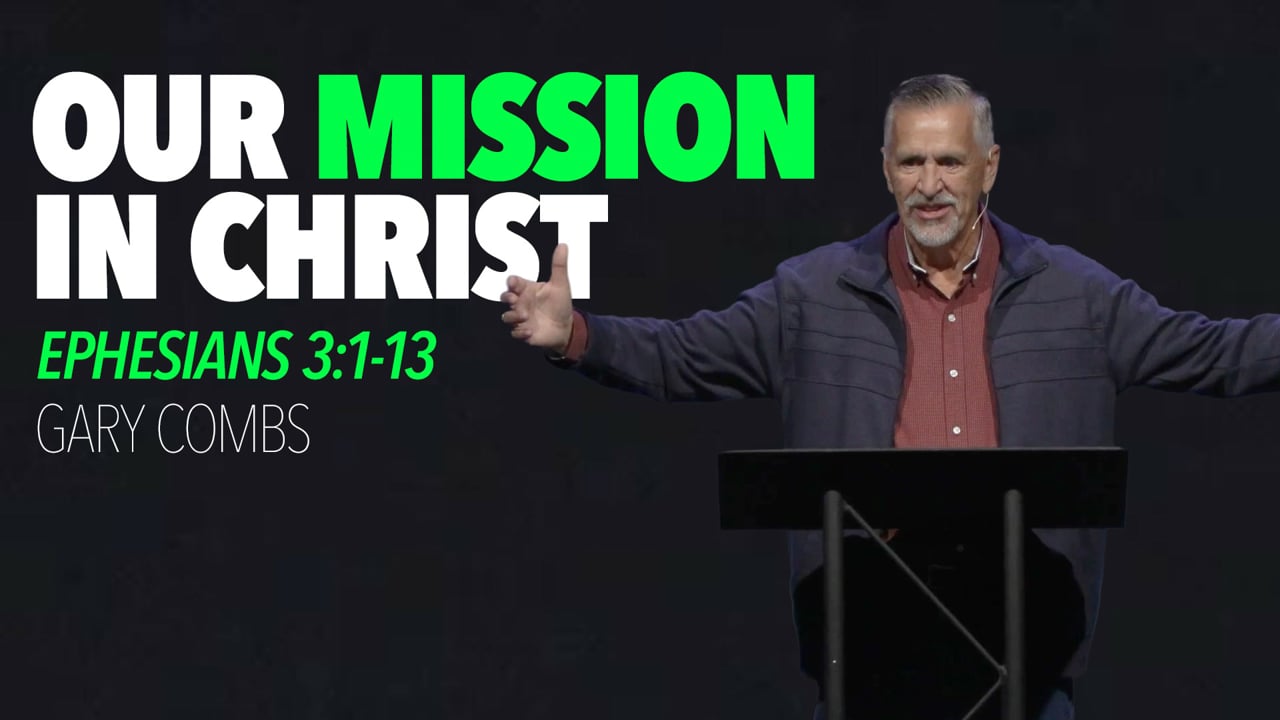
Read transcript
Good morning, church. Good morning. It’s good to see all of you here this morning. We’re continuing our series through the book of Ephesians, and we’ve entitled this series Life in Christ. And we get that title from the repetition of the phrase in Christ.
It appears over 36 times in this little letter to the church at Ephesus, these 6 chapters. It’s really the theme of what Paul’s telling us, that our life as believers is found in Christ. It’s in Christ. It’s not that we’re just followers of Christ. It’s not just that we’re for Christ, but that He lives in us by His Spirit.
It’s life in Christ. And as we begin chapter 3 today, we’ve finished the first 2 chapters, Paul turns his attention to his own calling and ministry. He spent a couple of chapters talking about the blessings we have in Christ. He talks about his prayer for us in Christ. The salvation that we have in Christ.
But he gets to chapter 3 and he takes a moment to talk about himself. In fact, in this book, this is the most he ever talks about himself. He talks a whole lot about himself in the next few verses. He talks about himself, his calling, his ministry, and even his suffering. He talks about how he’s suffering, he’s struggling.
And why does he talk so much about himself in this passage? And I think it’s because he wants to encourage the believers in Ephesus not to lose heart. Now, why would they lose heart? It’s because their spiritual father, the one who planted the church at Ephesus, the one who had discipled them and preached to them for 3 years, is imprisoned in Rome.
Now look, I know y’all love me. Some of you’ve been on this journey with me for years and years. But if next week you see on the headlines that Pastor Gary is in— there’s a picture of him in handcuffs and he got locked up, it’s on WRAL News that Pastor Wilson locked up, some of you won’t be back next Sunday. You’d be like, I knew that. I saw that mischievous look on his face.
I saw that coming. Some of you would be so convinced, you know, that you love me that you’d show up anyway. But many of you would despair and say, you know, that’s the reason I don’t, I should have never come back to church. Church is full of hypocrites. And there’ve been various responses to me getting locked up.
Well, pray for me that I don’t get locked up next week.
But Paul’s locked up. He’s imprisoned, he’s in chains. And he knows that they’ve heard about this. And can you imagine, this is not the church of today, this is the church just starting out, and they’re under this Roman dictatorship, under Caesar Nero, and it had to be terrifying for them. Like, does this mean the gospel’s coming to nothing?
Does this mean our spiritual father, where’d he go? I’m sure they felt discouraged, and so I think he takes a little timeout here to address that. And I wonder if you’ve ever become discouraged, if you’ve ever lost heart. And even more specifically, have you ever lost heart in God’s calling on your life? See, that’s a particular kind of discouragement for a believer who’s come to Christ and you’ve been obedient and you’ve stretched out of your comfort zone, you’ve said yes to do something for God, and then you’re surprised That you are suffering not because you’ve sinned, but because you’ve obeyed.
That’s a surprise for many believers, and they’ll lose heart at a moment like that. Maybe you’ve been praying for someone in your family, a friend, a neighbor, a coworker to come to Christ, and you’ve been praying for them for some time, and you see no evidence of life change. You see no evidence of receptivity. Have you lost heart praying for them? Have you lost heart?
We have this receptacle in front of me right here that we’ve had up for a year and a half now, and it’s where we’re writing the names of people that are far from God that we’re praying for them to come to Christ. And as an expression of our prayer, a physical expression, we write it down and we drop it in here and we pray not just for their name but for all the names that are represented here. When’s the last time you prayed for the name you dropped in here? Have you lost heart? God called you to pray for somebody far from God.
Have you lost heart? Perhaps you’ve said yes to a ministry area. You said yes to be on guest services, or you said yes to teach in children’s ministry, and you’ve, you’ve lost the joy, and you’re starting to think about stepping away from it. Doesn’t feel quite like you thought it would.
You’ve lost heart in it, or I don’t know, maybe you said yes to being a parent, a mama or a daddy, and boy, those middle-of-the-night feedings and diaper changes, and boy, those teenagers when they— you think it’s got to get easier. No, it gets harder, and you’re like, man, Do you lose heart, Mom? You ever lose heart? God called you to do that, to be a good mom, to be a good dad, but you lose heart. And so we lose heart sometimes not because we’ve sinned, far from it, because we’re actually obedient and it doesn’t look like what we thought it would and we lose heart.
Well, the Apostle Paul is saying here, be careful. That you don’t lose heart because of me, he says. Don’t lose heart because you see me struggling. And he’s going to explain why and how they can avoid, they can keep from losing heart. So how do we listen to this?
How do we obey what God’s Word wants to teach us today? As the Apostle Paul writes to the church at Ephesus, he reminds them that because of the great calling of the gospel that he has upon him and they have upon themselves as God’s church, that they can keep from losing heart by being reminded of that. As we look at the text today, I think we’ll see 3 reminders, 3 ways that we can keep from losing heart because of the calling that God has on us. So let’s look, chapter 3, starting in verse 1. For this reason, I, Paul, a prisoner for Christ Jesus on behalf of you Gentiles, assuming that you have heard of the stewardship of God’s grace that was given to me for you, how the mystery was made known to me by revelation, as I have written briefly.
When you read this, you can perceive my insight into the mystery of Christ, which was not made known to the sons of men in other generations as it has now been revealed to His holy apostles and prophets by the Spirit. This mystery is that the Gentiles are fellow heirs, members of the same body and partakers of the promise in Christ Jesus through the gospel. Of this gospel I was made a minister according to the gift of God’s grace, which was given me by the working of His power. To me, though I am the very least of all the saints, this grace was given to preach to the Gentiles the unsearchable riches of Christ and to bring to light for everyone what is the plan of the mystery hidden for ages in God, who created all things, so that through the church the manifold wisdom of God might now be made known to the rulers and authorities in the heavenly places. This was according to the eternal purpose that He has realized in Christ Jesus our Lord, in whom we have boldness and access with confidence through our faith in Him.
So I ask you not to lose heart over what I am suffering for you, which is Your glory. This is God’s Word. Amen. We’re looking for 3 ways that we can remember our mission in Christ so that it keeps us from losing heart. The first way is by focusing our hearts on God’s revealed mystery, on focusing our hearts on God’s revealed mystery, which is the gospel.
Now, before we dig into explaining this first way, I wanted to begin where Paul begins, uh, and he really writes these 13 verses kind of like he’s got bookends. Verse 1 and verse 13 are like bookends, and then in the middle he’s got a by the way kind of— verses 2 through 12 are kind of like he’s texting us and he’s, he’s going, hey, I need to tell you this for this reason. It’s like he’s getting ready to pray for us, which he finally does in verse 14, and we’ll get to that next week, that he finally goes, for this reason I’m praying for you. But it’s like he’s He starts to pray for us and then he goes, oh, BTW, by the way, the reason I’m in lockup is because of you, because I’ve been preaching to the Gentiles. But notice how he begins.
He goes, for this reason, I, Paul, and there’s more I statements in this passage than anyplace else in Ephesians. Paul really self— talking about himself. I’m a prisoner of Nero in Rome, right? That’s what he says, right? He goes, I’m a prisoner of Rome.
Is that what it says, verse 1? No, that’s not what it says. Y’all out there, y’all looking at Scripture? Y’all with me? Y’all in the house?
Who does he say he’s a prisoner of? Christ Jesus. What in the world? He’s telling the people in Ephesus, don’t be discouraged because it was Jesus that put me here. You see, he doesn’t recognize Rome as the authority over Paul.
He’s under King Jesus. If he’s in Rome, that’s where Jesus wanted him. That’s where he wanted him. And so he’s not losing heart. In fact, we have to be happy that the Lord put him there because he wrote the book of Ephesians, so we have it today.
He also wrote Colossians. He also wrote Philippians. He also wrote Philemon. From that imprisonment. See, Paul was so busy he probably wouldn’t have had time to write all those letters.
God said, you know what, I’m going to give you a little sabbatical, give you a chance to do some important writing for the New Testament. You know, sometimes God has to give us a break so we’ll actually do what he called us to do, because sometimes we get off track. But Paul’s not off track. Paul says, the reason I’m here, the reason I’m a— so he starts out good. For this reason, I’m going to pray.
Wait a minute, I, Paul, I’m in lockup under King Jesus for you Gentiles. It’s for Him, it’s under Him, but it’s for you. The Greek word for Gentiles here is ethnos. That’s where we get the word ethnic. For you Gentiles, you non-Jews got me locked up.
But don’t be discouraged about that. And I’m going to tell you why. And now he does his by the way. And, and he gets down to verse 13, which verse 13 is really the verse that explains the whole first part of the chapter, where he says, um, so I ask you not to lose heart over what I am suffering for you. Don’t lose heart because I’m in prison for you.
Don’t, don’t lose heart for that, because it’s for your glory. It’s for your glory. It’s, it’s, it’s, it’s so that the glory of the gospel would go out. It’s so the glory of the gospel would go to the It’s why I’m here. So he knows why he’s there, so he’s not losing heart.
He doesn’t want them to lose heart either because he’s there because Christ put him there for the sake of the gospel. Now, now we can deal with the BTW section, verses 2 through 12, ’cause now Paul is taking this, what sometimes we call in a community group, if we’re leading a community group, all of a sudden somebody unleashes a rabbit in the room. So it seems like Paul’s going on a rabbit trail, but he’s not. He’s not. He’s going, timeout, BTW, here’s why you shouldn’t lose heart.
Even though I’m in prison, don’t let that— I’m your spiritual father. I know you love me. I know I gave you the gospel. I know you’re despairing, but don’t, because this is offered. Hey, look what God’s doing.
Okay, so now we’re in verse 2, and he starts reminding. He goes, assuming that you, verse 2, Have heard. See, this is Paul using kind of rhetorical language here. He’s like, I know you’ve heard, I spent 3 years with you. Assuming you remember is another way of saying it.
Assuming you remember, uh, about my stewardship of God’s grace that was given to me for you. God gave Paul— remember, he gave Peter— Peter was to go to the Jews. Paul and Peter had a, had a different stewardship. Peter was Carry the gospel to the Jews primarily. Paul carried it primarily to the Gentiles, and he knew what his calling was.
Jesus told him that that was his calling, and he had clarity about it. He goes, so I’ve got a divine stewardship. I’m the manager of the Gentile mission.
Interesting Greek word there for stewardship. It’s where we get the English word economy. Oikonomos, house rules, literally. It’s the economy of the gospel to the Gentiles. I’ve been given stewardship of that.
And so he says, so don’t lose heart because that’s what I’ve been doing, that’s what got me here. And he gets more detailed, how the mystery was made known to me by revelation. That’s one of Paul’s favorite words in the book of Ephesians is mystery. And when he says mystery, he’s not talking about an Agatha Christie book or movie where it’s a whodunit movie where you got to go, well, I got to figure out whodunit, like you through your deductive reasoning can somehow figure it out. It’s what we think of when we hear mystery, but that’s not what Paul means when he’s using mystery here, the Greek word mysterion, which could maybe be more precisely interpreted as a secret.
That the only way you could find out the truth of is if God reveals it to you. So it’s not like a mystery you could figure out on your own, although there are hints back here where God says to Abraham, through your seed, all nations will be blessed. That’s a pretty good hint that the gospel’s not going to be just for Israel, it’s going to be for all nations, all ethnos. So there’s a lot of hints back here, but the only way to really know the particulars is for Jesus to tell Paul, which is the very thing that happened. He blinded him on the road to Damascus and revealed Himself.
And there are many other times that he heard through the Spirit and he heard from Jesus and he has a revelation. How the mystery was made known to me by revelation, as I have written briefly. He’s written about this in other places. Okay, we’re moving on. When you read this, you can perceive my insight into the mystery of Christ.
I want you to really get this, he says. You can understand my insight into this. Verse 5, which was not made known to the sons of men in other generations. In other words, the Old Testament prophets, they didn’t have clarity on this. This is just now, this secret just now through Christ has been revealed, that this thing called the church which would be made up of both Jew and Gentile in Christ, one body.
The church was that secret that God had hidden but is now revealed. Y’all still in the house? Okay. Which was made known to me but not made known to the sons of men in other generations, as it has now been revealed to the holy apostles and prophets by the Spirit. And what is this mystery with more detail though, Paul?
Well, good, ’cause he’s gonna tell us, verse 6. Good question. This mystery is, what is this mystery? This mystery is, and he gives 3 particulars of this mystery to the Gentiles, that the Gentiles are number one, fellow heirs, fellow heirs with all of those in Israel who have believed. They’re equal heirs with Christ.
Number 2, that they are members of the same body. That there now is the, the wall of hostility’s been removed between the races, and there’s one people, and they’re called Christians. They’re Christ followers. They’re, they’re the body of Christ. Then here’s the third particular, that they are partakers of the promise in Christ Jesus through the gospel, that the gospel was for everyone.
And that so now they’re partakers. They, they are recipients of the promise. So they’re co-heirs. They’re one body and they’ve received this promise through Jesus. This is Paul saying, don’t get discouraged, don’t lose heart.
To lose heart, the King James, I think the translation says, don’t become faint, don’t get weak, don’t lose spirit, don’t lose hope, don’t lose heart because this divine mystery has been revealed to this generation. And the generations before that were looking forward in hope and looking for this. Now we have seen Him. It is Christ the Lord. And we’ve been given this gospel, this good news about Jesus.
And so don’t lose heart. Don’t lose heart. He reminds us in the book of Romans, he says, I’m not ashamed of the gospel, for it’s the power of God for salvation to everyone who believes, to the Jew first And also to the Greek. It’s just another way of referring to the Gentiles. He uses a different word than ethnos here.
He uses the word helos, which is the idea of Hellenic, the idea of the Greek culture. But it’s the same thing. He’s using them interchangeably. He’s talking about those non-Jews that the gospel is for all. Then in Colossians, he writes this, the mystery, there’s that word again, hidden for ages, right?
And generations, but now revealed to His saints. That’s us. God wanted to make known among the Gentiles the glorious wealth of this mystery, which is Christ in you, life in Christ, Christ in you, you in Christ, the hope of glory.
Now, Paul ended up imprisoned in Rome and it looks bad, but actually it’s for the gospel’s good. Remember how he got there? You have to read the last 8 chapters of the book of Acts to see how Paul got there. You ready to hear the last chapters? Last 8 chapters of Acts, here it goes.
Here’s the highlights of the last 8 chapters. Paul wants to go back to Jerusalem ’cause the Holy Spirit has called him back to Jerusalem, so he’s headed there. He’s got his face pointed towards Jerusalem, and the Holy Spirit’s already revealed to him it’s not going to go well for him personally there. It’s going to lead to suffering, but yet he knows he’s called, so he heads back. He drops off at a little town, a little seacoast town called Miletus on the way there, and he calls for the Ephesian elders to come down and visit with him because he doesn’t have time to drop off in Ephesus ’cause he knows he’ll get stuck there for a while ’cause he loves them so good.
So they come down to the sea port to meet with him. And soon as they get there, they’re going, Paul, please don’t go to Jerusalem. They’re going to imprison you. They’re going to kill you if you go there. He goes, you’re breaking my heart.
You’re breaking my heart. I’ve got to go. The Holy Spirit just told me to go. So he gets back on the boat and he pulls up in the port of Caesarea, Caesarea. And he pulls up in there and he drops off at the house of Philip the Evangelist.
Philip was one of the 7 deacons, but now he’s moved on from his deaconship to now he’s an evangelist. And he moves up, he stays some time at Philip’s house. And a fellow named Agabus who was, who was, had a prophetic word for Paul shows up there. And Agabus says, hey Paul, hey, can I borrow your belt? And Paul goes, okay.
He takes his belt off and Agabus uses that belt to hogtie himself and says, this is what’s going to happen to you, Paul, if you pull up there in Jerusalem. And Paul says, you’re killing me here. The Holy Spirit’s told me to go. And you’re breaking my heart. And he said, but I gotta go.
So he goes anyway. He goes in with his eyes wide open, and he goes to Jerusalem, and he gets to Jerusalem, he meets with James, who’s the, who’s the leader of the church of Jerusalem. It’s, it’s Christ’s half-brother James. He meets with him and the elders, and they go, Paul, you’ve been causing us a load of trouble up in here. We love you, but, uh, could you do this?
I think it would make the Jews happy. And they would maybe get off our backs. This is Gary’s paraphrase a little bit, but y’all read it on your own. If you would take these 4 fellas who want to do a vow of purification, they’re going to shave their heads. If you’ll join them and take them up and pay their way, and the Jews will see you, that you’re still following the Mosaic Law, maybe they’ll get off our backs too, and they’ll get off your back, ’cause they think that you’re destroying Judaism.
And Paul submits to this, and he goes up, and he goes up with the 4 men, and they go to the temple, and all seems to be well until the time he goes back to return at the end of the 7 days of purification. When he goes back to return, a group of Jews who came down from Asia Minor, where Paul’s been doing all this ministry, that’s where Ephesus is, by the way, that’s where Galatia is, Colossae, that’s all up in Asia Minor. They come down and go, wait a minute, we know that guy. He’s been preaching to the Gentiles, And they accuse him falsely of taking Gentiles into the inner court where Gentiles aren’t allowed to go in the temple. And a riot breaks out.
And look at this photo here, this photo. This is Paul on the steps of the temple in chains ’cause because a riot breaks out, the Roman soldiers arrest him. And he turns to the Roman centurion and he says, in Greek, he says to him, and he goes, oh, you speak my language? This is where I was born. Uh, in, you know, in a city, seaport city.
And, and so I know Greek. And he said, hey, can— would you give me a minute to speak to the Jews? I think I can calm them down. And he goes, okay. So he preaches about the— about his being blinded on the road to Damascus, how Jesus called him, and how all of this was the fulfillment of the Messiah coming.
And he preaches, he talks to the Roman guy, Roman centurion, in Greek. And he turns to them, he preaches in Hebrew, and they all get quiet. The riot stops and they listen to him right up until he gets to the last part. And when he gets to the last part, he goes, and then Jesus told me, go, I will send you far away to the Gentiles. And when he said that, they grabbed dirt off the ground, they threw it in the air, and they said, away with this fellow from the earth.
He does not deserve to live. And so why did they get ticked? They heard the whole message until he mentioned carrying the gospel to the Gentiles, and they hated the Gentiles. They hated the Romans. That’s why Paul is locked up, and he says, don’t let that discourage you.
I’m here with my eyes wide open. For you, to carry the gospel to you, and it’s for your glory. And so as we finish those 8 chapters, we finish the book of Acts. Acts 28:28, last verse of the book of Acts. We’re living in Acts 29 right now.
The last chapter is being written right now. The book of Acts is the Acts of the Apostles. It’s the history of the church. We’re in Acts 29. But Acts 28:28, how does it finish?
Therefore, let it be known to you that this salvation of God has been sent to the Gentiles. They will listen. It’s for your glory, he says. It’s not an accident. I’m in chains for Jesus.
Rome has no authority over me, recognizing His sovereign authority. That’s the first way that we can keep from losing heart by recognizing this high and holy calling that the mystery of Christ, which is Christ in you, the hope of glory, the glorious gospel, The gospel has been entrusted to us, the church. So don’t get discouraged ’cause the gospel will go forth and it will lead people to Him. Here’s the second, here’s the second way, by strengthening our dependence on God’s empowering grace, by strengthening our dependence on God’s empowering grace. How do we take heart?
Well, we’re at verses 7 through 9, Paul’s still helping us not to lose heart. It’s by strengthening our dependence on Him in His empowering grace rather than our own effort, our own strength, depending on His grace, His empowering grace rather than our own effort and strength. Look at verse 7.
He says, of this gospel, of this good news, I was made a minister according to the gift of God’s grace. Paul didn’t choose this. In fact, he had chosen the opposite. He was a persecutor of the saints. He’d chosen the opposite.
God called him on the road to Damascus. God called him miraculously. God called him and He gave him a gift of God’s grace, God’s favor, which was given me by the working of His power, His dunamis, His dynamic dynamite power. The power that raised Christ from the grave was given to Paul by his grace. Listen, when God calls you, and he calls all of us to different aspects of ministry, we’ve all been called to be ministers, we’ve all been called, and all of us have different roles, but when he calls you, sometimes you get confused and you start looking for success Like if he’s called you to be a mom and dad, you’re like, well, how do I know if he’s called me to be a mom and dad?
Do you have kids? Then he’s called you to be a mom and a dad. When you had them kids, you got a calling that came with it. You got a stewardship, not ownership, because God owns the world and all the people thereof. They don’t— those kids are not your kids, they’re God’s kids.
So remember that you got a divine stewardship to raise them up in the calling of the Lord. But when you had them kids, you got a calling. And I could go on, there’s so many callings that God puts on us, responsibilities of stewardship. But when you try to do it in your own power and you look for success, you’re looking at the wrong thing. We must look to the one who called us to remind us constantly so we don’t lose heart.
‘Cause you lose heart, ’cause you’re human, you lose heart. But when you’re reminded, it was God that called me to this, and so it’s also God who will empower me. He will empower me not to give up, not to faint, not to lose heart. And so he says, it was God. I wasn’t looking for this.
I wasn’t qualified for this, but he called me. And then verse 8, he gets real specific. To me, though I was the very least of all the saints. I was a persecutor. I was there approving the stoning of Stephen when he preached the gospel.
I was there. I was marching to Damascus. He was, he was a Jewish terrorist killing Christians.
I’m the least. He remembered who he was. I didn’t deserve it.
So I’m honored to be in chains for Jesus so I could declare his glory to you, his gospel. I’m the least, but to the least he gave me this grace, this grace, this favor. That’s what grace is, it’s unmerited favor. He gave me this grace to preach to the Gentiles the unsearchable riches of Christ, the bottomless. They’re unsearchable not because you can’t see them, but because there’s so many you can’t get your mind and your arms around all of it.
It’s so much, it’s so rich, and it’s so unsearchable because there’s so much. And I was given the favor to, to do this after what I was, and to bring to light for everyone what is the plan of the mystery. There’s that mystery hidden for ages. Where, where was the secret of the church that, that the gospel would go to all nations, that we would all be one in Christ? Where was the secret kept?
Paul tells us it was kept in God. How long? Who created all? How long since before He created? He starts using Genesis language here.
God always had in His heart the church. God always had in His heart that His ultimate plan was to reveal His glory through Christ in us, the church. Wow, Paul, don’t lose heart, he says. Don’t lose heart, church at Ephesus. Don’t lose heart, church in Wilson, because God has had this in His heart since before He created all things.
Don’t lose heart. And so he says to his letter to the Corinthians in chapter 4 of Corinthians, he says, therefore, having this ministry by the mercy of God, we do not lose heart. We have this mercy, this favor. We’ve been given this holy calling and we’re part of God’s eternal plan and we’ve been called to be part of that. And then he says later in that same chapter of 2 Corinthians, but we have this treasure in jars of clay to show that the surpassing power belongs to God and not to us.
So we’re like clay pots. Cracked pots, cracked pots, and that’s where the gospel leaks out. It doesn’t leak out ’cause wherever the pot is intact, it’s hidden, but wherever you’ve suffered, wherever you’ve been broken and had to be glued back together, the light, can you picture it leaking out of these clay pots? You see, because I don’t know what it is about the flesh, but the flesh doesn’t want to admit it’s been crucified with Christ and risen now in newness of life, and it wants to keep taking charge. And so the flesh has to be crucified over and over again, it seems.
And one of the ways that God helps us with that is often He allows suffering and struggles to happen so that there’s less of me and more of Him. And so then people far from God are actually more attracted to the gospel because they see how you live for Christ in the valley. Not so much when you’re on the hilltop. Anybody, hey, well, of course God’s blessed you, of course. But when you’re in the valley, where you’re in the hospital bed witnessing to the doctor and the nurse, when you’ve lost your job and you’re witnessing to your neighbors, That’s when people, their ears perk up and they go, wow, I want some of that.
That’s the kind of joy, that’s the kind of peace that surpasses all understanding, that goes beyond circumstances. And Paul talks about this. And so I think when I read this, of the gospel I was made a minister, I think, first of all, that’s Paul talking about himself, but man, I say that. God did this to me. Christ called me.
I, I had other plans, uh, 12 years in the corporate world. Uh, I had plans. I, I wanted to be comfortable. I wanted to be well off. I wanted stuff.
You know, I grew— my father died when I was 8 years old. I grew up on hand-me-downs and, and cousins. Uncles and aunts trying to take care of my widowed mother and us and her 4 kids and hand-me-down furniture and hand-me-down stuff. And I was like, you know, I’m the firstborn. When I get out of here, I’m gonna have some stuff.
I’m gonna succeed in life. I’m gonna be somebody, you know. But God called me, and he called me and he tested me. He let me try on what it felt like to to have some success and not be happy. And then he called me to ministry and I thought, okay, I’m being obedient now.
I just about lost my house. I just about lost everything quitting my job and going to seminary and planting this church. But now God’s going to bless me. And then the ’90s, man, the ’90s and the early 2000s. Some of you wave at me if you were there back in the ’90s.
There’s only a handful of you. But you’re still on the ship. You still— we’re still sailing together. Portable for 19 years, didn’t have a permanent home. We kept attracting people that were the least of the least.
We were that church. We were the roadie church, man. Give us a place to set up and we’ll set up. And so we, we were at Forest Hills Middle School for 19— for 15 years, Community Christian School for 4 years, renting space, setting up, tearing down, backing up trailers, setting up sound equipment week after week after week. And every Monday Just about every Monday, I’d lose heart.
I’d climb the mountain, have church on Sunday, get more encouragement, be with y’all, and then Monday morning, the devil would jump on me and I would lose heart and I’d be like, why am I doing this? Why am I doing this? I’ve got no success. Apparently I’m not good at this. God, did you make a mistake?
You might want to check out another church. What a broken pastor you have. But God, but God, by his empowering grace, never let me have 2 Mondays in a row. Tuesday always came, and I’d be reminded of the calling. And I would look at the results and I would go, these— this is not what I expected, Lord, but you called me, and I’m reminded that you called me.
And you’re, you’re the one has to empower me now because my strength ran out a long time ago. And so as I step humbly before you into this pulpit every Sunday, I humbly say, but Lord, I’m the least of these. Why are you putting me up here? Any one of you would be more qualified than me.
But he called me. So you’re stuck with me.
And he empowers me. I’m reminded of Hudson Taylor. Hudson Taylor, I read this book when I was in college, Hudson Taylor’s Spiritual Secret. He was the founding missionary to the China Inland Mission in the 1800s. And he went there as a British citizen, answered the call, went as a single man, got married, found his wife on the mission field, got married to his wife Maria.
Had a lot of success leading people to Christ in China, but in 1869, he became very discouraged. A lot of things worked against him during that time. One was he had made the decision to dress himself as the Chinese did rather than with Western garb. He felt moved by what Paul said, I’ve become all things to all men in order to reach some, and so he learned, he was fluent in Chinese and Mandarin and Cantonese, And he learned to live like the people lived and dress like the people lived so they could not be distracted by his appearance, but could hear the gospel clearly. But what happened was because he worked so hard, his body, his health started failing, and his fellow Western missionaries started ridiculing him.
And they were writing letters home saying he’s become one of them. He’s gone native. And so that really hurts, you know, when fellow Christians disparage you. That in some ways hurts worse than if the evil of the world disparages you. You expect it from the world, but when fellow Christians put you down, boy, that really hurts.
That’ll, that’ll cause you to lose heart. And in the midst of all that, he and his wife Maria lost their 8-year-old daughter Gracie that year. She passed away. He was so discouraged. And it was at that time that a fellow missionary, a brother in the Lord, John MacArthur, reminded him of John 15.
Of course, Hudson Taylor knew John 15 well. I am the vine, you are the branches. Apart from me, you can do nothing. He knew it well, but for some reason, he was more receptive to it at this broken phase. And he recognized, I’m nothing without Christ in me.
And it was a breakthrough for him. And he writes, not by striving after faith, but by resting in the faithful one.
And so he’s known for this turnaround, and it’s called his spiritual secret, his spiritual mystery, which is what? Christ in me. And he’s famous for this saying, God’s work done in God’s way will never lack God’s supply. God’s work done in God’s way will never lack God’s supply. Don’t lose heart because you feel inadequate to your calling.
Depend on Christ’s empowering grace. Here’s the third, here’s the third way, by lifting our eyes to God’s eternal purpose, by lifting our eyes to God’s eternal purpose. How do we take heart? Well, let’s look at these final 3 verses, 10 through 12.
Verse 10, so that through the church, the manifold wisdom of God, manifold wisdom of God. So through the church, God’s wisdom, His manifold wisdom, that word manifold is a beautiful word. You could, you kind of picture a spectrum where white light comes in on one side and it comes out multiple colors. It’s this idea of this multicolored wisdom. So that through the church, the manifold wisdom of God might now be made known where?
And you expect it to be among all nations. You expect it to be among the world, but that’s not what he says. He says that it might be made known to the rulers and authorities in the heavenly places. What? What is this?
What is he saying here? What’s this mean? Dig down, find out what is it. Heaven, these heavenly authorities that the church would somehow be the, the, the vehicle for expounding God’s manifold wisdom to the cosmos so that even in the spirit— spiritual realm, it was also a secret from them too, that even the devil and his angels, which is part of the evil uh, spiritual world— they have principalities and powers— but also the angelic host. None of them knew about it.
It was a secret kept in God. And now the church is now the place that this is being broadcast to the universe, the manifold wisdom of God. So that when he said, let us make man in our image, in the image of God he made them male and female He made them, that this, this, this imago Dei, this glory of God, image of God, is now being broadcast forth from the church to the cosmos. What in the world? I didn’t see that coming.
Paul, don’t look— don’t lose heart. Look who you are, church. Look who you are, made known. This was according, verse 11, to the eternal purpose that he has realized. Who’s he?
God. That God has realized in Christ Jesus our Lord. He’s made it come to pass in Christ. When Christ came, this hidden secret that’s now been revealed is now being broadcast out from the church when the church is being the church.
In whom, verse 12, we have boldness. In who? Jesus. In Jesus we have boldness and access with confidence through our faith in him. We have access to the throne room of God.
And so I ask you, don’t lose heart. Don’t lose heart for what I’m suffering for you, which is for your glory. Don’t lose heart. You’re part of God’s eternal purpose. God’s using the church to broadcast His manifold wisdom to all.
In 2 Corinthians, Paul writes, so we do not lose heart, though our outer self is wasting away, our inner self is being renewed day by day. For this light momentary affliction is preparing for us an eternal weight of glory beyond all comparison as we look not to the things that are seen but to the things that are unseen. For the things that are seen are transient, but the things that are unseen are eternal. Church, this, this is a temporary place that we’re in. The place— this season of life that we’re in is temporary, but we’re called to glory for eternity.
And so let’s live with our eyes set upon the eternal. Rather than dipping our eyes down to what’s happening in the moment, recognizing this high and holy calling that the church has been given. The church is like a diamond, and God’s wisdom shines like a white light at the church. And each one of us, every facet that a master jeweler cuts on a diamond is what makes the diamond so expensive, so beautiful, is those facets is what catches the light. And casts off different colors from the entire spectrum.
And that’s what the church is, it’s like a diamond. And so when God’s wisdom, and what is the wisdom of God? It’s Christ Jesus, he is the wisdom of God, and Christ Jesus in us. And so every one of us is like a different facet, each of us like a different facet. And so all the different colors, all the different giftings, all the different ways that God has made you and shaped you as he brings you together in the church, church, that you’re to broadcast Christ, the glory of God, to the cosmos, to the world, and to the universe.
Don’t measure the significance of your gospel ministry by solely on your little facet. You don’t know what God’s using you for, so don’t lose Heart. Keep the faith. Paul began his message to them in chapter 3 as a prisoner of Christ, and he ends it by reminding them not to lose heart because he hasn’t lost heart.
And we can know that too. We can know that. Remember how the disciples felt when Christ was crucified, how they scattered, how some of them returned to their nets and started fishing again? They lost heart. But then Jesus got up.
He got up from the grave and he was resurrected. See, that’s what God’s doing. That’s what he’s doing. We easily lose heart, but we have to recognize the victories in Christ. As we conclude this message, I want you to remember that he’s called us not to lose heart.
The mission is God’s, so don’t lose heart. The power is God’s, so don’t lose heart. And through Jesus Christ, the victory is God’s. So don’t lose heart. And if you’re far from God today and you’ve never given your life to him, do it today.
Why wait? Why wait? Let’s pray. Lord, I pray for our church. Lord, I pray that we would be like a diamond, like a, like a city on a hill in this, this community in Wilson and our campus in Rocky Mount, that, that we would broadcast the gospel so that every man, woman, and child has repeated opportunities to see, hear, and respond to the gospel.
I pray for that, Lord, today. I pray for revival.
And Lord, I especially pray for that one that came in today far from you. They’ve never given their life to you. I pray right now for you. You can pray with me. Pray like this.
If it’s your heart’s desire, pray like this. Dear Lord Jesus, I’m a sinner.
I’m far from you today, but I want to be brought near. I believe you died on the cross, that you were raised from the grave, and that you live today. I believe that, Lord Jesus. I, I ask you now to come into my life by your Spirit. Forgive me of my sin.
Adopt me into Your family. I want to be a Christ follower. I want to follow You as my Lord and Savior. I surrender my life to You. If you’re praying that prayer of faith, believing He’ll save you, that’s the gospel at work in you, the hope of glory, which is Christ in you.
Others are here today and you’ve been discouraged, not because you’ve done wrong, but because you’ve been obedient. Don’t lose heart right now. Hear the word of God. Don’t lose heart.
You’ve been called. We pray it in Jesus’ name. Amen.
Have you ever become discouraged while doing something you believed God had called you to do? Maybe you've prayed for a lost family member or friend for years, but they still haven't trusted Christ. Maybe you've invested your time in discipling someone, only to watch them turn away from the faith. Perhaps you've served faithfully in a ministry, but the results haven't matched your expectations. Or maybe you've faced criticism, rejection, or opposition because of your commitment to Christ.
We know that Jesus has commanded us to make disciples of all nations. We know that the gospel is the power of God for salvation. And we know that He has promised to be with us always.
Yet sometimes, despite our obedience, we experience suffering and setbacks. Instead of seeing people come to Christ, we experience rejection. Instead of seeing spiritual growth, we see people fall away. Instead of experiencing encouragement, we face discouragement. And if we're not careful, we can begin to lose heart.
How do we keep from losing heart when following Christ and fulfilling His mission becomes difficult? That's the very concern Paul addresses in Ephesians 3. And his answer isn't simply to try harder or work longer. Instead, he reminds us of the glorious mission God is accomplishing through Christ and His church. In the apostle Paul’s letter to the Ephesians, he encouraged believers not to lose heart over his suffering by reminding them of his mission in Christ.
Keep Watching
 Life In Christ – An Exposition of Ephesians
Our Peace in Christ
WilsonGary CombsRocky MountJonathan Combs
Life In Christ – An Exposition of Ephesians
Our Transformation in Christ
WilsonGary CombsRocky MountJonathan Combs
Life In Christ – An Exposition of Ephesians
Our Enlightenment in Christ
WilsonGary CombsRocky MountJonathan Combs
Life In Christ – An Exposition of Ephesians
Our Peace in Christ
WilsonGary CombsRocky MountJonathan Combs
Life In Christ – An Exposition of Ephesians
Our Transformation in Christ
WilsonGary CombsRocky MountJonathan Combs
Life In Christ – An Exposition of Ephesians
Our Enlightenment in Christ
WilsonGary CombsRocky MountJonathan Combs