
Our Peace in Christ
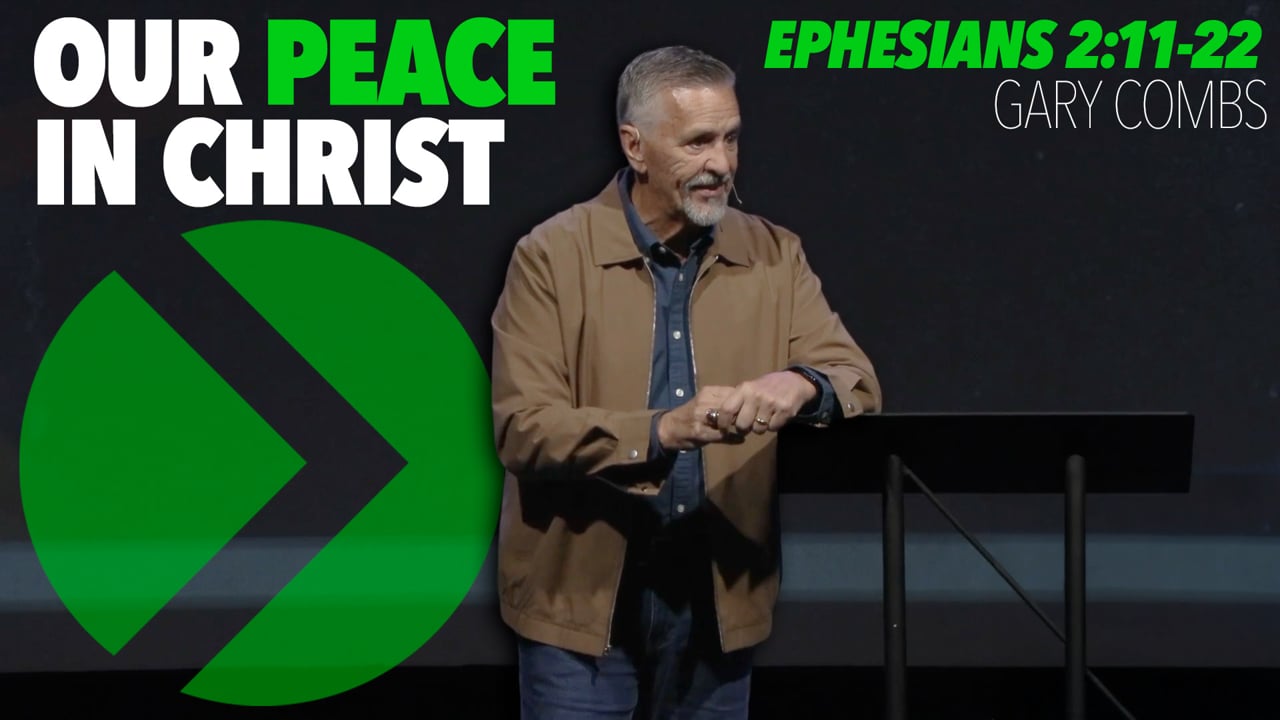
Read transcript
Hey, we’re in part 4 of our series through the book of Ephesians. We’ve entitled this Life in Christ, Life in Christ. And so we’re a church that really believes in studying God’s Word together, and we especially love doing it when we’re looking for Jesus on every page. And that’s what we’re doing. We’re continuing this series, Life in Christ.
We call it Life in Christ because that really is the theme of this 6-chapter series. Letter from the Apostle Paul to the church at Ephesus, and the word in Christ, or the phrase rather, in Christ repeats 36 times in various ways. In him, in Christ, in the beloved, in Christ Jesus, 36 times. And so that’s really what Christianity is, it’s Christ in you and you in Christ. And so Paul is teaching this afresh to us today.
He sent this letter to the church at Ephesus. It was a city that he knew well, a church that he knew well, he planted them, that church. It was a place that he stayed probably longer than he stayed anywhere else when he planted a church. We find in Acts chapter 19 and 20, he stayed there around 3 years. And so he really invested himself in the church of Ephesus.
It became really a Christian center that sent out church planters around Asia Minor, which is what that area was called at the time. It’s modern-day Turkey. And Ephesus was located on the west coast of Asia Minor, modern-day Turkey, then Asia Minor, against— it was a seaport city off the Mediterranean Sea, a very influential city in the Roman Empire. It was probably one of the 4 largest cities in the Roman Empire, 200,000, 250,000 people lived there during Paul’s time, a very important city. And he’s writing this letter around 61, 62 AD, and he’s writing this letter from his first imprisonment in Rome, he’s under house arrest, And he’s writing to a people that he knows well and that he loves well.
And this book really divides itself naturally into 2 parts, 6 chapters. The first 3 chapters really tell us who we are in Christ, our position in Christ, our possessions in Christ. And the back half, the last 3 chapters, 4 through 6, really tell us our practices in Christ, what’s it look like to live in Christ. And so we’re gonna cover these first 3 chapters going into the holidays, then we’ll take a break for the holidays, we’ll come back next year and finish the back half. So that’s our plan.
Now we’re in the latter part of chapter 2 today, and we’ve seen Paul’s prayer for the church at Ephesus, we’ve seen the blessings that he says we have in Christ, we see that he saved us by grace through faith and that we’re God’s workmanship, and now in these final verses, he begins to talk about the peace that we have in Christ. And when Paul uses the word peace, he’s thinking from a Hebrew background, and so when we see the word peace, which in Greek is eirene, which is if your name’s Irene, your name means peace, it’s the Greek word for peace, but Paul’s probably thinking shalom, ’cause that’s his background. Shalom, peace, is the idea not just the cessation of hostilities, but this idea of wholeness, of health, of everything’s at peace within and without.
But we live in a world today that longs for peace. We live in a world today that families are divided, friendships are broken up, even in our own hearts we struggle with anxiety, we struggle with guilt, with unrest. We want peace in our world, we want peace in our relationships, we want peace in our homes, yet no matter how hard we try, lasting peace seems unattainable.
And why is peace so difficult? Why is it so difficult to find peace and quiet in this loud, noisy, divisive world? Why is it so hard? The Bible tells us that our greatest problem is not political, although some would say it is. It’s not relational, it’s not emotional, although all of these do contribute.
The Bible says it’s primarily spiritual. That our problem is that there’s no peace within us. And the problem is, well, it’s a genetic problem. It’s a gene that was passed on to us from Adam and Eve. It’s called the sin gene.
We’re all born with it, and we were all born in rebellion against God, and even rebellion against the purpose for which he made us. And so we carry this unrest within us, and so then we carry it into our relationships and into our world. And so we need a Savior. We need someone to rescue us. We need someone to say to our hearts, which are filled with storms, peace, be still.
We really need that. And that’s the good news of today’s message. Paul reminds us that Jesus didn’t merely come to teach us how to find peace. In other words, he’s not going— Jesus doesn’t come and say, okay, here are the 3 steps steps you need to take to find peace. That’s not how he comes.
Jesus comes saying, I am your peace. I— he doesn’t say that peace is a place. He says peace is a person. He says, I am your shalom. It’s a radical claim.
Peace isn’t merely the absence of conflict, it’s the presence of Christ. In your life. And so no matter what the storms are outside your life, there can be rest in your soul, there can be peace in Christ. In the Apostle Paul’s letter to the believers in Ephesus, he called to Gentile believers, which was the prominent population there, to remember. That’s really his key word in our passage today is to remember who they used to be and who they are now at peace in Christ.
And so I believe today we can remember who we used to be and we can remember with great gratitude of who we are now in Christ through this peace that we have with God and with one another through Christ. So let’s look at the text. We’re going to be looking for 3 realities of our peace with God in Christ. So we’re in the latter part of chapter 2, starting at verse 11. Therefore remember.
That’s the only imperative in this section, by the way. An imperative is a command word. He says it twice. He says it again in verse 12, remember. Why is that?
Because we’re a forgetful people. We’re a forgetful people. Therefore remember that at one time you Gentiles in the flesh, called the uncircumcision, by what is called the circumcision, which is made in the flesh by hands, Remember that you were at that time separated from Christ, alienated from the commonwealth of Israel, and strangers to the covenants of promise, having no hope and without God in the world. But now in Christ Jesus, you who once were far off have been brought near by the blood of Christ. For He Himself is our peace, who has made us both one and has broken down in His flesh the dividing wall of hostility by abolishing the law of commandments expressed in ordinances, that He might create in Himself one new man in place of the two, so making peace, and might reconcile us both to God in one body through the cross, thereby killing the hostility.
And He came and preached peace to you who were far off and peace to those who were near. For through Him we both have access in one Spirit to the Father. So then you are no longer strangers and aliens, but you are fellow citizens with the saints and members of the household of God, built on the foundation of the apostles and prophets, Christ Jesus Himself being the cornerstone, in whom the whole structure being joined together grows into a holy temple in the Lord, In Him, you also are being built together into a dwelling place for God by the Spirit. This is God’s Word. Amen.
We’re looking for 3 realities of our peace with God in Christ. Here’s the first, we’ve been brought near by Christ’s blood. We have been brought near by Christ’s blood. And so we began this with a single word. It says, therefore.
What does it mean when we see this? What questions should we always ask if we see the word therefore? In the text, what’s it there for? And so therefore is like an equal sign in the text. It says whatever preceded this equals what’s coming next.
And so just quick reminder, earlier in chapter 2, he reminded us that it was by grace through faith that we were saved. It was not any works of our own. So we’ve got nothing to brag about, nothing to boast about. And then he concluded with verse 10 by saying, that we are God’s workmanship, that this is God’s project, and it’s this new reality that burst on the scene in the first century with Christ, and it’s this reality called the church. And he said, you, and when he says you are God’s workmanship, he’s saying not just you individually, but us together as the church, and that Greek word last week we learned was poema, which is where we get the word poem, and we are God’s masterpiece, This is His ultimate crowning of His glory is the church, which is the body of Christ.
And so therefore, remember, don’t forget. I think one of the main reasons we gather on the first day of the week is because that was the day Jesus defeated sin, death, and the grave and got up from the grave. But it’s also about every 7 days we need a reminder because we’re a forgetful people. And it’s even better if you’re part of a community group, a small group that meets during the week, so you get a bump in the middle of the week. Because we’re forgetful people.
We go out in the world and we get beat up by the sin of this old world and the worldviews that we encounter, and we gather together like this for encouragement from God’s Word and really to remember who we are. He says, therefore remember, he says it twice, verse 11, he says it again in verse 12, that at one time you Gentiles, that’s probably pretty much everybody in the room. There might be somebody here who has a Jewish background in your family, I don’t know, but most of us have a, we’re pretty much, and so that’s how Paul, he was a Jew from the tribe of Benjamin, and so the Jews really viewed the world in 2 columns, Jewish and non-Jewish, or uncircumcised and circumcised, which is how he talks here. He goes, therefore remember that at one time you Gentiles in the flesh called the uncircumcision, they didn’t call themselves that, that’s what the Jews called them. And then the Jews called themselves by what is called the circumcision.
But then he goes, which is made in the flesh by hands. So he’s kind of a, he offends both parties here. He goes, you know, the Jews always called you guys the uncircumcision, but their circumcision is only made by hand. It doesn’t circumcise the heart. He’s kind of an equal opportunity offender here.
He says both of us have a problem. We both have a sin problem. And so whether you’re a Jew or a Gentile, but he’s really talking to the, I would say the predominant population of Ephesus, it was a Roman city, was primarily Gentile. And so he’s redressing it. He goes, in verse 12, he goes, remember that you were at that time, and he’s going to give 5, ways that they were separated here in one verse.
In verse 12, he’s gonna give 5 expressions of separation. Remember that you were at that time separated from Christ. You had no Messiah figure in your future. You were looking for Caesars and politicians, but you had no idea that there could be a Savior, a Christ. So you were Christless.
That’s how you once were. Then he goes, you were alienated from the commonwealth of Israel. So you weren’t part of God’s chosen people, you were the uncircumcised. And so you’re outside, you’re stateless, you’re without a people, and strangers to the covenants of promise. That’s the third way they were separated.
So you’re strangers to the Abrahamic promise, which is that God was gonna bless all nations through the seed of Abraham, which is Christ. You were outside of that, so you were Christless, stateless, and friendless. Because Abraham was a friend of God. Having no hope, you were hopeless. He’s not finished.
And without God in the world, you were godless. The Greek word there for godless or without God was atheos, atheos. Sound familiar? You were atheists.
That’s who you were. Christless, stateless, friendless, hopeless, godless. Remember that, that’s where you were without Christ. But then as he did earlier when he came to verse 4 of chapter 2 and he goes, but God, now we have in verse 13, but now in Christ. What did I say?
That’s the thing. That’s the theme of this book. But now in Christ, all of that’s the former. All of that’s behind you. But now, oh, but now in Christ, what?
You who were once far off, you were far off from God.
And not only that, you were separated by your sins from one another. So really, The closeness that we have with one another through Christ is unlike, it’s unworldly, it’s unlike anything else in the world. And so you were, but now, you were far off, but now you’ve been brought near. How? How were you brought near?
Was it through human effort? No. Was it because you followed a plan, do A, then do B, then do, no. It was through the blood of Jesus. Through His sacrifice on the cross, that His blood paid for your being brought near.
Now, the modern mind doesn’t like this. The modern mind would do away with the blood, but the Bible says that the life is in the blood, that our life is in the blood. And so from very early on, even when we get in the book of Exodus or even before that, that Abel brought a sacrifice that was pleasing to God, and he brought a blood sacrifice, but Cain didn’t. And so very early on. And then we have whenever Moses is directed to bring the people out in the Exodus, he institutes the Passover.
And he said, there must be a way that you sacrifice a lamb and then take its blood and put it around the door of each home so that when the the angel of death comes, it will pass over that home when it sees the blood of the Lamb. And then when John the Baptist sees Jesus coming to be baptized in the River Jordan, he says, behold the Lamb of God who takes away the sins of the world. And so it’s by the blood, it’s not by human effort.
Our peace, remember this, and I remember our church doesn’t have a formal table, you know, we’re trying to reach a modern, But I always grew up, the church I always grew up in had a table down front and it said across the front of the table, do this in remembrance of me. And it was the Lord’s table and they would have the Lord’s Supper stuff often on that table. We have it on tables too, we just don’t have all the fancy equipment. We’re kind of a come-as-you-are church, as we’ve said before. But remember, remember who you were and remember it was by the blood, but now in Jesus.
Isaiah, he describes our problem. What was it that made us so separated from God and one another? Isaiah says this, he says, your iniquities have made a separation between you and your God, and your sins have hidden His face from you so that He does not hear. We’re all born in rebellion against God and our sin separates us from God. It creates a gulf, a Grand Canyon, if you will, between us and a holy God.
But because of Jesus and His sacrificial blood, and so there’s this imagery that you couldn’t get to God. And Paul’s really using sacrificial imagery that would remind those of us who, Remember the story of the temple and how for a Gentile especially, they’re in the outer court, which you could kind of picture concentric courts that go in like to a target, which is the temple. So the outer court, that’s as far as the Gentiles could go, then the Jewish women court, then the court of the Jewish men, and then the sacrificial courtyard, and then the temple with the holy place, and then the Holy of Holies beyond the curtain. And so you were far off, you Gentiles. You could see it from a distance, but you couldn’t come in.
But now because of the blood of Jesus, you’ve been brought near. And you can almost picture the imagery here of the high priest that was only allowed to come into the temple, into the Holy of Holies on one day of the year. And even then he had to come in bringing the blood the sacrificial blood of the lamb in order to enter into the Holy of Holies on the Day of Atonement, Yom Kippur. And he would come in past the curtain and he would spread the blood upon the mercy seat and pray for his own sins and for the sins of the people. And so that’s this imagery now that Jesus has done that once for all so that we see in Hebrews this, we see, therefore, brothers, since we have confidence to enter the holy places by the blood of Jesus, by the new and living way that He opened for us through the curtain, that is through His flesh.
And since we have a great High Priest over the house of God, let us draw near with a true heart in full assurance of faith. And so we have this imagery that he’s saying that we were brought from far away and we’ve been brought near into the Holy of Holies, into the throne room of the Father by the blood of Jesus. That’s the imagery that’s at work here. And not only that, we have in the Gospel of Matthew chapter 27, we have the imagery of what God accomplished on the day that He was crucified. When Jesus says, it is finished, the Gospel writers report there was an earthquake and that the earth and the sky was darkened and that the temple curtain that separated the Holy from the Holy of Holies was torn.
And it didn’t just say that it was torn, it was descriptive in the manner in which it was torn. It was torn from top to bottom. Matthew 27:51 says it was torn from top to bottom. Now if a man would’ve torn it, so this is like a 2-story-high curtain here, if a man would’ve torn it, he would’ve torn it from as high as he could reach, he would’ve torn it from bottom to top. But God tore that curtain from top to bottom because when Jesus died, He opened up a new and living way.
That’s who you were before, you were far away, but now you’ve been brought near. How? Not anything by you, but by the blood of Jesus so that in Christ we can enter with a true heart full of assurance of faith. I want to ask you a question today, do you feel How do you feel today? Now feelings are fickle.
Do you feel close to God today? Do you feel near to God? On a scale of 0 to 10, 0 meaning I am so far from God today, and 10 meaning I’m as close as I’ve ever been, where you at? By the blood of Jesus, you’ve been given level 10 access. You’ve been given level 10 brought near.
To the Father. So if you’re feeling a level 5 or level 6, remember feelings are fickle, they’re like a roller coaster ride. But Jesus says to us through His Word here this morning, through His Word, by My blood, which is sufficient to pay for most of your sins, nearly all of your sins, all of your sins. So now you can come boldly with confidence by the blood of Jesus into the presence of the Father. So if you don’t feel near, you need to get your feelings in a line with your faith because by God’s Word, God’s Word says you’ve been brought near if you’re in Christ.
And so we have peace with God because Christ has brought us near by His blood. That leads us to the second reality that we have. This peace that we have in Christ is we have been reconciled through Christ’s cross. We have been reconciled through Christ’s cross. We’re at verse 14 and following now, and as we get to verse 14, he tells us that it’s by the cross that we’ve been brought near.
If you look down into verse 16, it says, in one body through the cross. And so the cross and the blood are really the same event, But here Paul is pulling at a different aspect, that we were far off, we’ve been brought near, which is kind of the imagery from the temple. But now it’s kind of this idea of reconciliation, that which was broken has been reconciled. And so he uses the imagery of the cross to talk about that. And so let’s just kinda go verse by verse again.
Verse 14, for he himself, who’s he? Christ. And this is the emphatic use to make sure you don’t miss it. He himself is our, what? Peace.
The word peace is in our reading today 4 times. It’s really the centerpiece of what Paul’s talking about here, but it’s not a philosophy, It’s not a place, it’s a person. Our shalom, our peace is He Himself, Christ. If you have Christ, you have the peace of God. Regardless of the storms around you, you have the peace of God.
For He Himself is our peace who has made us both, who’s both? The Jew and the Gentile. That’s who he’s talking to. He’s made us both Jew and Gentile, and He’s made us one. And He’s broken down in His flesh the dividing wall of hostility.
The dividing wall of hostility. What in the world is he talking about? You have to kind of put yourself in Paul’s position. He’s this from the tribe of Benjamin, Jewish background guy who went to like Jewish Harvard and studied under Gamaliel. He’s really, When he’s teaching, he’s teaching out of his Jewishness, having come to Christ, and he’s putting it all together.
And so when we look at it like that, he’s probably thinking of the very wall that separated the Gentiles from their court to the next court. In fact, archaeologists have discovered a plaque that was connected to the Gentile court from Herod’s Temple. If you remember, Solomon built the first temple, it was destroyed by Nebuchadnezzar, Zerubbabel came in and rebuilt it, and then King Herod the Great followed along and supersized it. And this inscription in Greek is found, and archaeologists have interpreted it. It was found on the Temple Mount, and it says this, no foreigner shall enter within the balustrade around the sanctuary and the enclosure.
Whoever is caught will be responsible for his subsequent death. So do not enter here, skull and crossbones, Gentiles. And so wall of hostility, Paul probably had in mind that wall. And he says this, he goes, He’s made us both one and has broken down in His flesh the dividing wall of hostility. That wall of hostility between Jew and Gentile.
Broke it down. By abolishing the law of commandments expressed in ordinances, that part that made the Jews different from the rest of the world, the ceremonial law, not the moral law so much, but the ceremonial law, the dietary ordinances, the Sabbath-keeping ordinances, those have now been abolished in Christ, ’cause He’s making a new thing called the church, this new man called the church, And so that differentiation has changed. Now the 10 Commandments and the idea of morality, that’s not being talked about here. He’s talking about certain ordinances. And that he might create in himself, we’re still talking about Jesus, that Jesus might create in himself one new man in place of the 2, Jew and Gentile, so making peace.
In other words, he doesn’t build a hybrid. He doesn’t make Gentiles. He does not make Gent-Jews.
He makes a new people called the church. It’s not a hybrid.
And so He’s making a new thing, a new man in place of the two, so making peace. In verse 16, and might reconcile us both to God. And that word reconcile has the idea of something that was broken being reconnected and brought back together. And so he says, and reconciled, right, both to God in one body through the cross, thereby killing the hostility. He said, reconcile us both, Jew and Gentile.
And so I made this little image to try to illustrate this, that just think about the cross as, the horizontal crossbeam and the vertical way the cross is shaped. And you just kind of see, so that in Christ there is no Jew nor Gentile anymore. There’s neither Jew nor Greek, male nor female, slave nor free, all are one in Christ. That’s Galatians, right? And so he’s saying that here, that he tore down this wall of hostility.
So Jew and Gentile, there’s no, like I said, there’s no Jew, there’s no Gentile, Jin-Jew or Jew-Tao. There’s just Christians now. And He’s made us one because Christ is the God-Man. He’s made us one. And so the cross, which was an instrument of Roman execution, has become a symbol of reconciliation.
And so the cross, its very imagery points to this reconciliation that He’s made us one body through the cross. Thereby, and this is unusual language, thereby, Killing the hostility. Like he killed the hostility that was between us, that separated us.
He destroyed it. He killed the hostility. And he came, the he is still Jesus, and Jesus came and preached peace to you who were far off and peace to those who were near. And what are we talking about here? This is the gospel.
Christ came preaching the gospel of the kingdom, the good news, right? And he preached to those who were far off, the Gentile, and those who were nearer and near, that was the Jew. They had the prophets and he preached to all. And so he brought the good news, the gospel of peace. And then verse 18, for through him, through Jesus, We both, Jew and Gentile, have access.
We have an open door, a torn curtain, complete access to one Spirit, or in one Spirit, to the Father. Now what we have in verse 18 is a Trinitarian promise. In Him, you see that, that’s Christ, access through Him, we have both access in one Spirit. You see the Holy Spirit, you see God the Father, God the Son, God the Holy Spirit. In verse 18.
We have access, we have access through Him. Through Christ’s blood on the cross, He has reconciled everything to Himself. It says in Colossians 1:20, and through Him, God reconciled everything to Himself. He made peace with everything in heaven and on earth by means of Christ’s blood on the cross.
He has made peace. Between us. We are now not only given this peace, but we’ve been made ambassadors of this peace. 2 Corinthians, Paul writes, everything is from God who has reconciled us to Himself through Christ and has given us the ministry of reconciliation. That is, in Christ, God was reconciling the world to Himself, not counting their trespasses against them, and He has committed the message of reconciliation to us.
And so we now are ambassadors, we are ministers of reconciliation. And you’re looking at me saying, well, I thought you were the minister. No, you’re the ministers, I’m the pastor. Go read, we’ll get to it later, but we get over to Ephesians chapter 4, we find out that I’m an equipper of the saints. I’m a pastor, you’re the ministers.
And so we don’t wanna turn that upside down. And so you come in to remember, every Sunday you come in to remember who you are and what God’s called you to. And so we gather, to worship, but we scatter for witness, right? So we come together for power and we scatter for proclamation, like that. And so you’re the ministers of reconciliation.
So who are you sideways with today? Who do you have a broken relationship with today? You’re called to be the ones carrying the gospel, the good news of forgiveness, You’re the ones who are to deal with this problem that we have in the world of violence and not being reconciled. This is what we’re called to be. When I went to seminary in the very early ’90s, like I was over there in about ’91, a couple years there, there was a young man who couldn’t afford seminary tuition and he offered, he was a stonemason, he offered to rebuild the wall around the seminary.
And if you’ve ever been to Wake Forest and you’ve seen Southeastern Seminary over there, you’ll recognize that there’s a stone wall. You know, you walk along the sidewalk, it’s about that tall from the sidewalk side, but it’s not a very tall wall. Probably it’s only about that tall. And what’s unusual about this wall is there’s no cement, there’s no mortar holding the stones together. And so he agreed, if you’ll allow me to rebuild it, ’cause a lot of it had fallen down, there were vines growing through it, It really needed to be rebuilt.
And so the seminary agreed to give him free seminary if he’d rebuild the wall. And it took him pretty much the whole time he was there. And you’d see him, you’d see him after class, he’d be out there. And the thing was, he had to very carefully put it together ’cause it was held together by gravity. And so he rebuilt this wall.
He tore it down though, you’d see him, he’d tear down a section because it had broken down and then he’d rebuild it carefully and he had to look at each stone and make sure it was placed just perfectly. That’s what Christ has done. He’s torn down the dividing wall. People ask sometimes, is Eastgate a white church or a black church? And I go, it’s not a white church and it’s not a black church.
It’s a red church because of the blood of Jesus that was shed upon the cross. And abolished the separation, the wall of hostility between us. There’s not a black church, it’s not a white church. There’s no racism in the church. If there is, we need to put it to death.
We need to get it out of here. There’s only one race, that’s the human race, and Jesus died for it. That’s the kind of church we are. That’s the kind of church that Jesus calls us to be. His crown, his masterpiece.
And so he’s building us to be that and to be reconcilers of this divisiveness that we see in our culture today, which leads us to the 3rd reality. We are being built together into Christ’s temple. The last 2 points were really past tense points, something Christ has already done for us that we need to recognize, but now this reality is the thing he’s doing now. Paul now moves to what Christ has accomplished, from what Christ has accomplished to what Christ is actively doing now in the present. And he’s changing it with kind of a time word here in verse 19.
He goes, so then. It’s kind of similar to the but God back in verse 4, and it’s a little bit similar to the but now in verse 13. But now he goes, so then.
You are no longer strangers and aliens. If you ever visit a foreign country, you’re an alien there. You don’t have the rights that the citizens there have.
You’re an alien. So you’re no longer that. You’re no longer strangers and aliens, but you are fellow citizens with the saints and members of the household of God. You’re members of the house of God. Because the church is not the steeple, the church is the people, and you are members of it if you are in Christ.
You’re not strangers. Have you met your family?
Do you say hello to people when you come up in here? Because these are your brothers and sisters. Do y’all know each other? Do y’all spend time together? I mean, you better get used to each other now, come on.
You’re gonna spend eternity together. You better learn to like each other a little bit. You’re commanded to love each other. So then you are no longer strangers and aliens, but you are fellow citizens with the saints and members of the household of God, built on the foundation of the apostles and the prophets. So he’s building a house, it’s called the church.
And at the foundation, he has the apostles and the prophets. And another way you might look at that is, The prophets, well, that’s back here, that’s the Old Testament, you could look at it like that. And the apostles wrote the New Testament, those who saw the risen Lord and had the authority to write Scripture. You could look at it like that, that the Scripture is our record of the prophets and the apostles, and it’s foundational to the church, but there’s something very much more important at the foundation, and he says it next, built on the foundation of the apostles, Apostles and prophets, Christ Jesus himself being the cornerstone. And so if you’re building a foundation, you lay the cornerstone very carefully because all the other stones in the foundation and all the stones above it have to be in alignment with the cornerstone.
See, so that cornerstone, that’s a big, that’s a big stone. It carries a lot of weight and it, and it sets so that it’s plumb, so it’s square for the rest of the house. Now Jesus is the cornerstone, and then the prophets and the apostles, they’re the foundation, and each of us are being built upon top of that. And so that the temple was destroyed in 70 AD, but yet a new temple has been being formed and built for the last 2,000 years. Some time ago, there was a preacher named Billy Sunday who said he was preaching so that maybe tonight, maybe, you know, he was an evangelist, maybe on this day, the last living stone would land in the building and Jesus would come and take us, ’cause he was waiting for the last one.
Well, Jesus is still building. He’s still building His house. He’s still building this temple built on the foundation of the apostles and the prophets, Christ Jesus himself being the cornerstone, in whom, in Jesus, the whole structure being joined together. Remember me talking about the guy rebuilding the wall around the seminary?
If the stone had crumbled or something, he had to bring fresh stone in, he would take a little pick and a little hammer and he would shape it so it would fit perfectly because there was no mortar And this wall is so beautiful, every stone is a different shape. But the top ones are very, they’re very carefully laid because they have to be flat and even. And so he would have all these round, square, rectangle, all these, but at the top these, and the wall is the same height. You can run a string on it. It’s so, like, it’s so plumb like that.
This guy was an expert stonemason. And he knew how to lay it out so that each stone was fitted together for that space, and it’s held together by gravity. Now after the first service, I had 2 young men stop me in the lobby saying, I used to live in Wake Forest, or I used to go over there all the time, and I used to jump up and down on that wall and run along that wall. I didn’t know it was only held together by gravity. I didn’t know that.
Well, it’s because every stone was fitted together perfectly. By a master stonemason. And so then we see this in verse 21, in whom the whole structure being joined together. Can you picture that? Each of you, we’re all shaped different.
Just look around, a lot of different shapes in here. It’s like a Crayola coloring, there’s all kind of colors in here. You know, it’s not just white and black anyway, it’s just like every color in between, you know? There’s all kind of color here. I got it on a lot of you white people.
I got a pretty good tan. But listen, that’s just skin. That’s just skin. He says he takes all of you and he made you and he knows who you are and he’s got a place that he wants to fit you into his temple. Look at that, man.
Joined together grows into a holy temple unto the Lord. In him, Who? In Christ, you also are being built together into a dwelling place for God by his Spirit. What’s the church supposed to be? What’s the church supposed to be?
It’s supposed to be God’s people with the Holy Spirit living in us, living in us so that when we come together, it’s like a forest fire just blazes off of us because all these little lights, all these little lights of the world come together. We got the Holy Spirit living in us individually, but when we come together, oh my goodness, It gets hot in here. Or it should. I mean, it should. Don’t you want to be the church that’s filled with the Holy Spirit?
That’s what he’s called us to be. That’s who we are. We know who we once were, but now we know who we are in Christ. So let us live as members of God’s household, as living stones. It says in 1 Corinthians, do you not know that you are God’s temple and that God’s Spirit dwells in you?
It says in 1 Peter, as you come to him, a living stone rejected by men but in the sight of God chosen and precious, you yourselves like living stones are being built up as a spiritual house to be a holy priesthood, to offer spiritual sacrifices acceptable to God through Jesus Christ. That’s the church. That’s who we are. Find your place in God’s church. Don’t be a spectator.
Be a living stone. We began by acknowledging that we live in a world longing for peace, and we’ve learned that this peace is not something we can achieve through human effort. What we’ve learned is, though, that Christ by his blood and through his cross has made peace possible with God and with one another. It’s something that Christ has already accomplished. But we must remember that and take hold of that by faith.
We were once far off, but Christ’s blood has brought us near. We were once divided, but Christ’s cross has reconciled us.
And we were once strangers, but now we are family in the body of Christ, in the family of God. He himself is our peace. Do you know Jesus today? If you’re a Christ follower today, let us live in humble remembrance, saying we used to be like that, we’ve got nothing to brag about because it was the blood and the cross of Jesus that made it possible for me to be part of God’s family. And so we just wanna tell other people about it.
If that’s you, that’s how, that’s our only response is humility and gratitude and proclamation to those who are far from God to be brought near. But if you’re here today and you came in on a thin thread and you came in here and you barely got here, and when I asked you where you were at on a scale of 0 to 10, you said, I’m like a 0, but I don’t wanna be. I pray today that you’d receive Jesus, for He is our peace with God and with one another. Let’s pray. Lord, I pray for that one that’s here today, came in far off but wants to be brought near.
Is that you? Would you humbly admit with me right now in prayer, right in your seat, you can pray right where you’re at. Dear Lord Jesus, I’m a sinner. I came in today far from you, but I don’t want to stay that way. I believe that you died on the cross for my sin, that you were raised from the grave, and that you live today.
Come and live in me by your Spirit. Bring me near to the Father.
Forgive me of my sins and make me a child of God. I want to be a child of God and to follow you the rest of my life. If you pray that prayer of faith believing today, the Bible says if you confess Jesus as Lord and you believe in your heart that God raised him from the dead, you’ll be saved. So just give him thanks. Say, Lord, I believe.
I thank you for saving me. Others are here today and you’re a Christ follower, but you’ve got some unreconciled relationships that you need to forgive. Some of them you can’t reconcile with them, they’re not with us anymore, but you can forgive them even in the Lord. You know who you are, you know who you’re sideways with, you know who you’re not getting along with right now. Just say, Lord, help me to be a minister of reconciliation everywhere I go.
Help me to be forgiving. Help me to be grace-filled with people. And so I pray for marriages right now, Lord, that are not doing well. I pray for broken friendships. I pray for broken relationships between fathers and daughters and mothers and sons and neighbors.
And Lord, I pray against racism in our culture, but especially in our church, Lord, that that we would be a red church covered by the blood of Jesus, filled with the Holy Spirit. Lord, we thank you, we love you, and we pray it in the name of Jesus. Amen.
We live in a world that longs for peace, yet seems unable to find it. Nations are at war. Families are divided. Friendships are broken. Even in our own hearts, we struggle with anxiety, guilt, and unrest. We want peace in our world, peace in our relationships, and peace within ourselves.
Yet, no matter how hard we try, lasting peace seems just beyond our reach.
Why is peace so difficult to find? The Bible tells us that our greatest problem is not political, relational, or emotional. It's spiritual. Sin has separated us from God, and that separation has affected every other relationship in our lives. We cannot have true and lasting peace until we first have peace with God. And that's a peace we cannot achieve through our own efforts. We need a Savior.
That's the good news of today's passage. Paul reminds us that Jesus didn't merely come to teach us how to find peace. Paul doesn't say that Christ merely gives us peace, although He certainly does. He says that Christ IS our peace! That's a powerful distinction. Peace isn't merely the absence of conflict. It's the presence of Christ!
In the apostle Paul’s letter to the Ephesians, he called the Gentile believers to remember how Christ had brought them from separation to reconciliation with God and His people.
Keep Watching
 Life In Christ – An Exposition of Ephesians
Our Transformation in Christ
WilsonGary CombsRocky MountJonathan Combs
Life In Christ – An Exposition of Ephesians
Our Enlightenment in Christ
WilsonGary CombsRocky MountJonathan Combs
Life In Christ – An Exposition of Ephesians
Our Blessings in Christ
WilsonGary CombsRocky MountJonathan Combs
Life In Christ – An Exposition of Ephesians
Our Transformation in Christ
WilsonGary CombsRocky MountJonathan Combs
Life In Christ – An Exposition of Ephesians
Our Enlightenment in Christ
WilsonGary CombsRocky MountJonathan Combs
Life In Christ – An Exposition of Ephesians
Our Blessings in Christ
WilsonGary CombsRocky MountJonathan Combs